Tradition credits one Gupta emperor with a decision that outlived his own empire by 700 years. But the actual evidence behind that credit is thinner than the popular story suggests. This article covers Kumaragupta I’s reign, and what is actually known versus traditional about Nalanda’s founding.


Kumaragupta I’s Reign Need to Know
- Kumaragupta I ruled the Gupta Empire from around 415 to 455 CE. He succeeded his father Chandragupta II.
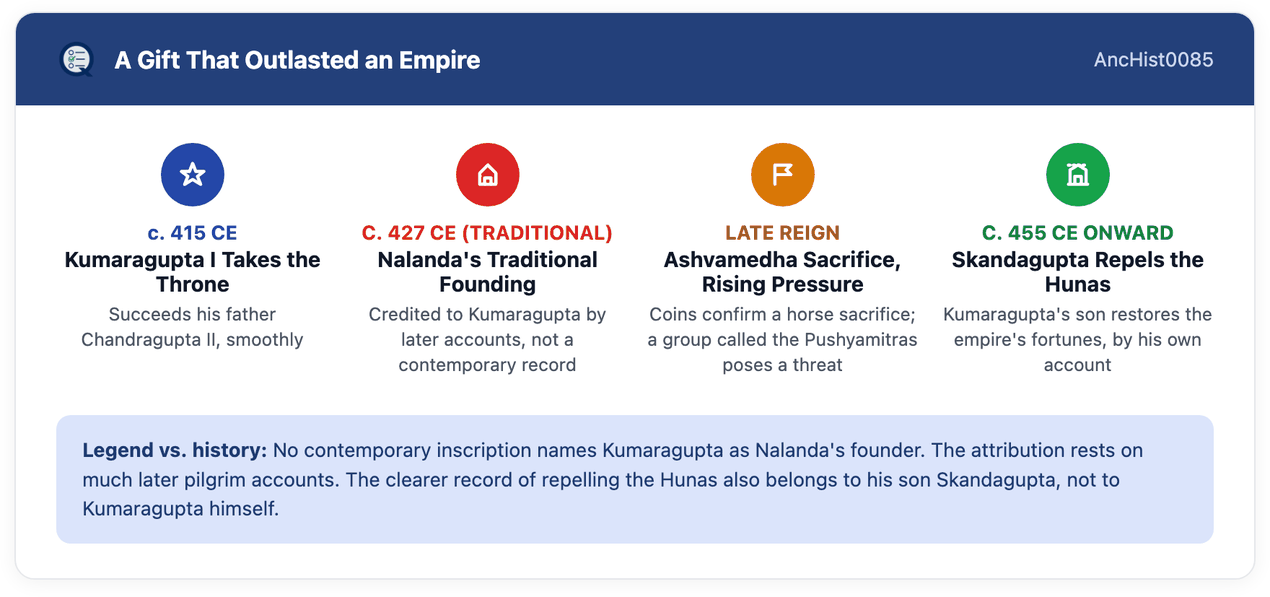
- The succession itself appears smooth. Chandragupta II’s last known inscription and Kumaragupta’s earliest inscription follow on cleanly, with no epigraphic sign of a contested handover.
- He held several titles, including Mahendraditya and Maharajadhiraja (“great king of kings”).
- His coins show real religious variety. Some mark him a Vaishnava devotee, using Garuda imagery. Others depict Kartikeya on a peacock, the god he named his son Skandagupta after.
- His administration ran through provincial governors called Uparikas, overseeing districts with local guild councils.
Nalanda’s Traditional Founding Good to Know
- Textbooks often state flatly that Kumaragupta founded Nalanda University in 427 CE, in what is now Bihar. The real evidence is thinner than that.
- No inscription from Kumaragupta’s own time names him as Nalanda’s founder. The attribution comes from much later sources: the Chinese pilgrim Xuanzang, and the writer Prajnavarman, both centuries after Kumaragupta’s reign.
- These later sources credit a king called “Shakraditya.” Scholars link this name to Kumaragupta, since he also held the closely related title Mahendraditya. This is a reasonable inference, not a direct contemporary record.
- Gupta-era coins found at the Nalanda site do confirm activity there during Kumaragupta’s reign. That’s evidence of his-era presence, not proof he personally founded it.
- Nalanda’s early, Kumaragupta-era form was modest. Its fame as a vast international university came later, under Harshavardhana in the 7th century and the Pala dynasty afterward. This article’s own focus stays on the founding-era origins.
- Nalanda taught Buddhism, Hindu philosophy, logic, grammar, medicine, mathematics, and astronomy. Bakhtiyar Khilji’s forces destroyed it in 1193 CE, burning its buildings and manuscripts.
Test Yourself

Late-Reign Pressure and the Ashvamedha Great to Know
- Late in his reign, Kumaragupta faced a threat from a group called the Pushyamitras. Their exact identity is uncertain. Scholars treat them as likely a central Indian tribe or rebel group, not a firmly identified power.
- The Bhitari pillar inscription, often cited for this period, was actually issued by Kumaragupta’s son Skandagupta, not by Kumaragupta himself. It’s a cryptic, eulogistic text, not a detailed military record.
- Popular accounts often credit Kumaragupta with personally defeating the Hunas. The clearer historical record of repelling the Hunas belongs to Skandagupta instead, documented in the Junagadh inscription.
- Kumaragupta did issue rare Ashvamedha-type gold coins, confirming he performed at least one horse sacrifice, a traditional Vedic ritual marking a king’s supremacy. No independent record survives naming which specific victory it celebrated.
- Kumaragupta is remembered today mainly for Nalanda’s traditional founding, not for his military record. A tradition can outweigh the underlying, thinner evidence, in how history remembers a ruler.
Leave a Reply