Millions of Indians now earn a living through an app. The law only caught up to that fact five years after it was written.
 MCQ Questions
App-Based Services · Timeline
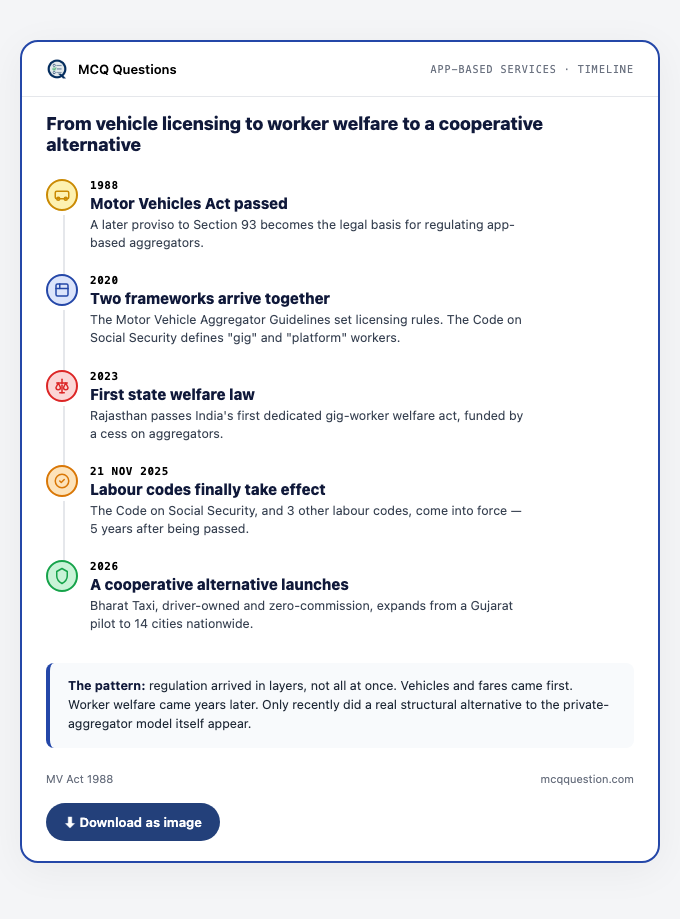
From vehicle licensing to worker welfare to a cooperative alternative
1988
Motor Vehicles Act passed
A later proviso to Section 93 becomes the legal basis for regulating app-based aggregators.
2020
Two frameworks arrive together
The Motor Vehicle Aggregator Guidelines set licensing rules. The Code on Social Security defines “gig” and “platform” workers.
2023
First state welfare law
Rajasthan passes India’s first dedicated gig-worker welfare act, funded by a cess on aggregators.
21 Nov 2025
Labour codes finally take effect
The Code on Social Security, and 3 other labour codes, come into force — 5 years after being passed.
2026
A cooperative alternative launches
Bharat Taxi, driver-owned and zero-commission, expands from a Gujarat pilot to 14 cities nationwide.
The pattern: regulation arrived in layers, not all at once. Vehicles and fares came first. Worker welfare came years later. Only recently did a real structural alternative to the private-aggregator model itself appear.
⬇ Download as image
Must Know
- App-based platforms in India span ride-hailing (Uber, Ola, and the newer cooperative Bharat Taxi) and food and grocery delivery aggregators.
- Aggregators are licensed under the Motor Vehicles Act, 1988, through the central Motor Vehicle Aggregator Guidelines (MVAG). States issue the actual licences.
- The Code on Social Security, 2020 formally defines “gig workers” and “platform workers.” It requires aggregators to fund a Social Security Fund for them.
- Rajasthan became the first state with a dedicated gig-worker welfare law, in 2023.
- Bharat Taxi, launched in 2026, is a direct structural alternative: a driver-owned cooperative, not a private aggregator company.
Good to Know
- Under Section 114 of the Code on Social Security, aggregators contribute 1 to 2% of annual turnover to the Social Security Fund. That contribution is capped at 5% of what they pay their gig workers.
- The Motor Vehicle Aggregator Guidelines were updated in 2025. The update extended coverage to bike taxis, EVs, and app-based autorickshaws.
- Karnataka has its own draft gig-worker welfare bill, released in 2024, following Rajasthan’s lead.
- The Code on Social Security only came into force on 21 November 2025. That’s 5 years after Parliament passed it, along with India’s 3 other labour codes.
Test Yourself

Great to Know
- App-based platforms sit under two separate regulatory tracks, not one. The MVAG governs vehicles, fares, and safety. The Code on Social Security governs worker welfare. The same platform answers to both.
- The cooperative-versus-private contrast is a real structural difference, not just branding. A private aggregator answers to its shareholders and investors. A cooperative like Bharat Taxi answers to its own driver-members, who own it.
- Bharat Taxi fits a broader government push toward the cooperative sector, run through the Ministry of Cooperation.
Current Affairs
- Bharat Taxi is India’s first cooperative-sector, driver-owned ride-hailing platform. It was launched on 5 February 2026 in New Delhi, by Union Home and Cooperation Minister Amit Shah.
- Bharat Taxi calls its drivers “Sarathis.” It runs on a zero-commission, surge-free pricing model, with profits going directly to drivers.
- Drivers get health insurance, accident insurance, and retirement savings, without exclusivity clauses tying them to the platform.
- A women’s initiative called “Bike Didi” is part of the platform, with over 150 women drivers enrolled.
- The Gujarat pilot soft-launched in December 2025, then formally launched across 14 cities on 27 June 2026. It registered about 1.5 lakh drivers and nearly 7 lakh customers, running over 3,500 rides a day.
Leave a Reply