A Bandhani saree gets its name from tying, not dyeing. “Bandhani” comes from “bandh,” meaning to tie. Thousands of tiny knots, tied by hand before the fabric ever touches dye, are what create its signature dotted pattern.
 MCQ Questions
ARTNCULTURE0117
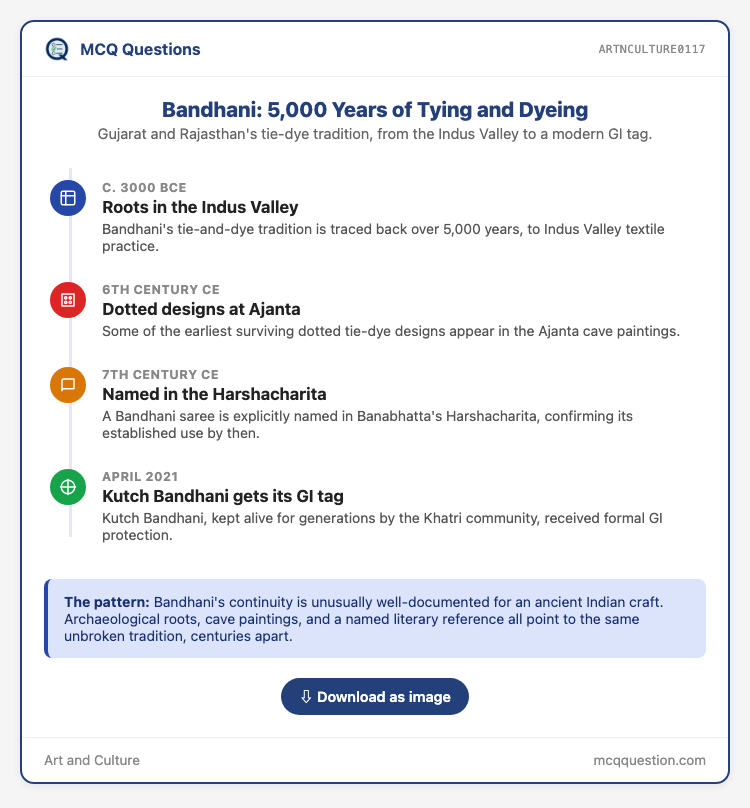
Bandhani: 5,000 Years of Tying and Dyeing
Gujarat and Rajasthan’s tie-dye tradition, from the Indus Valley to a modern GI tag.
c. 3000 BCE
Roots in the Indus Valley
Bandhani’s tie-and-dye tradition is traced back over 5,000 years, to Indus Valley textile practice.
6th century CE
Dotted designs at Ajanta
Some of the earliest surviving dotted tie-dye designs appear in the Ajanta cave paintings.
7th century CE
Named in the Harshacharita
A Bandhani saree is explicitly named in Banabhatta’s Harshacharita, confirming its established use by then.
April 2021
Kutch Bandhani gets its GI tag
Kutch Bandhani, kept alive for generations by the Khatri community, received formal GI protection.
The pattern: Bandhani’s continuity is unusually well-documented for an ancient Indian craft. Archaeological roots, cave paintings, and a named literary reference all point to the same unbroken tradition, centuries apart.
Art and Culturemcqquestion.com
Must Know
- Bandhani is a tie-and-dye technique, not a fabric type. The name comes from “bandh,” meaning to tie.
- Artisans tie thousands of tiny sections of fabric with thread, called “beendni,” before dyeing. Untying them after dyeing reveals small circular dots arranged in patterns.
- Bandhani’s roots trace back over 5,000 years, to Indus Valley Civilisation textile practice. Dotted tie-dye designs appear in Ajanta cave paintings from the 6th century CE.
- A Bandhani saree is explicitly named in Banabhatta’s 7th-century text, the Harshacharita. This confirms Bandhani was an established, recognisable craft by then.
- Bandhani is closely associated with Gujarat and Rajasthan’s Khatri community, who have preserved the craft for generations. Major centres include Kutch, Jamnagar, and Bhuj in Gujarat, and Jaipur, Jodhpur, and Bikaner in Rajasthan.
- Kutch Bandhani received its Geographical Indication (GI) tag in April 2021.
Good to Know
- Tradition credits a Fakir from Sindh with introducing the craft to Kutch. From there, the Khatri community developed and sustained it as a distinct regional tradition.
- Bandhani’s dot patterns often carry specific names and regional variations. Common motifs include Chandrokhani (moon-circle) and Shikari (hunting scene) patterns, each tied to particular regions and occasions.
- Bandhani sits alongside Kalamkari as one of India’s major traditional textile-dyeing crafts, though the two techniques are entirely different. See ArtnCulture0110 — The Banarasi Saree for a comparison with a woven, rather than dyed, textile tradition.
Test Yourself

Great to Know
- Bandhani offers unusually strong layered evidence for its own age, compared to most crafts in this batch. Archaeology, painted art, and a named literary text all independently confirm the same multi-century timeline, rather than relying on oral tradition alone.
- The 2021 GI tag covers Kutch Bandhani specifically, not the broader technique across Gujarat and Rajasthan. This mirrors the Dhokra pattern: a shared ancient technique can still be split into separate, region-specific legal protections.
- Bandhani’s knot-based resist-dyeing logic is conceptually simple. Physically block dye from reaching part of the fabric. But its visual complexity comes entirely from how many thousands of tiny knots a skilled artisan can place, and how precisely.
This craft is one of many now sold directly to buyers through India’s digital marketplace for handloom and handicrafts. See ArtnCulture0134 — Indiahandmade for how the platform works.
Beyond the answer
Browse all art-and-culture topics →
📚 Keep reading
GK0040 — Rajasthan: Capital, Government, and India's Zinc CountryGK0030 — Gujarat: India's Longest Coastline and Its Industrial RiseModHist0153 — Ravishankar Maharaj: Gandhi's Constructive-Work Partner in GujaratArtnCulture0113 — Blue Pottery of Jaipur: The No-Clay Ceramic CraftArtnCulture0118 — Kalamkari: Andhra Pradesh's Painted and Printed Textile Art❓ Practice this topic
D0421 — Which Director-General led the revival of the ASI under Lord Curzon in 1902?D0420 — Under which Ministry does the Archaeological Survey of India function?D0419 — Which Act governs the protection of monuments and archaeological sites of national importance in India?D0418 — Who is regarded as the founder and first Director-General of the Archaeological Survey of India?🎲 Take a Art And Culture Quiz
Leave a Reply