Munshi Premchand wrote about peasants, debt, and caste when Hindi and Urdu literature mostly avoided them. He is still called the “Upanyas Samrat,” the Emperor of Novels. His stories built the realist tradition modern Hindi fiction stands on today.

Timeline
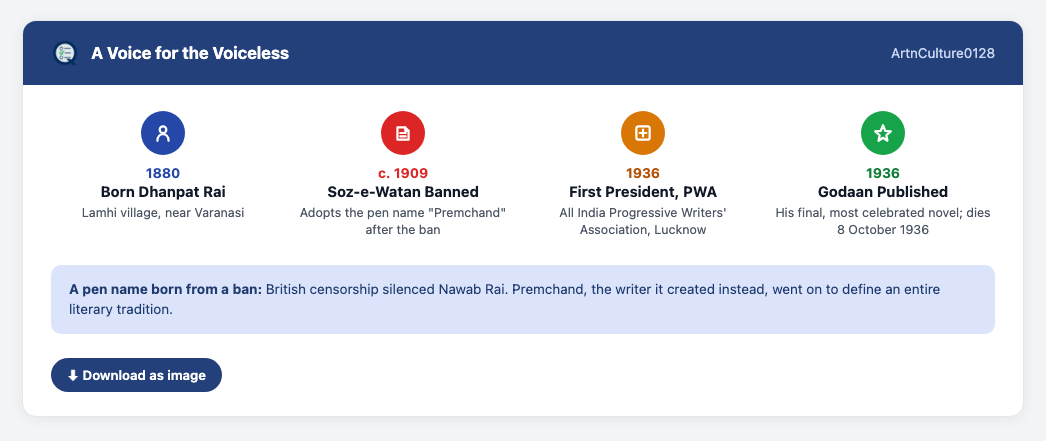
- 31 July 1880: Born Dhanpat Rai Srivastava in Lamhi village, near Varanasi.
- Early career: Begins writing under the pen name “Nawab Rai.”
- 1907-1909: Publishes the patriotic story collection Soz-e-Watan. British officials ban it as seditious around 1909, destroying roughly 500 copies.
- After the ban: Adopts the pen name “Premchand,” on the advice of editor Munshi Daya Narain Nigam.
- 1919: Publishes Sevasadan, one of his major early novels.
- 1928: Publishes Gaban, a novel about middle-class greed and moral compromise.
- March 1930: Launches Hans, a literary-political weekly magazine.
- 1932: Publishes Karmabhoomi.
- 1936: Elected first president of the All India Progressive Writers’ Association, at its founding conference in Lucknow. Publishes Godaan, his final and most celebrated novel.
- 8 October 1936: Dies in Varanasi, aged 56.
Must Know
- Munshi Premchand was born Dhanpat Rai Srivastava on 31 July 1880, in Lamhi village near Varanasi.
- He is known as the “Upanyas Samrat,” the Emperor of Novels, for bringing realism and social consciousness to Hindi and Urdu fiction.
- His most celebrated novel, Godaan (1936), follows an indebted peasant. It was published the same year he died.
- His other major novels include Gaban (1928), about middle-class greed, and Sevasadan (1919).
- Across his career, he wrote roughly 300 short stories and about 14 novels, alongside numerous essays.
Good to Know
- He first wrote under the pen name “Nawab Rai.” He switched to “Premchand” after British officials banned his story collection Soz-e-Watan as seditious, around 1909.
- He wrote in both Hindi and Urdu, often producing a Hindi and an Urdu version of the same work. This bridged two literary traditions that were growing apart.
- In March 1930, he launched Hans, a literary-political weekly magazine. He later edited Jagran and Maryada too.
- In 1936, he became the first president of the All India Progressive Writers’ Association, at its founding conference in Lucknow.
- His fiction centred on ordinary people — peasants, workers, women, and the socially oppressed. He introduced themes like communalism, corruption, poverty, and colonialism into mainstream Hindi and Urdu writing.
Current Affairs
- 31 July 2026: Premchand’s 146th birth anniversary is observed nationally, honouring his contribution to Hindi and Urdu literature.
- 31 July 2016: Google marked his 136th birthday with a dedicated Doodle, depicting the working-class characters central to novels like Godaan.
Test Yourself

Great to Know
- Premchand’s realism marked a break from earlier ornate, courtly Hindi and Urdu writing. His plain, everyday language made his fiction accessible far beyond the literary elite.
- Unlike India’s cinema icons, Premchand died decades before India’s national literary honours existed. The Sahitya Akademi was founded only in 1954, and the Jnanpith Award began in 1965 — both after his death.
- For India’s literary honours system, see GK0016 — The Jnanpith Award and GK0005 — Cultural Institutions of India.
- For the broader literary movement his generation shaped, see ArtnCulture0015 — Modern Indian Literature and the Impact of the West.
Leave a Reply