He put a 100-piece orchestra behind a Hindi film song, first in the country to do it. He composed for 65 years.
 MCQ Questions
ArtnCulture0158
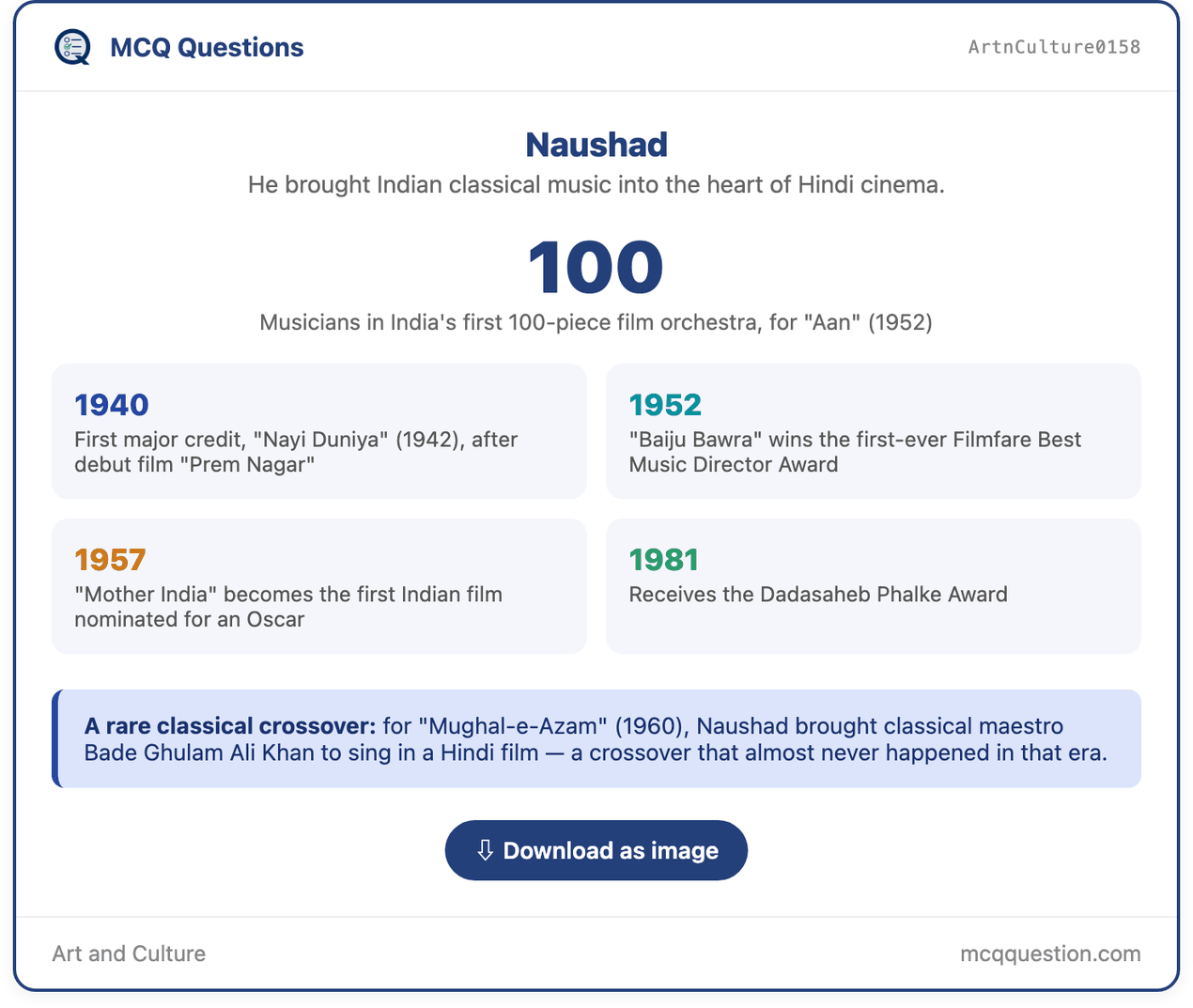
Naushad
He brought Indian classical music into the heart of Hindi cinema.
100
Musicians in India’s first 100-piece film orchestra, for “Aan” (1952)
1940
First major credit, “Nayi Duniya” (1942), after debut film “Prem Nagar”
1952
“Baiju Bawra” wins the first-ever Filmfare Best Music Director Award
1957
“Mother India” becomes the first Indian film nominated for an Oscar
1981
Receives the Dadasaheb Phalke Award
A rare classical crossover: for “Mughal-e-Azam” (1960), Naushad brought classical maestro Bade Ghulam Ali Khan to sing in a Hindi film — a crossover that almost never happened in that era.
Art and Culturemcqquestion.com
Must Know
- Naushad Ali was born on 25 December 1919, in Lucknow.
- He trained in Hindustani music under Ustad Ghurbat Ali, Ustad Yusuf Ali, and Ustad Babban Saheb.
- He moved to Mumbai in 1937, to work in the film industry.
- His first major credit came with “Nayi Duniya” (1942).
- “Baiju Bawra” (1952) won the first-ever Filmfare Best Music Director Award, in 1954.
- For “Aan” (1952), he used a 100-piece orchestra — the first of its size in Indian cinema.
- “Mother India” (1957) became the first Indian film nominated for an Academy Award.
- He received the Dadasaheb Phalke Award in 1981.
- He died on 5 May 2006, in Mumbai, aged 86.
Good to Know
- His career ran from 1940 to 2005. Across those years, he composed music for 65 films in total.
- His films included 26 Silver Jubilee hits, which ran for 25 weeks or more.
- Mohammed Rafi sang many of Naushad’s most famous compositions.
- He often worked with lyricist Shakeel Badayuni, across dozens of films.
- He received the Padma Bhushan in 1992, alongside the Sangeet Natak Akademi Award.
- He is remembered by the title “Moseeqar-e-Azam,” meaning “The Great Musician.”
Test Yourself

Great to Know
- For “Mughal-e-Azam” (1960), Naushad brought classical maestro Bade Ghulam Ali Khan to sing for a Hindi film. Such a crossover was rare for a classical artist of that stature, at that time.
- Don’t confuse Naushad with the singers he worked with. Naushad was the music director and composer. Mohammed Rafi and other artists were the playback singers who performed his tunes.
- His most acclaimed film, “Baiju Bawra” (1952), leaned on real classical vocalists, Amir Khan and D.V. Paluskar, to anchor its music.
Beyond the answer
Browse all art-and-culture topics →
📚 Keep reading
GK0014 — National Film AwardsHow Odia Got Classical Language StatusArtnCulture0103 — Hindustani Classical MusicArtnCulture0106 — The Indian Film IndustryArtnCulture0005 — Indian Music: Hindustani and Carnatic Traditions❓ Practice this topic
D0421 — Which Director-General led the revival of the ASI under Lord Curzon in 1902?D0420 — Under which Ministry does the Archaeological Survey of India function?D0419 — Which Act governs the protection of monuments and archaeological sites of national importance in India?D0418 — Who is regarded as the founder and first Director-General of the Archaeological Survey of India?🎲 Take a Art And Culture Quiz
Leave a Reply