Bandhavgarh has the highest tiger density ever recorded anywhere in the world. It is also the birthplace of every white tiger living in captivity today.


 MCQ Questions
IndGeo0093
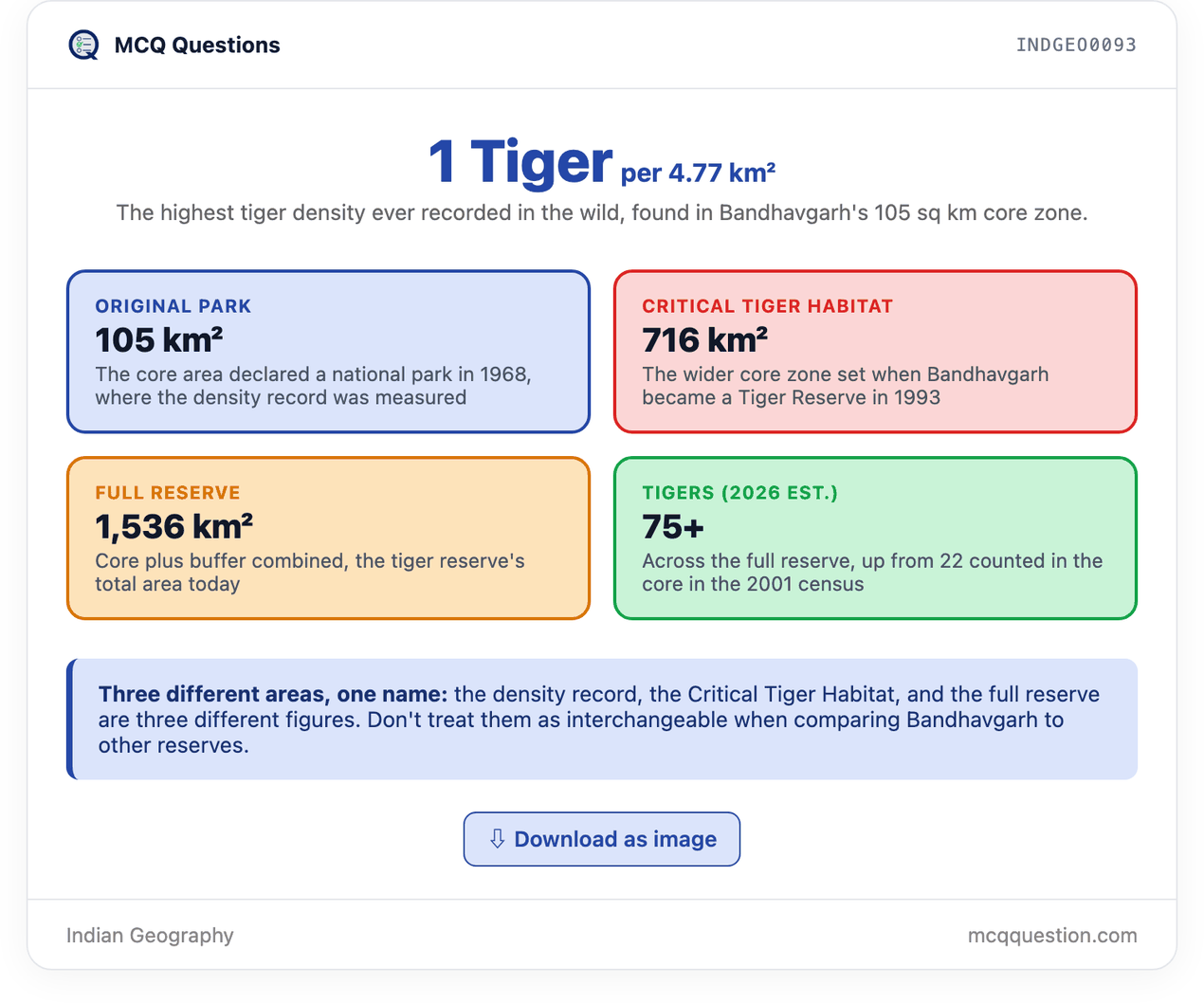
1 Tiger per 4.77 km²
The highest tiger density ever recorded in the wild, found in Bandhavgarh’s 105 sq km core zone.
Original Park
105 km²
The core area declared a national park in 1968, where the density record was measured
Critical Tiger Habitat
716 km²
The wider core zone set when Bandhavgarh became a Tiger Reserve in 1993
Full Reserve
1,536 km²
Core plus buffer combined, the tiger reserve’s total area today
Tigers (2026 est.)
75+
Across the full reserve, up from 22 counted in the core in the 2001 census
Three different areas, one name: the density record, the Critical Tiger Habitat, and the full reserve are three different figures. Don’t treat them as interchangeable when comparing Bandhavgarh to other reserves.
Must Know
- Bandhavgarh National Park lies in the Umaria district of Madhya Pradesh. It was once the private hunting ground of the Baghel Maharajas of Rewa.
- The area was declared a national park in 1968, covering about 105 sq km. It became a full Tiger Reserve in 1993, with a Critical Tiger Habitat of 716 sq km.
- Today the full reserve, core plus buffer, spans about 1,536 sq km.
- Bandhavgarh holds the highest tiger density ever recorded in the wild. A 2001 census found 22 tigers in the 105 sq km core, about one tiger per 4.77 sq km.
- By 2026 estimates, the wider reserve holds more than 75 tigers, spread across a much larger area than the original density survey covered.
- Every white tiger alive in captivity today traces its ancestry to a single tiger captured here. In 1951, Maharaja Martand Singh of Rewa captured an orphaned white cub in Bandhavgarh and named him Mohan.
Good to Know
- Mohan went on to father dozens of white cubs at Rewa. Nearly every captive white tiger in the world today descends from him.
- Wild white tigers are now essentially extinct. Mohan is widely believed to be the last one ever born free.
- Bandhavgarh’s forests are mostly Sal-dominated moist deciduous forest, with drier mixed forest toward the centre of the park.
- The park records over 515 plant species. Besides tigers, it holds Indian bison (gaur), sloth bears, chital, sambar, nilgai, and wild boar.
- Over 250 bird species have been recorded here, along with occasional sightings of the Indian wolf and the blackbuck.
Test Yourself


Great to Know
- Bandhavgarh Fort sits inside the park. Legend holds that Lord Rama gifted it to his brother Lakshmana, and Bandhav (“brother”) plus Garh (“fort”) gives the park its name.
- Several dynasties held the fort over the centuries, ending with the Baghels, who ruled it from 1535 until independence. They shifted their own capital to nearby Rewa in 1617.
- Mohan’s white-tiger legacy has a difficult side. Keepers bred him repeatedly with his own daughters and granddaughters to fix the rare recessive gene, a level of inbreeding conservationists now view as a serious welfare cost behind a striking image.
Leave a Reply