In 1945, roughly a third of the world’s people lived under colonial rule. By 1970, almost none did. This article covers that great wave of decolonization across Asia and Africa.


Timeline
- 15 August 1947: India and Pakistan became independent from Britain, partitioned into two dominions. See ModHist0085 — Indian Independence Act, 1947 for the full transfer of power.
- 4 January 1948: Burma became independent under Prime Minister U Nu, months after independence leader Aung San was assassinated in July 1947.
- 4 February 1948: Ceylon (now Sri Lanka) gained dominion status under the Soulbury Constitution. D. S. Senanayake became its first Prime Minister.
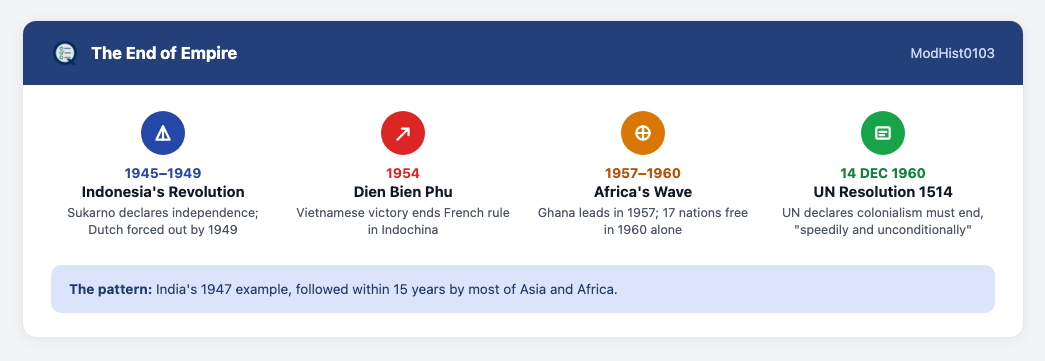
- 1945–1949: Sukarno and Hatta declared Indonesia’s independence on 17 August 1945. Dutch forces fought back for four years. The Netherlands transferred sovereignty on 27 December 1949, under US pressure.
- 1954: The Viet Minh defeated France at Dien Bien Phu. The Geneva Accords that followed ended French rule across Indochina, and split Vietnam at the 17th parallel.
- 1957–1960: Ghana won independence in 1957, under Kwame Nkrumah, the first sub-Saharan African nation to do so. Seventeen more African countries followed in 1960 alone, a year historians call the “Year of Africa.”
- 14 December 1960: The UN General Assembly adopted the Declaration on the Granting of Independence to Colonial Countries and Peoples. It passed 89 votes to 0, with 9 abstentions.
- September 1961: India, Yugoslavia, Egypt, Ghana, and Indonesia co-founded the Non-Aligned Movement at Belgrade, giving the newly independent world a collective voice.
How the Empire Unwound Need to Know
- Decolonization is the process by which colonies won independence from their European colonial rulers, mostly between 1945 and the mid-1970s.
- India’s own independence in 1947 came early in this wave, alongside Pakistan’s. Both became reference points for later movements, across Asia and Africa.
- Burma became independent on 4 January 1948, under Prime Minister U Nu. Ceylon (now Sri Lanka) followed a month later, on 4 February 1948, through a largely peaceful transition.
- Indonesia fought a four-year war against the Dutch before winning full sovereignty in 1949. Vietnam fought France until the French defeat at Dien Bien Phu in 1954.
- Ghana’s 1957 independence, led by Kwame Nkrumah, opened the door for sub-Saharan Africa. It was followed by the 1960 “Year of Africa,” when 17 nations became independent.
- The UN Declaration on the Granting of Independence to Colonial Countries and Peoples passed in December 1960. It formally condemned colonialism and affirmed every people’s right to self-determination.
Turning Points and Global Links Good to Know
- British Prime Minister Harold Macmillan gave his “Wind of Change” speech to South Africa’s Parliament on 3 February 1960. It signalled that Britain would no longer resist independence for its African colonies.
- Not every transition was peaceful. The Algerian War of Independence ran from 1954 to 1962, a far bloodier path than Ghana’s largely negotiated exit from British rule.
- For the 1955 Bandung Conference, where newly independent Asian and African states first met as a bloc, see ModHist0037 — The Bandung Conference: Precursor to Non-Alignment.
- India carried that Bandung spirit forward. It co-founded the Non-Aligned Movement at Belgrade in September 1961, alongside Yugoslavia, Egypt, Ghana, and Indonesia. See IntlRel0059 — The Non-Aligned Movement: Founding a Third Way in the Cold War.
- Gandhi’s methods directly influenced later leaders like Nkrumah. For that connection, see ModHist0070 — The Freedom Struggle’s Global Legacy and Gandhi’s Relevance Today.
Test Yourself

Why the Timing Differed Great to Know
- Asia’s decolonization mostly finished by the mid-1950s. Africa’s largest wave came five years later, in 1960. World War II had weakened the European powers first in the colonies closer to Japan’s wartime advance.
- Ghana’s comparatively peaceful transition and Algeria’s brutal eight-year war show two very different paths to the same outcome. A colonial power’s willingness to negotiate mattered as much as the colony’s own readiness.
- Macmillan gave his “Wind of Change” speech first in Accra, Ghana, on 10 January 1960, with little reaction. He repeated it in Cape Town three weeks later, and that version made history instead.
- UN Resolution 1514 carried real weight partly because of numbers. By 1960, newly independent Asian and African states already held enough General Assembly votes to pass it, over the old colonial powers’ objections.
- India’s own path set a template others followed: negotiate, transfer power, then lead the newly independent world as a bloc. Nehru became one of five founding leaders of the Non-Aligned Movement in 1961.
Beyond the answer
Browse all modern-indian-history topics →
📚 Keep reading
WorldHist0037 — West Africa's Anti-Colonial Movement and DecolonizationWorldGeo0040 — The Geography of AfricaWorldHist0032 — Kwame Nkrumah: Ghana's Independence and a Coup AbroadWorldGeo0029 — World Cocoa ProducersModHist0070 — The Freedom Struggle's Global Legacy and Gandhi's Relevance Today❓ Practice this topic
Dadra and Nagar Haveli remains a Union Territory today. In 2020, it was administratively merged with which other territory?India formally integrated Dadra and Nagar Haveli as a Union Territory only in 1961, through which mechanism?In 1954, Dadra and Nagar Haveli were freed from Portuguese control not by the Indian Army, but by whom?Verrier Elwin first arrived in India in 1927. What was his original purpose?🎲 Take a Modern Indian History Quiz
Leave a Reply