A fight over a goldsmith’s daughter dragged Vijayanagara into a war it lost. A dam across the Tungabhadra river helped it recover and grow rich.

Timeline
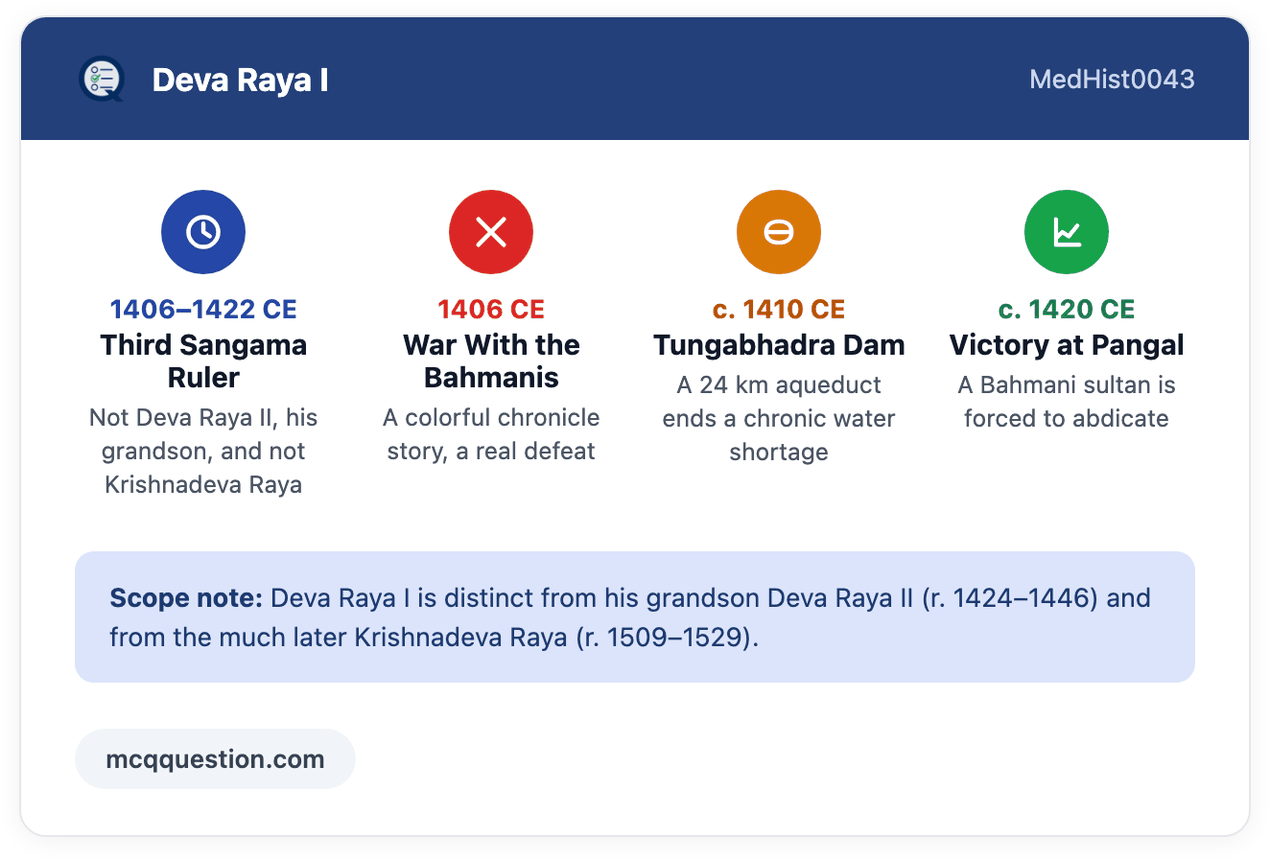
- 1406–1422 CE: Deva Raya I reigns as the third ruler of the Sangama dynasty.
- 1406 CE: war breaks out with the Bahmani Sultanate under Sultan Firuz Shah Bahmani.
- c. 1410 CE: a dam and canal across the Tungabhadra river relieve the capital’s water shortage.
- c. 1420–1422 CE: Deva Raya I defeats Firuz Shah Bahmani at Pangal, forcing his abdication.
- 1424 CE: Deva Raya II, his grandson, succeeds to the throne after an intervening reign.
Reign and Family Need to Know
- Deva Raya I ruled Vijayanagara from 1406 to 1422 CE, as the third ruler of the Sangama dynasty.
- He is distinct from his grandson Deva Raya II, who reigned from 1424 to 1446 CE. Persian envoy Abdur Razzaq visited Deva Raya II’s court, not Deva Raya I’s. See MedHist0046 — Abdur Razzaq.
- He is also distinct from Krishnadeva Raya, who belonged to a different dynasty entirely, the Tuluva, and reigned nearly a century later, from 1509 to 1529 CE. See MedHist0045 — Krishnadeva Raya.
- His reign strengthened Vijayanagara’s finances and territory well before the empire’s most celebrated era. See MedHist0007 for the empire’s wider founding and dynastic arc.
The Tungabhadra Dam and a War Over a Goldsmith’s Daughter Good to Know

- Around 1410 CE, Deva Raya I built a dam and a roughly 24 km canal across the Tungabhadra river. This relieved a chronic water shortage that had constrained the capital’s growth.
- He is also credited with a dam on the Haridra river for further irrigation.
- In 1406, war broke out with the Bahmani Sultanate under Sultan Firuz Shah Bahmani.
- A popular story blames this war on Deva Raya I’s infatuation with a goldsmith’s daughter from Mudgal. This colorful account comes from the 16th-century Persian chronicler Ferishta. Treat it as a chronicle anecdote about the war’s cause, not a fully verified diplomatic trigger. The war itself, and Vijayanagara’s defeat in it, are well attested.
- Deva Raya I conceded heavy terms: marrying his daughter into the Bahmani ruling family, ceding the territory of Bankapur as dowry, and paying an indemnity that reportedly included pearls, fifty elephants, and dancers.
Test Yourself

Recovery at Pangal and a Bahmani Abdication Great to Know
- Around 1420 CE, Firuz Shah Bahmani besieged the fort of Pangal. The siege dragged on for roughly two years.
- Disease spread through the Bahmani camp during the siege. Deva Raya I used the opening to inflict a decisive defeat.
- The defeat was severe enough that Firuz Shah was compelled to abdicate the Bahmani throne, in favour of his brother Ahmad Shah, around 1422.
- By 1422, Deva Raya I had gained territory up to the Krishna-Tungabhadra doab, including Pangal itself.
- This recovery reversed the terms of the 1406 defeat within Deva Raya I’s own reign, restoring Vijayanagara’s regional standing before his grandson Deva Raya II’s later reign.
Beyond the answer
Browse all medieval-indian-history topics →
📚 Keep reading
MedHist0045 — Krishnadeva Raya: Vijayanagara's Golden Age EmperorMedHist0007 — Vijayanagara Empire: Founding to Krishnadeva RayaMedHist0008 — Vijayanagara: Decline, Sources and MonumentsMedHist0042 — The Bijapur Sultanate (Adil Shahi)ArtnCulture0009 — Regional Sultanate Architecture: Gujarat, Malwa, and the Bahmani Deccan❓ Practice this topic
During which two Mughal emperors' reigns did Tavernier make his six voyages to India, between 1630 and 1668?The 115-carat rough diamond Tavernier acquired in 1666 was later cut down and sold to Louis XIV as which famous diamond?In which year did Tavernier publish “Les Six Voyages,” recording diamond prices and mining techniques from his travels?Jean-Baptiste Tavernier's book gave the first detailed European technical description of which diamond mines?🎲 Take a Medieval Indian History Quiz
Leave a Reply