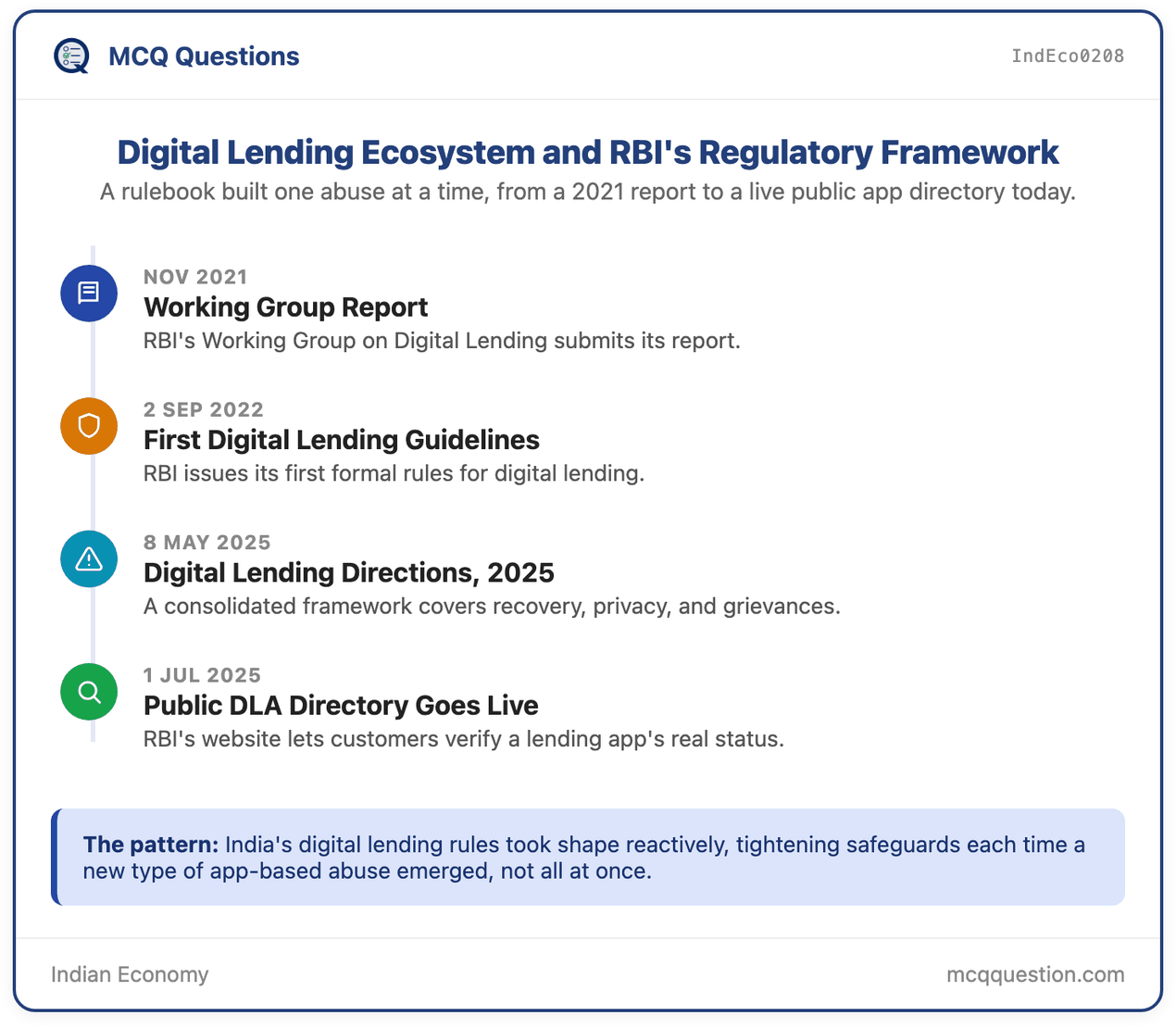
India’s digital lending rules didn’t arrive all at once. Each layer of regulation was built after a new kind of app-based lending abuse showed up first. Predatory recovery agents, hidden charges, and fake apps mimicking real banks each triggered their own fix. The rulebook is still being written today.
 MCQ Questions
IndEco0208
Digital Lending Ecosystem and RBI’s Regulatory Framework
A rulebook built one abuse at a time, from a 2021 report to a live public app directory today.
NOV 2021
Working Group Report
RBI’s Working Group on Digital Lending submits its report.
2 SEP 2022
First Digital Lending Guidelines
RBI issues its first formal rules for digital lending.
8 MAY 2025
Digital Lending Directions, 2025
A consolidated framework covers recovery, privacy, and grievances.
1 JUL 2025
Public DLA Directory Goes Live
RBI’s website lets customers verify a lending app’s real status.
The pattern: India’s digital lending rules took shape reactively, tightening safeguards each time a new type of app-based abuse emerged, not all at once.
Indian Economymcqquestion.com
Timeline
- November 2021: RBI’s Working Group on Digital Lending submits its report, after a wave of predatory and illegal loan-app complaints.
- 2 September 2022: RBI issues its first formal Digital Lending Guidelines.
- June 2023: RBI permits regulated Default Loss Guarantee (DLG) arrangements between lenders and their app partners.
- 8 May 2025: RBI issues the consolidated RBI (Digital Lending) Directions, 2025.
- 1 July 2025: RBI’s public Digital Lending Apps (DLA) directory goes live on its website.
Must Know
- Digital lending means lending money through mobile apps and online platforms, without in-person interaction.
- RBI regulates this space through Regulated Entities (REs), such as banks and NBFCs. REs, in turn, engage Lending Service Providers (LSPs) and Digital Lending Apps (DLAs).
- RBI’s Working Group on Digital Lending submitted its report in November 2021, after a wave of complaints about predatory and illegal loan apps.
- RBI issued its first formal Digital Lending Guidelines on 2 September 2022.
- RBI issued the consolidated RBI (Digital Lending) Directions, 2025, on 8 May 2025. These are mandatory for REs, LSPs, and DLAs, and cover recovery practices, data privacy, and grievance redressal.
- From 1 July 2025, RBI has run a public online directory of Digital Lending Apps. Customers can use it to verify whether an app is tied to a Regulated Entity.
- India’s digital lending disbursements crossed ₹1.7 lakh crore through fintech platforms in FY 2024-25.
Good to Know
- Under the 2022 guidelines, loan money must be disbursed directly into the borrower’s own bank account. It cannot be routed through the lending app or a third party.
- Lenders cannot increase a borrower’s credit limit automatically, without the borrower’s explicit consent.
- Every digital loan must come with a Key Fact Statement (KFS), in simple language. This spells out the annual percentage rate and all charges.
- Borrowers get a cooling-off period. They can exit a loan early, by repaying the principal and proportionate interest, without penalty.
- In June 2023, RBI allowed Default Loss Guarantee (DLG) arrangements between REs and LSPs. These are a regulated version of “First Loss Default Guarantee,” capped at 5% of the outstanding loan portfolio.
- The Information Technology (Intermediary Guidelines and Digital Media Ethics Code) Rules, 2025, were notified on 22 October 2025. They let sectoral regulators like RBI ask for illegal digital lending content to be blocked.
Test Yourself

Great to Know
- As of July 2026, the Ministry of Electronics and IT had blocked 87 illegal loan-lending apps, under Section 69A of the IT Act, 2000.
- The Indian Cyber Crime Coordination Centre (I4C), under the Ministry of Home Affairs, proactively analyses digital lending apps for red flags.
- Citizens can report fake loan apps and other cybercrimes, through the National Cybercrime Reporting Portal (cybercrime.gov.in) or the “1930” helpline.
- Banks also run the “SACHET” portal, alongside State Level Coordination Committees. Citizens can use these to report illegal deposit-collection schemes.
- RBI’s e-BAAT (electronic-Banking Awareness and Training) programmes specifically build public awareness of digital-lending fraud risks.
- India’s digital lending market is projected to grow at nearly 31% CAGR between 2024 and 2030. This makes continued regulatory vigilance an ongoing task, not a one-time fix.
Current Affairs
- 21 July 2026: In a Rajya Sabha reply, the government confirmed the Ministry of Electronics and IT had blocked 87 illegal loan-lending apps under Section 69A of the IT Act. It also detailed RBI’s DLA directory, the 2025 Digital Lending Directions, and citizen-protection tools like I4C and the SACHET portal. (Source: PIB)
Leave a Reply