Contents
1. Start with the gas state
1.1 How do pressure, volume and temperature connect?
- Thermodynamics studies energy, heat, work, and measurable changes in a system.
- A gas state is described by pressure, volume, temperature, and amount of gas.
- The ideal gas law is PV = nRT.
- P is pressure, usually measured in pascals.
- V is volume, usually measured in cubic metres.
- n is the amount of gas, measured in moles.
- T is absolute temperature, measured in kelvins.
- R is the universal molar gas constant.
- Its useful rounded value is 8.314 J mol⁻¹ K⁻¹.
- One joule equals one pascal cubic metre.
- Therefore, SI units fit directly into PV = nRT.
- The same number also works with kilopascals and litres.
- One kilopascal litre equals one joule.
Worked example: One mole occupies 0.0249 m³ at 300 K under about 100 kPa.
P = nRT/V = (1 × 8.314 × 300)/0.0249 ≈ 100,000 Pa.
How do the three named gas laws follow from the same equation?
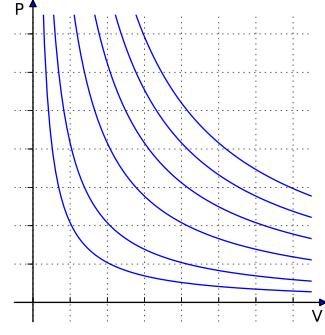
Boyle's law keeps temperature and gas amount fixed. The ideal gas law then gives PV = constant, so pressure varies inversely with volume. For the example above, halving volume doubles pressure if the same mole stays at 300 K. The pressure therefore rises from about 100 kPa to about 200 kPa.
Charles's law keeps pressure and gas amount fixed. The ideal gas law then gives V/T = constant, so volume varies directly with kelvin temperature. For the same mole at about 100 kPa, raising temperature from 300 K to 600 K doubles volume. The volume therefore increases from 0.0249 m³ to about 0.0498 m³. Doubling a Celsius reading does not necessarily double volume.
Avogadro's law keeps pressure and temperature fixed. The ideal gas law then gives V/n = constant, so volume varies directly with the mole amount. At about 100 kPa and 300 K, two moles occupy twice the volume of one mole. Doubling the mole amount increases volume from 0.0249 m³ to about 0.0498 m³. This comparison adds gas; Boyle's and Charles's laws instead keep gas amount fixed.

2. The ideal model has limits
2.1 Why does the ideal model become less accurate?
- An ideal gas is a model, not a special chemical substance.
- Its particles occupy negligible volume within the container.
- The model ignores intermolecular forces except during collisions.
- Collisions are treated as elastic, so total kinetic energy is conserved.
- Real gases approach ideal behaviour at low pressure and high temperature.
- High pressure makes molecular volume harder to ignore.
- Low temperature makes attractive forces more important.
- These changes make PV = nRT less accurate.
The kinetic picture explains pressure through repeated molecular impacts on container walls.
For an ideal gas, average translational kinetic energy depends only on absolute temperature.
3. Heat, work, and internal energy
3.1 Where does transferred energy go?
- Heat is energy transferred because of a temperature difference.
- Work is energy transferred through an organised force and displacement.
- Internal energy is energy stored in microscopic motions and interactions.
- This lesson uses ΔU = Q − W.
- Q is positive when heat enters the gas.
- W is positive when the gas does work on its surroundings.
- Expansion work is W = ∫P dV for a quasi-static path.
- A pressure-volume graph shows this work as the area under the process curve.
- Heat and work depend on the path between two states.
- Internal energy depends only on the state.
- An ideal gas has ΔU = nCᵥΔT when Cᵥ stays approximately constant.
4. Why two heat capacities are needed
4.1 Why is constant-pressure heating different?
- Cᵥ is molar heat capacity at constant volume.
- Cₚ is molar heat capacity at constant pressure.
- Both use J mol⁻¹ K⁻¹.
- Constant-volume heating does no expansion work.
- Constant-pressure heating usually includes expansion work.
- Therefore, Cₚ exceeds Cᵥ for an ideal gas.
- Mayer's relation is Cₚ − Cᵥ = R.
- The heat-capacity ratio is γ = Cₚ/Cᵥ.
- For a monatomic ideal gas, Cᵥ = 3R/2 and γ = 5/3 ≈ 1.67.
- A room-temperature diatomic approximation gives Cᵥ = 5R/2 and γ = 7/5 = 1.40.
- Each active quadratic degree of freedom contributes R/2 to molar Cᵥ.
- Vibrational modes can activate as temperature rises.
- Therefore, heat capacities and γ are not fixed at every temperature.
5. Four named ideal-gas processes
5.1 Which condition stays fixed?
The following energy relations assume a closed gas with only pressure-volume work possible.
Isothermal process
- Temperature remains constant, so ΔT = 0.
- For an ideal gas, ΔU = 0.
- With fixed gas amount, PV = constant.
- For reversible expansion, W = nRT ln(V₂/V₁).
- The first law then gives Q = W.
Isochoric process
- Volume remains constant, so ΔV = 0.
- Expansion work is zero.
- The heat transfer is Q = ΔU = nCᵥΔT when Cᵥ stays approximately constant.
- Pressure changes in direct proportion to kelvin temperature.
Isobaric process
- Pressure remains constant.
- Expansion work is W = P(V₂ − V₁).
- For an ideal gas, this becomes W = nRΔT.
- The heat transfer is Q = nCₚΔT when Cₚ stays approximately constant.
When heat capacity varies, calculate heat by integrating nC(T) over the temperature interval.
Adiabatic process
- No heat crosses the system boundary, so Q = 0.
- Expansion work comes from internal energy, so temperature usually falls.
- Compression work raises internal energy, so temperature usually rises.
- A reversible adiabatic ideal-gas process obeys PV^γ = constant.
- This relation also assumes approximately constant heat capacities.
6. Polytropic processes connect many paths
6.1 How does a process rule determine the result?
- A polytropic process follows PV^m = constant.
- The symbol m is the process exponent.
- It must not be confused with the mole amount n.
- m = 0 gives an isobaric process.
- m = 1 gives an isothermal ideal-gas process.
- m = γ gives a reversible adiabatic ideal-gas process.
- Constant volume is often described by the limiting case m → ∞.
- The polytropic work is (P₂V₂ − P₁V₁)/(1 − m) when m ≠ 1.
- The formula assumes a quasi-static pressure-volume path.
Exam application: A fixed amount of ideal gas obeys PV² = constant and PV = nRT.
Then TV = constant, so T₁/T₂ = V₂/V₁.
Exam application: A fixed amount of ideal gas follows P = kT, where k remains constant.
Then V = nRT/P = nR/k, so the process is isochoric.
Its molar process heat capacity is therefore Cᵥ.
National Defence Academy and Naval Academy (I), 2026: General Ability Test, Q54
National Defence Academy and Naval Academy (I), 2026: General Ability Test, Q55
7. Sound moves through rapid gas compression
7.1 Why does pressure alone leave sound speed unchanged?
- A sound wave creates small pressure and density changes.
- These rapid changes are approximately adiabatic and reversible.
- The ideal-gas speed is c = √(γRT/M).
- c is sound speed in metres per second.
- M is molar mass in kilograms per mole.
- For fixed gas composition and nearly constant γ, sound speed rises approximately with the square root of kelvin temperature.
- Pressure alone does not change the ideal-gas result at fixed temperature.
- Pressure and density then change together, leaving γP/ρ unchanged.
Newton's isothermal assumption predicted a value below measurements.
Laplace used adiabatic compressions, which introduced the factor γ.
National Defence Academy and Naval Academy (I), 2026: General Ability Test, Q62
8. A reliable solving method
8.1 What should you decide before using a formula?
- Write the process condition before selecting any formula.
- Convert temperature to kelvins.
- Use one consistent unit system.
- Decide the signs of heat and work.
- Apply the ideal gas law between states.
- Apply the first law after identifying the path.
- Check whether reversible or constant-heat-capacity assumptions are required.
Questions learners often ask
Why can an isothermal gas absorb heat without getting hotter?
The ideal gas keeps the same internal energy because its temperature stays constant. During expansion, incoming heat supplies the energy used for work. For a closed gas with only pressure-volume work, Q = W.
Does adiabatic mean constant temperature?
No. Adiabatic means no heat crosses the system boundary. An expanding gas can use internal energy to do work, lowering its temperature. Compression can increase internal energy and raise the temperature.
Why does constant-volume heating raise pressure?
For a fixed amount of ideal gas, P = nRT/V. With volume fixed, pressure rises in direct proportion to kelvin temperature. Doubling the kelvin temperature therefore doubles pressure within the ideal-gas model.
Why does doubling pressure leave ideal-gas sound speed unchanged at fixed temperature?
For fixed composition and temperature, doubling pressure also doubles density. The ratio γP/ρ therefore stays unchanged. Sound speed is the square root of that ratio.
Check your understanding
This score resets when the page reloads.
Related articles and exam questions
Practice thermodynamics: 8 MCQs
Try eight questions on gas states, energy transfers and process conditions.
0 of 8 answered
Question 1 of 8
Question 2 of 8
Question 3 of 8
Question 4 of 8
Question 5 of 8
Question 6 of 8
Question 7 of 8
Question 8 of 8
Leave a Reply