500 elephants changed the outcome of a battle fought thousands of miles from India. This article covers Seleucus Nicator’s invasion, the treaty that ended it, and where those elephants went next.


Timeline
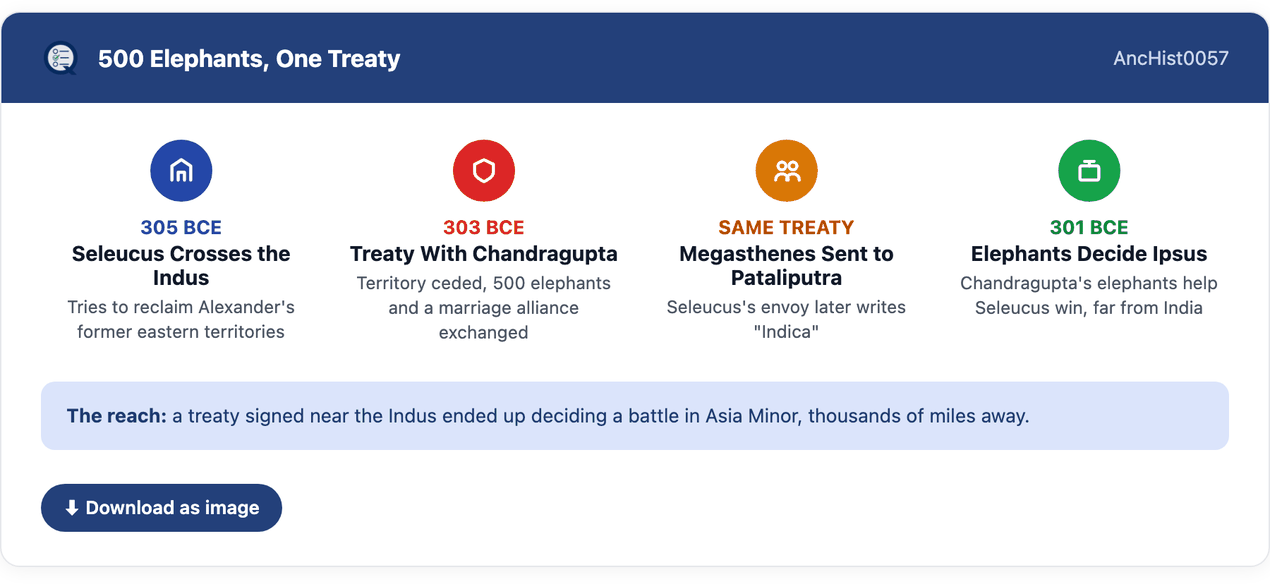
- 305 BCE: Seleucus I Nicator, a former general of Alexander, crosses the Indus, trying to reclaim Alexander’s old eastern territories.
- 303 BCE: A treaty ends the conflict. Seleucus cedes major territory to Chandragupta Maurya, and the two rulers exchange elephants and a marriage alliance.
- Same treaty: Seleucus sends Megasthenes as his envoy to Chandragupta’s court at Pataliputra. Megasthenes later writes “Indica.”
- 301 BCE: Chandragupta’s 500 war elephants help decide the Battle of Ipsus in Seleucus’s favour, fought far away in Asia Minor.
Seleucus’s Indian Campaign Need to Know
- Seleucus I Nicator was one of Alexander’s own former generals. After Alexander’s death, he became the founder of the Seleucid Empire in the east.
- By 305 BCE, Chandragupta Maurya had already taken advantage of the political chaos following Alexander’s earlier invasion of India. He had built up his own power in the Indus region.
- Seleucus crossed the Indus around 305 BCE, attempting to reclaim the eastern satrapies Alexander had once held.
- Chandragupta held off Seleucus’s forces. The exact course of the fighting is not well documented in surviving sources. It ended in a negotiated treaty, not a clear Seleucid victory.
The Treaty of 303 BCE: Verifying the Terms Need to Know
- Under the treaty, Seleucus ceded major territory to Chandragupta. This included the satrapies of Paropamisadae (the Kabul region), Arachosia (around modern Kandahar), and Gedrosia (Baluchistan).
- This cession extended Mauryan control up to the Hindu Kush, based on Strabo’s account of the treaty.
- In exchange, Chandragupta gave Seleucus 500 war elephants. This figure comes directly from Strabo.
- The two rulers also agreed to a marriage alliance, which Strabo calls an “epigamia.”
- The popular version of this story often states that Seleucus gave his own daughter in marriage to Chandragupta. The actual Greek sources are less specific. They confirm a marriage alliance existed, but do not clearly name Seleucus’s daughter as the bride.
- Historians still debate the exact relationship of the woman involved, whether a daughter, a niece, or another female relative of Seleucus. This detail should be treated as uncertain, not settled fact.

Megasthenes and the Indica Good to Know
- As part of the same diplomatic exchange, Seleucus sent Megasthenes as his ambassador to Chandragupta’s court.
- Megasthenes resided at Pataliputra, the Mauryan capital, and later composed an account of India called “Indica.”
- The original text of Indica has not survived. It is known today only through fragments quoted by later classical writers, including Diodorus, Strabo, Arrian, and Pliny.
- Despite this loss, Indica remains one of the most important sources on Mauryan India. See Life of the People in the Mauryan Empire for how its details are used to reconstruct everyday Mauryan society.
Test Yourself

Legacy Great to Know
- The Seleucus treaty shows something unusual. A young Mauryan Empire negotiated as an equal with one of Alexander’s own successors, not as a defeated frontier state.
- Territory flowed toward India, not away from it. This was a rare outcome for a region invaded twice in a decade, first by Alexander and then by Seleucus.
- Chandragupta’s war elephants travelled all the way to Asia Minor, where they helped decide a Hellenistic succession battle at Ipsus. A single diplomatic exchange near the Indus rippled across the ancient world’s power struggles.
- Megasthenes’s posting to Pataliputra turned a diplomatic formality into one of history’s most valuable sources on the Mauryan Empire.
- This treaty predates the later Indo-Greek kingdom by roughly a century. See Indo-Greeks, Shakas and Kushans for that later chapter.
- For Chandragupta’s full reign and the Mauryan side of this relationship, see The Mauryan Empire: Chandragupta Maurya.
Leave a Reply