India’s last census counted 450 million internal migrants. That’s more people than the entire population of the United States. This article covers why people move, and how settlements take shape once they do.

Must Know
- Migration is classified two ways. By space: internal (within the country) or international (across borders). By duration: permanent, semi-permanent (seasonal), or temporary (circular).
- Push factors drive people away from a place: unemployment, low wages, and disasters. Pull factors draw them elsewhere: better jobs, wages, and services.
- Rural settlements fall into three main patterns. A nucleated settlement clusters houses tightly, often around a market or water source. A dispersed settlement scatters isolated homesteads over a wide area. A linear settlement strings houses along a road, river, or canal.
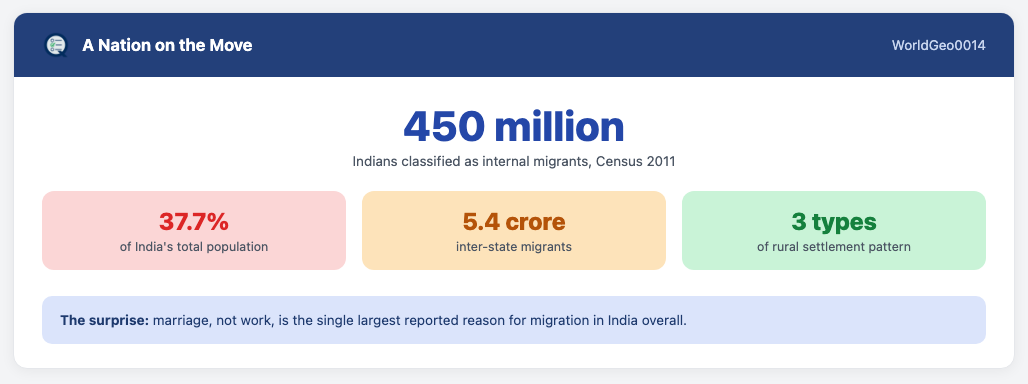
- Census 2011 counted 450 million internal migrants in India, using the “Place of Last Residence” measure. That is 37.7% of the total population.
Good to Know
- Census 2011 recorded 5.4 crore inter-state migrants. The Economic Survey 2016-17 separately estimated around 9 million people crossed state lines each year between 2011 and 2016. (Source)
- Marriage, not work, is the single largest reported reason for migration in India overall. It accounts for roughly two-thirds of female migration. Work and employment dominate migration reasons for men instead. (Source)
- Most Indian internal migration is short-distance. Around 62% of migrants move only within their own district.
- Settlements are also classified by function, not just pattern. A town can be primarily agricultural, mining, manufacturing, or administrative, based on what most of its workforce does.
Test Yourself

Great to Know
- Nucleated settlements aren’t just about convenience. In much of South Asia, they also reflect a defensive logic. Clustering near a shared water source or fort once meant safety in numbers, a pattern that persisted long after the original threat disappeared.
- The gender split in migration reasons reveals something structural, not incidental. Marriage-driven migration follows patrilocal residence norms, where a woman moves to her husband’s household. This is itself a settlement pattern shaped by social rules, not just economic push and pull.
- Short-distance, intra-district migration dominating the data complicates a common assumption. Migration in India isn’t mostly rural workers travelling to distant megacities. It is far more often a much smaller, local move.
- Reading settlement pattern and migration data together explains regional disparity. States with more nucleated settlements and stronger push factors send more inter-state migrants, while states with dispersed settlements and stronger local economies retain more of their population.
Leave a Reply