The Periodic Labour Force Survey (PLFS) is India’s main tool for tracking jobs and unemployment. Its monthly bulletins now shape the national conversation on jobs, almost as much as GDP data does.
 mcqquestion.com
Indian Economy · IndEco0179
PLFS: June 2026 Bulletin
India’s Monthly Jobs Snapshot
5.5%
Overall Unemployment Rate, Age 15+
54.4%
Labour Force Participation Rate
51.4%
Worker Population Ratio
32.7%
Female LFPR
Fifteenth in a New Series
Since January 2025, PLFS has produced monthly, all-India estimates — rural and urban both — not just quarterly urban data.
Must Know
- The PLFS is conducted by the National Statistical Office (NSO), under the Ministry of Statistics and Programme Implementation (MoSPI).
- It was launched in April 2017. It replaced NSSO’s old quinquennial (five-yearly) employment-unemployment surveys, the last of which covered 2011-12.
- PLFS tracks three headline indicators: the Labour Force Participation Rate (LFPR), the Worker Population Ratio (WPR), and the Unemployment Rate (UR).
- It uses two different reference periods. “Usual Status” looks at a person’s activity over the preceding 365 days. “Current Weekly Status” (CWS) looks only at the preceding 7 days.
- The first PLFS report covered July 2017 to June 2018. It was published in 2019, after a well-known release controversy (see Good to Know).
- From January 2025, the PLFS methodology was revamped. It now produces monthly and quarterly estimates, for both rural and urban India, at the all-India level.
- This measurement work sits alongside India’s broader system for classifying jobs, covered in IndEco0018 — Employment Types and Measurement in India.
Good to Know
- The first PLFS report was controversial. Leaked data showed a 45-year-high unemployment rate of 6.1% for 2017-18, months before the government’s official release.
- Two members of the National Statistical Commission, including its acting chairman, resigned. They said the government had withheld data the Commission had already approved for release.
- The report was finally released in 2019, after that year’s Lok Sabha elections were over.
- The National Statistical Office (NSO) itself was formed on 23 May 2019. It merged the NSSO, which collected survey data, with the Central Statistical Office (CSO), which compiled it.
- Before the 2025 revamp, PLFS gave annual “Usual Status” estimates for all of India, but only quarterly CWS estimates for urban areas. Rural areas had no quarterly data — only the annual figures.
Test Yourself

Great to Know
- In the controversial 2017-18 report, urban youth unemployment was far higher than the national average: 18.7% for young men, 27.2% for young women.
- The Current Weekly Status method is the more “live” measure. It classifies a person based on their most time-consuming activity in just the last 7 days.
- Usual Status, by contrast, looks at a full year. This smooths out the effect of seasonal work, like farm labour that only exists at harvest time.
Current Affairs
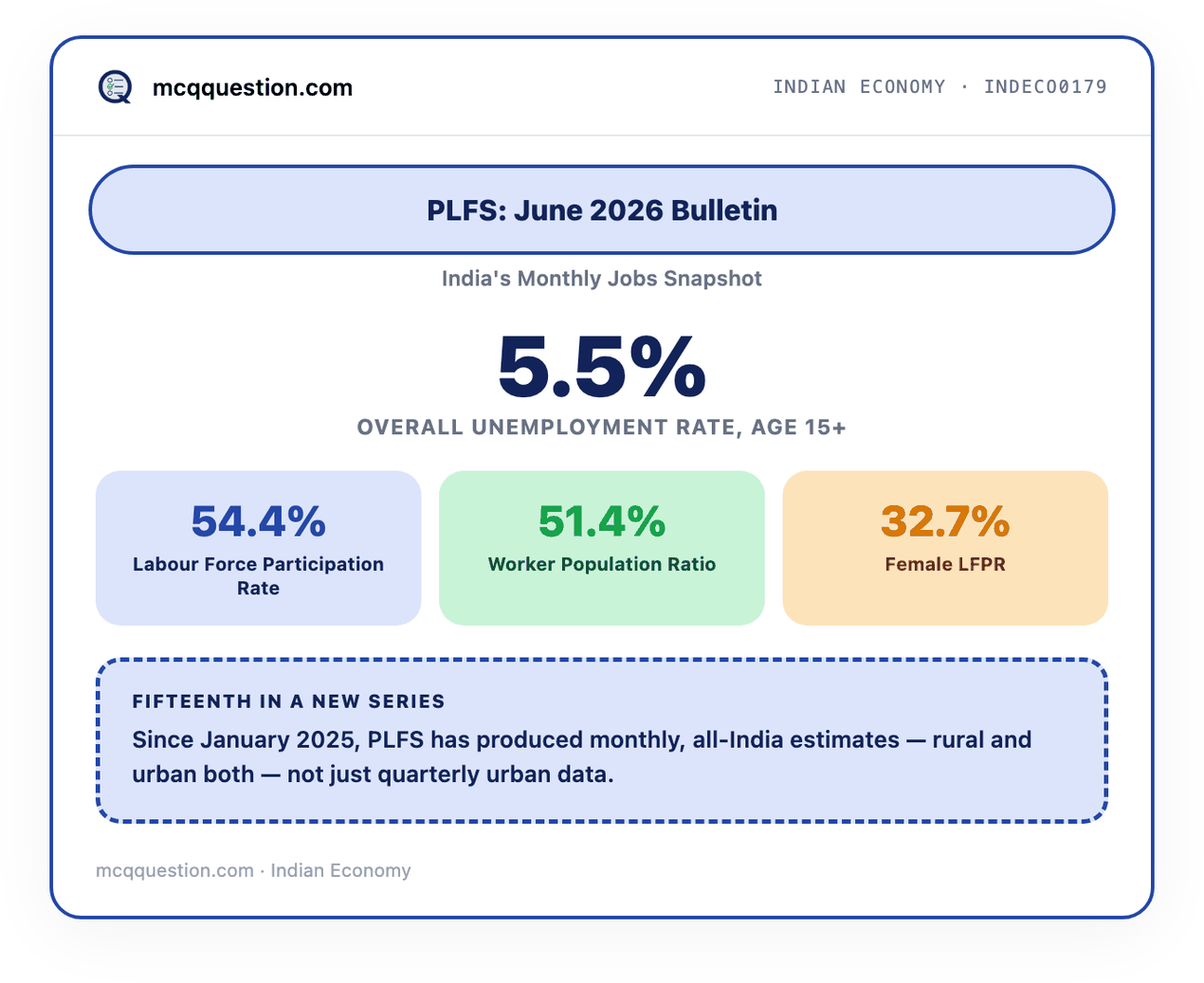
- On 15 July 2026, MoSPI released the PLFS Monthly Bulletin for June 2026, the fifteenth bulletin under the new monthly series. (Source: PIB)
- Overall LFPR (age 15+) stood at 54.4% in June 2026, unchanged from May 2026 and slightly above 54.2% a year earlier. (Source: PIB)
- Female LFPR was 32.7% in June 2026, marginally down from 32.8% in May 2026, but 0.7 percentage points above June 2025’s 32.0%. (Source: PIB)
- Overall WPR held steady at 51.4% in June 2026, up 0.2 percentage points over June 2025’s 51.2%. (Source: PIB)
- The overall Unemployment Rate was 5.5% in June 2026, against 5.6% in June 2025. Urban UR eased year-on-year, from 7.1% to 6.6%. (Source: PIB)
- The June 2026 bulletin drew on a sample of 3,72,852 people: 2,12,390 in rural areas and 1,60,462 in urban areas. (Source: PIB)
Leave a Reply