Since 1983, one institute has trained the trainers behind India’s entrepreneurship programmes. In July 2026, it finally brought its own alumni together for the first time.
 MCQ Questions
IndEco0181
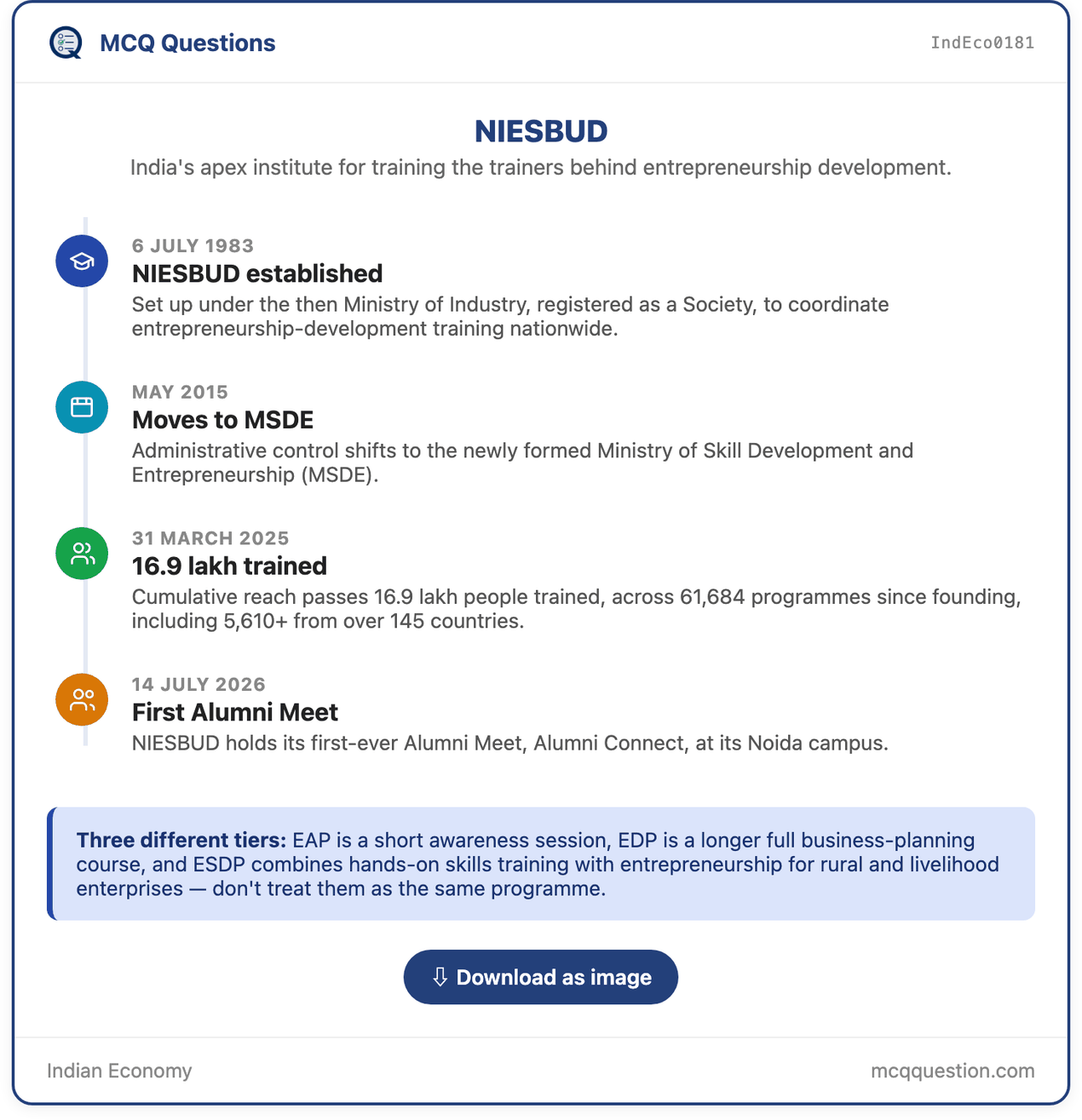
NIESBUD
India’s apex institute for training the trainers behind entrepreneurship development.
6 July 1983
NIESBUD established
Set up under the then Ministry of Industry, registered as a Society, to coordinate entrepreneurship-development training nationwide.
May 2015
Moves to MSDE
Administrative control shifts to the newly formed Ministry of Skill Development and Entrepreneurship (MSDE).
31 March 2025
16.9 lakh trained
Cumulative reach passes 16.9 lakh people trained, across 61,684 programmes since founding, including 5,610+ from over 145 countries.
14 July 2026
First Alumni Meet
NIESBUD holds its first-ever Alumni Meet, Alumni Connect, at its Noida campus.
Three different tiers: EAP is a short awareness session, EDP is a longer full business-planning course, and ESDP combines hands-on skills training with entrepreneurship for rural and livelihood enterprises — don’t treat them as the same programme.
Indian Economymcqquestion.com
Must Know
- NIESBUD stands for the National Institute for Entrepreneurship and Small Business Development.
- It was established on 6 July 1983, under the then Ministry of Industry, and is registered as a Society under the Societies Registration Act, 1860.
- It works as India’s apex body for coordinating entrepreneurship-development activities, focused especially on training the trainers who run entrepreneurship programmes elsewhere.
- In May 2015, its administrative control moved to the newly formed Ministry of Skill Development and Entrepreneurship (MSDE).
- Its main campus is in Noida.
- By 31 March 2025, it had trained more than 16.9 lakh people, through over 61,684 programmes since its founding. This included more than 5,600 international participants, from over 145 countries.
Good to Know
- NIESBUD runs three main tiers of programmes. Entrepreneurship Awareness Programmes (EAP) are short introductory sessions.
- Entrepreneurship Development Programmes (EDP) are longer courses, covering business planning, costing, and regulation.
- Entrepreneurship-cum-Skill Development Programmes (ESDP) are hands-on, aimed at rural and livelihood-focused enterprises.
- It also runs Training of Trainers and Management Development Programmes.
- On 14 July 2026, NIESBUD held its first-ever Alumni Meet, called Alumni Connect, at its Noida campus.
- Union Minister Jayant Chaudhary, who heads the Ministry of Skill Development and Entrepreneurship, addressed the event.
Test Yourself

Great to Know
- Don’t treat EAP, EDP, and ESDP as the same thing. They are three different tiers, from a short awareness session up to a full, hands-on skill-and-enterprise programme.
- NIESBUD’s own home ministry has changed once already. It started under the Ministry of Industry, later sat within the MSME sphere, and has been under MSDE since May 2015. Know which ministry currently governs it, not just where it started.
- See IndEco0055 — MSMEs and Industrial Policy for the broader ministry and policy context that NIESBUD’s own training work supports.
Current Affairs
- 14 July 2026: At NIESBUD’s first Alumni Meet, Union Minister Jayant Chaudhary launched two publications: “Swavalamban Ki Ore – 4,” on entrepreneurial success stories, and “Alumni Connect Volume – 1,” profiling successful alumni entrepreneurs. (Source: PIB)
- 14 July 2026: The event brought together nearly 200 alumni entrepreneurs from 19 states, alongside mentors from NITI Aayog‘s Women Entrepreneurship Platform (WEP), and a panel on digital growth strategies covering ONDC, Meta, and GeM. (Source: PIB)
Leave a Reply