In 1991, India’s economy was in crisis, and its tax system was part of the problem: high rates, few payers, and a tangle of exemptions. The government turned to Raja Chelliah to fix it. What his committee recommended still shapes how India taxes income, goods, and trade today.

Timeline
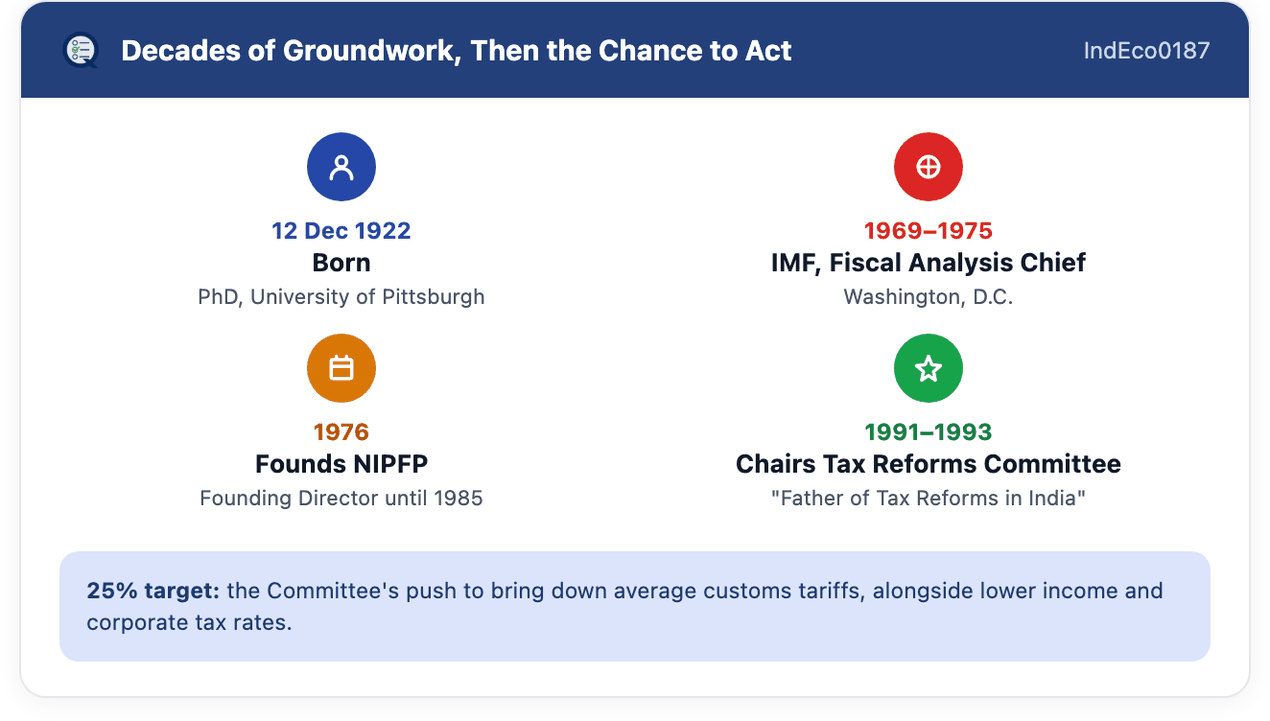
- 12 December 1922: Born. Later earns an M.A. in Economics from the University of Madras and a Ph.D. from the University of Pittsburgh.
- 1958–1969: Works as a senior economist at NCAER, then teaches at the University of Rajasthan and Osmania University.
- 1969–1975: Serves as Chief of the Fiscal Analysis Division at the IMF, in Washington, D.C.
- 1976: Founds the National Institute of Public Finance and Policy (NIPFP), and serves as its founding director until 1985.
- 1985–1990: Serves as a member of the Planning Commission.
- 1991–1993: Chairs the Tax Reforms Committee, the work that earns him the title “Father of Tax Reforms in India.”
- 2007: Receives the Padma Vibhushan.
- 7 April 2009: Dies, aged 86.
Must Know
- Raja Chelliah is widely known as the “Father of Tax Reforms in India.”
- He chaired the Tax Reforms Committee, set up by the Union Government in 1991. It submitted its reports across 1991, 1992, and 1993.
- The Committee’s recommendations included bringing average customs tariff rates down to around 25%. It also proposed cutting personal and corporate marginal tax rates, and integrating excise duties with a Value-Added Tax system.
- Most of the Committee’s proposals were accepted, and many were implemented by 1997.
- Chelliah founded the National Institute of Public Finance and Policy (NIPFP) in 1976, serving as its founding director until 1985.
Good to Know
- Chelliah earned an M.A. in Economics from the University of Madras, and a Ph.D. from the University of Pittsburgh, on a Fulbright-Smith-Mundt fellowship.
- Before NIPFP, he served as Chief of the Fiscal Analysis Division at the IMF in Washington, D.C., from 1969 to 1975.
- He also served as a member of the Planning Commission (1985–1990) and the Finance Commission (1987–1989).
- Later in his career, he chaired Tamil Nadu’s Tax Reforms and Revenue Augmentation Commission, from 2002 to 2003.
- He received the Padma Vibhushan in 2007. NIPFP continues to honour him each year through its Raja Chelliah Memorial Lecture Series.
Test Yourself

Great to Know
- Chelliah’s tax reforms sit alongside a broader family of 1991-92 reform-era committees. See IndEco0173 — Narasimham Committee for the parallel effort that reshaped India’s banking sector in the same period.
- He belongs to the same generation of technocrats who authored India’s 1991 reform blueprint from within its institutions. See IndEco0177 — Montek Singh Ahluwalia for another figure from that same era.
- Founding an independent research institute, then later chairing the very committee that reshaped national tax policy, is an unusual career arc. Chelliah spent decades building the intellectual groundwork before he was ever handed the power to act on it.
Leave a Reply