A turmeric grown on a few Meghalaya hillsides has nearly four times the world’s average curcumin content. The government now wants it sold as a global luxury spice.

Timeline
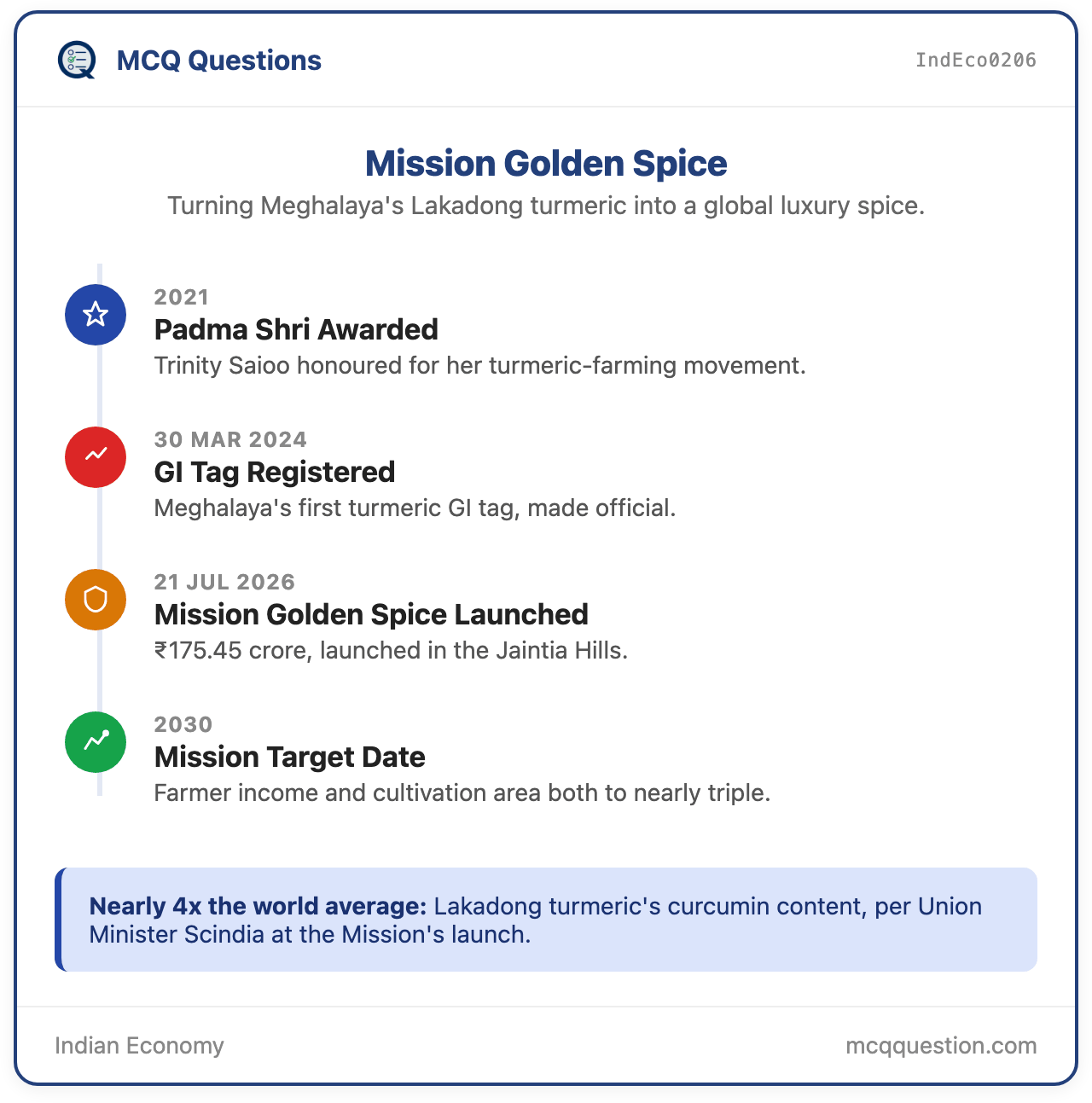
- 2021: Agriculturist Trinity Saioo receives a Padma Shri, for promoting Lakadong turmeric farming.
- 30 March 2024: Lakadong Turmeric is formally registered with India’s Geographical Indication (GI) tag.
- 21 July 2026: The Union and Meghalaya governments launch Mission Golden Spice, with a ₹175.45 crore outlay.
- 2030: The Mission’s target date, for nearly tripling both cultivation area and farmer income.
Must Know
- Lakadong turmeric is grown in Meghalaya’s Jaintia Hills, centred on Lakadong village. It is prized for an exceptionally high curcumin content.
- Its curcumin content runs 7-10%, against a world average of roughly 2-3%. This makes it one of the most potent turmeric varieties known.
- It received India’s Geographical Indication (GI) tag, registered on 30 March 2024. This was Meghalaya’s first turmeric GI, and its third GI tag overall.
- Agriculturist Trinity Saioo, a former school teacher, led the farmer movement behind Lakadong turmeric’s revival. She received a Padma Shri for this work in 2021.
- On 21 July 2026, Union Minister Jyotiraditya Scindia and Meghalaya Chief Minister Conrad Sangma launched Mission Golden Spice. Its full name is the Integrated Lakadong Turmeric Value Chain Enhancement Project.
- The Mission carries a ₹175.45 crore outlay. It is anchored by the Ministry of Development of North Eastern Region (MDoNER) and the North Eastern Council.
- It runs on a 5-year roadmap, from 2025 to 2030, in two phases: Value Chain Strengthening, followed by Expansion and Scale-up.
- The Mission is part of the government’s “Ashtalakshmi” approach. Each of India’s 8 northeastern states gets one flagship product built into a global brand; Lakadong turmeric is Meghalaya’s.
Good to Know
- Farmers currently earn about ₹30-40 a kilo for Lakadong turmeric. The Mission aims to raise this to nearly ₹80 a kilo by 2030.
- The area under cultivation is targeted to grow from around 2,500 hectares to nearly 7,500 hectares.
- The Mission converges with several existing agencies. These include APEDA, the Spices Board, the National Turmeric Board, ICAR, NABARD, and the Government of Meghalaya.
- It plans to build the northeast’s largest integrated organic turmeric processing and curcumin-extraction facility.
- Structural gaps the Mission targets include post-harvest losses, missing cold-chain infrastructure, weak branding, and no structured system for monetising the GI tag itself.
- Women are described as the crop’s “true custodians.” The Mission places them at the centre of its farmer institutions and enterprises.
Test Yourself

Great to Know
- Lakadong turmeric’s high curcumin content is closely tied to its specific soil and climate. Meghalaya’s Chief Minister has noted that saplings grown outside the state consistently show lower curcumin levels.
- Prime Minister Modi recently showcased Lakadong turmeric at the G7 Summit, drawing interest from world leaders. Mission Golden Spice is meant to help the crop meet that global demand at scale.
- Turmeric is one of many spices grown across India, each with its own agro-climatic story. See IndEco0107 — Spice Cultivation in India.
- Mission Golden Spice reflects a broader shift in India’s GI strategy. A GI tag alone only protects a name. Converting that protection into real farmer income needs processing, branding, and market access, and this Mission specifically funds all three.
Current Affairs
- On 21 July 2026, Union Minister Jyotiraditya Scindia launched Mission Golden Spice, alongside Meghalaya Chief Minister Conrad Sangma. (Source: PIB)
- Scindia said Lakadong turmeric’s curcumin content is nearly four times the world average. He highlighted the extraordinary role women play in its production and processing. (Source: PIB)
- The Mission’s goal is to nearly double farmer income, from ₹30-40 a kilo to close to ₹80 a kilo by 2030. It also aims to expand the cultivation area threefold. (Source: PIB)
- MDoNER Secretary Nivedita Shukla Verma said the Mission would address post-harvest losses and weak processing infrastructure. It would also fix the lack of a structured system to monetise the GI tag. (Source: PIB)
Leave a Reply