A bank spent 41 years trying to rescue India’s failing companies. In 2012, the government decided to close the bank too.
 mcqquestion.com
Indian Economy · IndEco0223
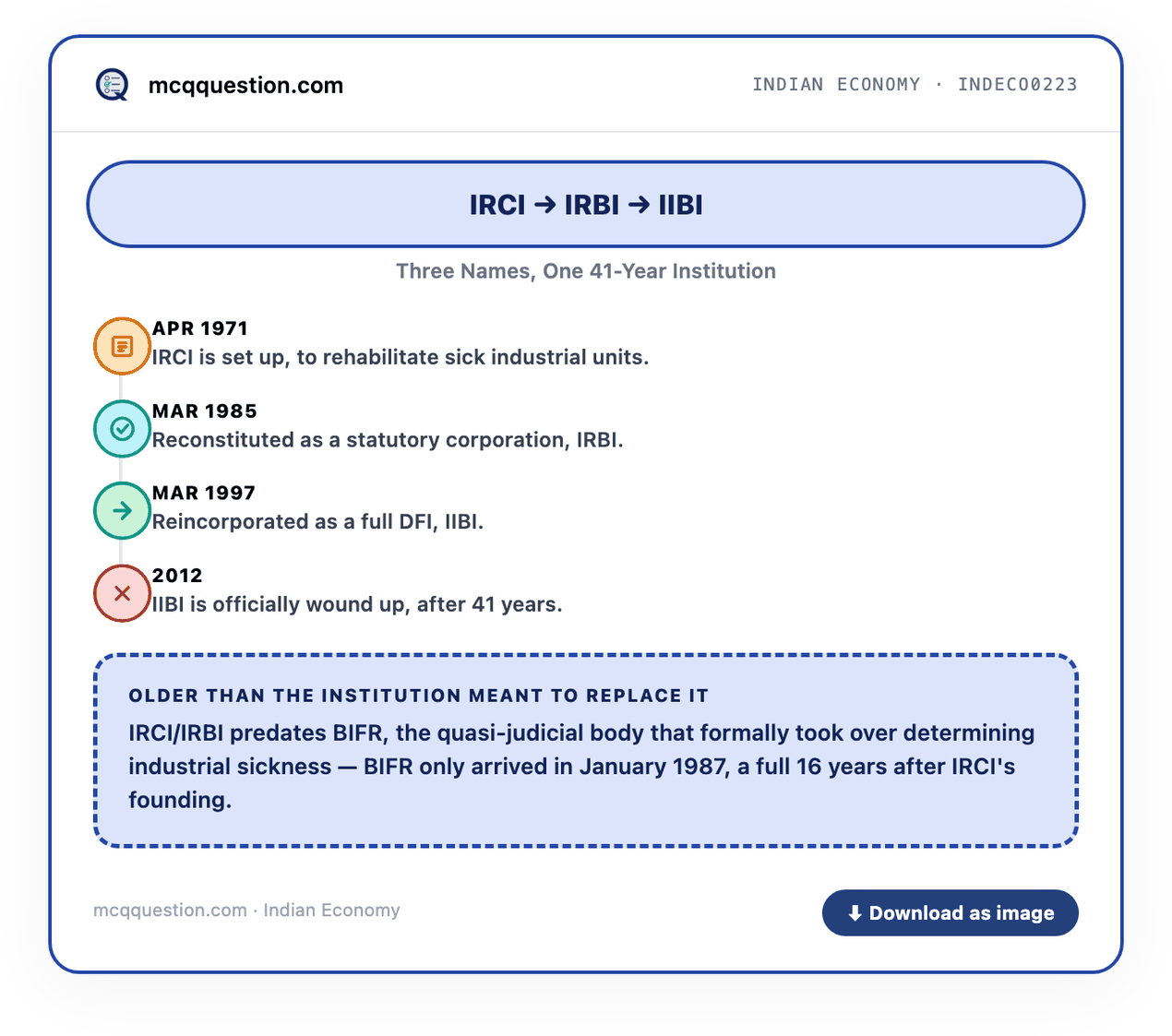
IRCI → IRBI → IIBI
Three Names, One 41-Year Institution
Apr 1971
IRCI is set up, to rehabilitate sick industrial units.
Mar 1985
Reconstituted as a statutory corporation, IRBI.
Mar 1997
Reincorporated as a full DFI, IIBI.
2012
IIBI is officially wound up, after 41 years.
Older Than the Institution Meant to Replace It
IRCI/IRBI predates BIFR, the quasi-judicial body that formally took over determining industrial sickness — BIFR only arrived in January 1987, a full 16 years after IRCI’s founding.
Timeline
- April 1971: The Industrial Reconstruction Corporation of India (IRCI) is set up, to rehabilitate sick industrial units.
- March 1985: IRCI is reconstituted as a statutory corporation, the Industrial Reconstruction Bank of India (IRBI).
- March 1997: IRBI is reincorporated as the Industrial Investment Bank of India (IIBI), a full development financial institution.
- 2012: IIBI is officially wound up, ending the institution’s 41-year existence.
Must Know
- The Industrial Reconstruction Corporation of India (IRCI) was set up in April 1971, to rehabilitate sick industrial units.
- It was headquartered in Calcutta, with an initial share capital of ₹10 crore.
- In March 1985, it was reconstituted as a statutory corporation, the Industrial Reconstruction Bank of India (IRBI).
- In March 1997, IRBI was reincorporated as the Industrial Investment Bank of India (IIBI), a full development financial institution.
- IIBI was officially wound up in 2012, ending the institution’s 41-year existence.
Good to Know
- IRCI started as a public limited company, under the joint control of the Reserve Bank of India and the Central Government.
- IRBI’s 1985 conversion was carried out under a dedicated law, the IRBI Act, 1984.
- As IRBI, the institution held an authorised capital of ₹200 crore, and a paid-up capital of ₹50 crore.
- IIBI’s closure followed a rejected 2005 proposal, to merge it with IDBI and IFCI.
- Deloitte and Touche was later appointed, to help dispose of IIBI’s non-performing assets.
Test Yourself

Great to Know
- IRCI/IRBI predates India’s more famous sick-industry framework. The Sick Industrial Companies Act, and its Board, BIFR, only arrived in January 1987.
- IRBI worked as a specialised lender for sick-unit rehabilitation. BIFR, by contrast, was a quasi-judicial body, formally determining sickness and ordering revival or closure.
- This institution’s history reflects a broader pattern. Many of India’s early development finance institutions were eventually merged, restructured, or wound up, once commercial banks took over their role.
- The institution’s full career spanned three different names and legal structures, across 41 years, from 1971 to 2012.
- IIBI’s closure was formally announced in the Union Budget, 2012.
Leave a Reply