In 2016, one new operator gave away free calls and near-free data. Within two years, half of India’s telecom companies had merged or shut down. By May 2026, the survivors and the state together served 1.34 billion phone connections, more than the population of the country.

Timeline
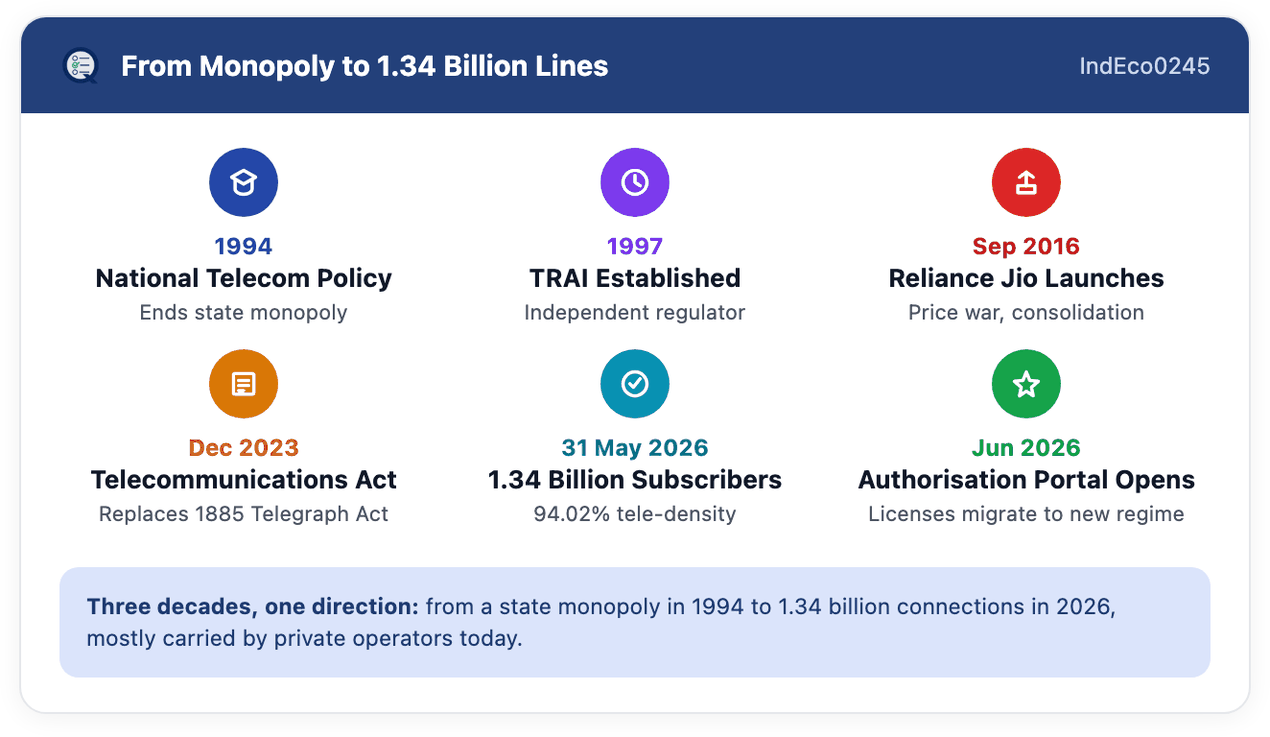
- 1994: The National Telecom Policy ends the government’s monopoly, allowing private entry into fixed-line and cellular mobile services.
- 20 February 1997: The Telecom Regulatory Authority of India (TRAI) is established by Act of Parliament, as an independent regulator.
- 1999: The New Telecom Policy replaces fixed license fees with a revenue-sharing model, further liberalising the sector.
- 5 September 2016: Reliance Jio launches, offering free calls and cheap data. A price war follows, and Vodafone and Idea later merge to survive.
- 2022: Private telecom operators launch 5G services across India.
- 24 December 2023: The Telecommunications Act, 2023 is enacted, replacing the colonial-era Indian Telegraph Act, 1885.
- 23-25 June 2026: The Department of Telecommunications notifies rules under the 2023 Act and opens an online portal for the new authorisation and license-migration regime.
Must Know
- India’s telecom sector moved from a state monopoly to a private-led market, starting with the National Telecom Policy of 1994.
- The Telecom Regulatory Authority of India (TRAI), set up in 1997, independently regulates services and tariffs.
- Reliance Jio’s 2016 launch triggered a major price war, leading to consolidation. Vodafone and Idea merged, and several smaller operators exited the market.
- The Telecommunications Act, 2023 replaced the 138-year-old Indian Telegraph Act, 1885, modernising the legal basis for telecom regulation.
- As of May 2026, India had about 1.34 billion telephone subscribers, with an overall tele-density of 94.02%.
Good to Know
- Private operators now dominate mobile services, holding 92.71% of the wireless subscriber market. State-run BSNL and MTNL together hold the remaining 7.29%.
- Reliance Jio leads broadband, with a subscriber base of 529.61 million at the end of May 2026, ahead of Bharti Airtel and Vodafone Idea.
- Mobile Number Portability (MNP) was introduced in Haryana in November 2010, then nationwide in January 2011. Inter-circle portability followed in July 2015.
- Tele-density varies sharply by region. Delhi’s tele-density stood at over 366% (counting multiple SIMs per person) at the end of May 2026, while Bihar’s was under 64%.
- The Department of Telecommunications actively manages disruptions too. In June 2026, it activated emergency roaming across storm-hit districts of Arunachal Pradesh to keep networks running.
Test Yourself

Great to Know
- Between 1997 and 2007, TRAI’s tariff reforms cut mobile call rates from around Rs 16.80 per minute to close to Rs 1 per minute. This helped subscribers grow from about 15 million to over 200 million.
- The 2023 Act replaces India’s old licensing system with a “digital by design” authorisation framework. Operators can now apply for and migrate licenses entirely online, through the Telecom eServices Portal.
Current Affairs
- On 24 June 2026, C-DOT signed an MoU with IIT Hyderabad, to set up a Centre of Excellence (CoE) in advanced communication technologies. It’s C-DOT’s fourth such CoE, after IIT Kanpur, IIT Gandhinagar, and IIT Roorkee. (Source: PIB)
- The CoE will focus on wireless communications, quantum technologies, cybersecurity, and AI-driven applications. Planned work includes 5G Advanced/6G, large-scale MIMO systems, and post-quantum communications. (Source: PIB)
- C-DOT is India’s premier telecom R&D centre, under the Department of Telecommunications. (Source: PIB)
- On 22 June 2026, TRAI released its Indian Telecom Services Performance Indicator Report for the quarter ending 31 March 2026. Total internet subscribers rose from 1,028.61 million in December 2025 to 1,092.79 million, a quarterly growth of 6.24%. (Source: PIB)
- Broadband subscribers grew to 1,065.88 million, and wireline subscribers rose to 48.25 million. Monthly ARPU for wireless service increased to Rs 196.04, up 7.15% year-on-year. (Source: PIB)
Beyond the answer
Browse all indian-economy topics →
📚 Keep reading
Polity0254 — Draft Telecommunications (Television, Radio and Associated Services) Rules, 2026IndGov0022 — Digital IndiaPolity0187 — Spam Calls and Messages in India: TRAI's UCC FrameworkPolity0036 — Regulatory Bodies Governing India's EconomyIntlRel0074 — India-USA Relations and Trade❓ Practice this topic
Per capita income can rise while inequality also rises because:Which ministry oversees the National Statistical Office (NSO) that publishes India's national income data?Why is it important to note the base year when comparing GDP figures across different time periods?Which of the following best distinguishes GDP from GNP?🎲 Take a Indian Economy Quiz
Leave a Reply