Fishing, mining, forestry and herding feed millions of Indians.
These non-farm primary activities follow the shape of the land itself.


Must Know
What Non-Farm Primary Activities Are
What non-farm primary activities are
- DefinitionNon-farm primary activities draw goods straight from nature.
- CoverageThey include fishing, animal husbandry, forestry, mining and quarrying.
- ContrastFarming grows crops; these activities collect or extract them instead.
- StatusThey remain primary work, not manufacturing or services.
Fishing and the coasts
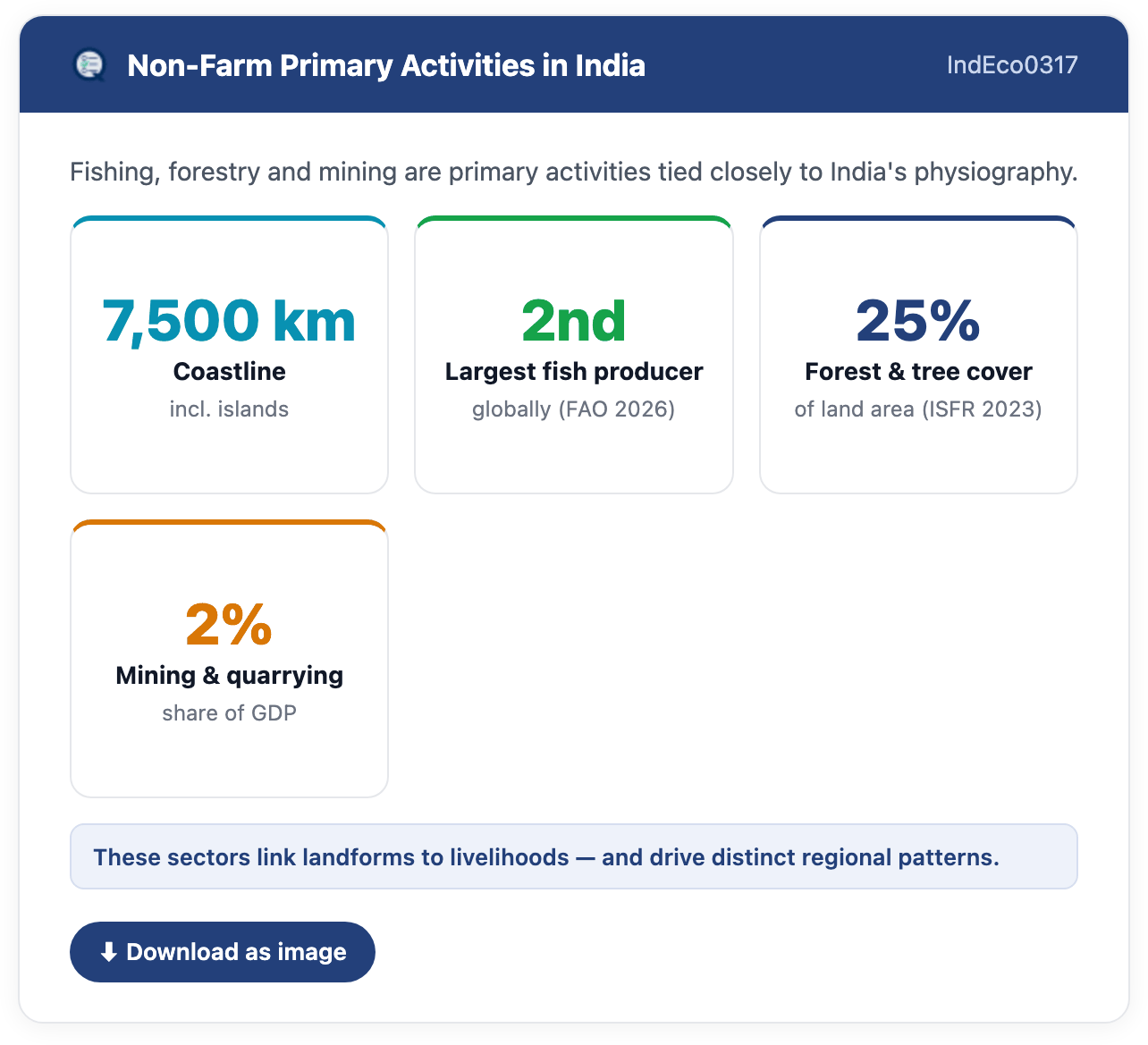
- CoastlineIndia’s coastline, including islands, is about 7,500 km long.
- Marine HubsKerala, Gujarat, Tamil Nadu, Maharashtra and Odisha lead marine fishing.
- Inland LeadRivers, reservoirs and ponds now supply most of India’s fish.
- Global RankIndia is the world’s second-largest fish producer (FAO, 2026).
Animal husbandry and dairying
- LivestockCattle, buffalo, goats and sheep anchor rural livelihoods.
- MilkIndia is the world’s largest milk producer.
- PastoralismHimalayan herders like Gujjars and Bakarwals move with the seasons.
- Dry LandRajasthan’s Raika herders rear camels and sheep in arid land.
Forestry and forest produce
- Forest CoverIndia’s forest and tree cover is about 25% of its land area (ISFR 2023).
- ProduceTendu leaves, mahua, bamboo, honey and lac come from forests.
- RegionsChhattisgarh, Madhya Pradesh, Jharkhand and the Northeast gather them.
- LivelihoodMillions of tribal households earn from forest collection.
Mining and quarrying
- Mineral BeltThe Chotanagpur plateau holds India’s richest coal and iron ore.
- MineralsCoal, iron ore, bauxite, manganese and limestone are mined widely.
- QuarryingRiver beds supply sand and stone for construction everywhere.
- ShareMining and quarrying add roughly 2% to India’s GDP.
Good to Know
How Physiography Shapes Each Activity
Beach sands and coastal minerals
- DepositKerala, Tamil Nadu, Odisha and Andhra coasts hold heavy-mineral sands.
- MineralsIlmenite, monazite, rutile and zircon are extracted from them.
- UsesThese feed titanium, rare-earth and ceramic industries.
- ChavaraKerala’s Chavara sands are among the world’s richest deposits.
Deltas and aquaculture
- Shrimp BeltThe Krishna-Godavari delta leads India’s shrimp farming.
- EstuariesThe Sundarbans and the Hooghly estuary support brackish-water fishing.
- BackwatersKerala’s backwaters are famous for fish and prawn culture.
- GrowthInland aquaculture is India’s fastest-rising fish source.
Plateaus and mineral wealth
- ChotanagpurJharkhand, Odisha and Chhattisgarh mine coal, iron and bauxite.
- DeccanMaharashtra mines manganese; Karnataka and Goa mine iron ore.
- GoldKolar in Karnataka was India’s historic gold-mining centre.
- DiamondPanna in Madhya Pradesh yields diamonds from kimberlite pipes.
Mountains, forests and pastures
- HimalayaUttarakhand, Himachal Pradesh and the Northeast hold dense forests.
- ProductsHill forests give timber, fuelwood, fodder and medicinal plants.
- TranshumanceHerders shift livestock between summer and winter pastures.
- HerbsHimalayan plants feed India’s herbal and ayurvedic industry.
Arid lands and salt
- RannThe Great Rann of Kutch is India’s biggest salt-producing region.
- Lake SaltRajasthan’s Sambhar Lake is another major inland salt source.
- HerdingSheep and goat rearing suits Rajasthan’s dry grasslands.
- FitEach landform shapes which non-farm activity can thrive there.
Test Yourself


Great to Know
Deeper Links and the Policy Angle
Why physiography decides location
- DeterminismLandforms fix where each activity can physically happen.
- LocalisationFisheries hug coasts; mining follows mineral belts; forests climb hills.
- LimitA desert cannot host marine fishing, and a plateau lacks deltas.
- ResultRegional economies mirror their physical geography.
Non-farm work in rural India
- MixingMost rural households combine farming with allied activities.
- BufferSuch work smooths income when crops fail.
- WomenDairy and forest collection employ many rural women.
- PushLand fragmentation pushes more people into these activities.
Government support
- FisheriesPM Matsya Sampada Yojana funds fisheries and aquaculture.
- ForestryThe National Forest Policy (1988) links forests to tribal welfare.
- MiningThe Mines and Minerals (Development and Regulation) Act, 1957 governs extraction.
- DairyOperation Flood built India’s dairy cooperatives decades ago.
PYQ
Previous Year Questions
UPSC CSM 2025 GS Paper I, Q5
- UPSC 2025UPSC CSM 2025 GS Paper I, Q5 — View this question.
- AskThe question wants a definition plus physiographic examples.
- PlanDefine non-farm primary activities, then map them to landforms.
- TipUse named examples like Kerala fishing and Chotanagpur mining.
Leave a Reply