A container ship docks at an Indian port. One importer’s cargo clears customs in hours, with almost no paperwork. Another’s sits for days, inspected line by line. The difference usually isn’t luck. It’s a customs status called Authorised Economic Operator, or AEO. This article covers what AEO status actually is, how India’s programme works, and the real trap in CBIC’s own “10 years” claim about it.

 MCQ Questions
Must Know
The Basics
What AEO Status Actually Is
- DefinitionAn Authorised Economic Operator is a business that Customs certifies as compliant and secure in how it handles international trade.
- Who QualifiesImporters, exporters, customs brokers, warehouse operators and other supply-chain players can all apply.
- VoluntaryAEO status is voluntary, not mandatory. A business applies for it to unlock faster, cheaper customs treatment.
- Who Runs ItIndia’s programme is administered by the Central Board of Indirect Taxes and Customs (CBIC), under the Ministry of Finance.
- OriginIndia’s AEO Programme began in 2011, one of many national programmes built on a common global template.
Four Tiers, and What Each One Buys You
- Three TiersImporters and exporters can hold AEO-T1, AEO-T2, or AEO-T3 status, with T3 being the highest level.
- A Fourth CategoryAEO-LO covers everyone else in the chain: customs brokers, custodians, and terminal operators.
- Escalating BenefitsEach tier up unlocks more facilitation: fewer physical checks, faster clearance, and less paperwork.
- Real PerksBenefits include direct port delivery, 24×7 clearance access, and deferred payment of customs duty.
- Financial PerksCertified operators can also get reduced or waived bank guarantees, cutting a real compliance cost.
Good to Know
The Global Framework
The WCO SAFE Framework Behind AEO
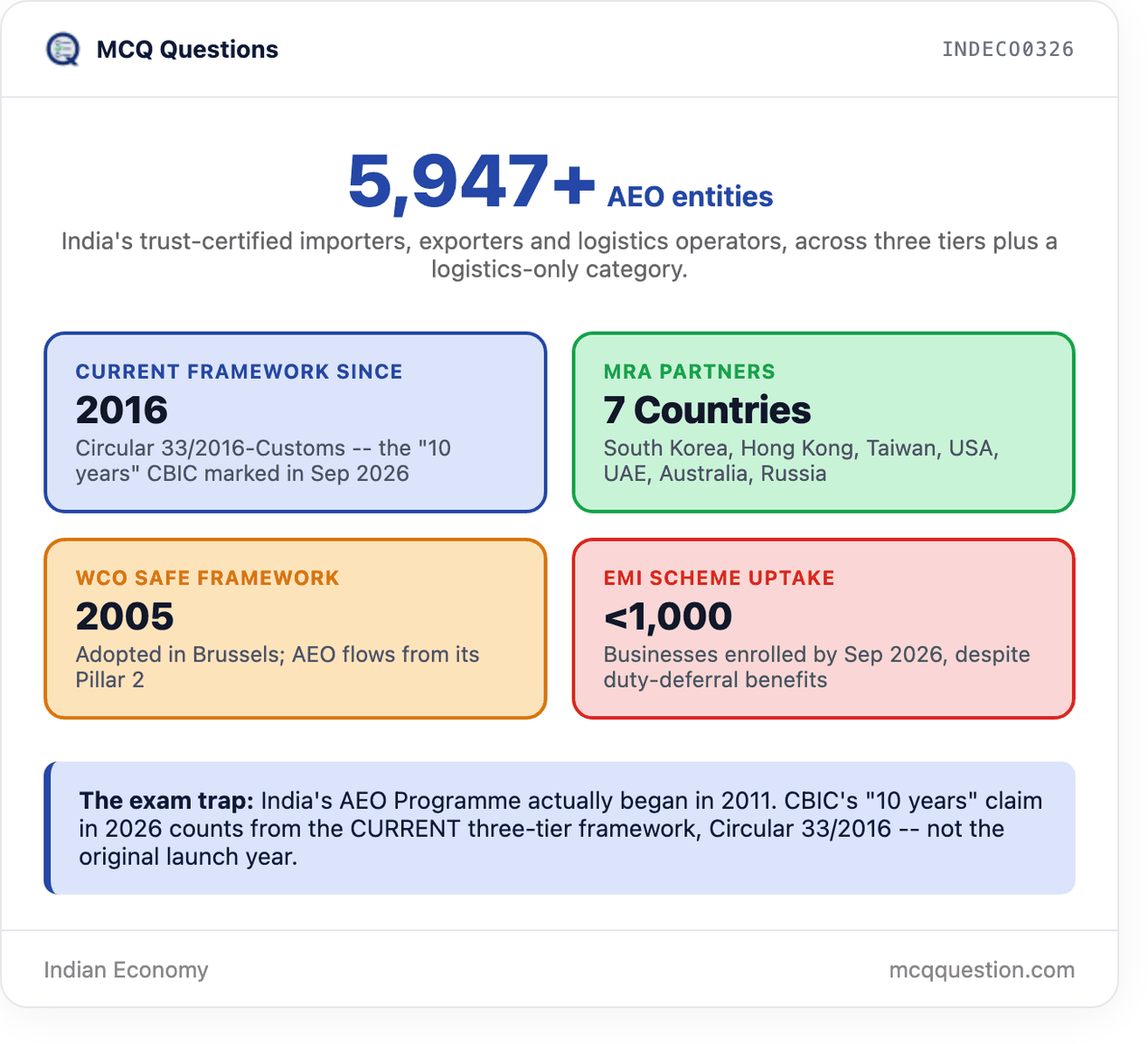
- OriginThe World Customs Organisation adopted the SAFE Framework of Standards in June 2005, at its Council Session in Brussels.
- GoalSAFE aims to secure global trade against threats like terrorism, while still keeping legitimate goods moving fast.
- Three PillarsSAFE has three pillars: Customs-to-Customs, Customs-to-Business, and Customs-to-Government-Agencies.
- Where AEO FitsAEO status flows specifically from Pillar 2, Customs-to-Business, the pillar built on trust between Customs and traders.
- Why It MattersBecause AEO follows a shared global template, an AEO-certified business can be recognised by other countries too.
Mutual Recognition, and India’s AEO Scale
- What MRA DoesA Mutual Recognition Arrangement lets two countries’ customs authorities recognise each other’s AEO status.
- India’s PartnersIndia has signed AEO MRAs with South Korea, Hong Kong, Taiwan, the USA, the UAE, Australia, and Russia.
- Real BenefitAn Indian AEO’s shipment can get faster clearance in a partner country too, not just at home.
- Scale TodayIndia had more than 5,947 AEO-certified entities as of late 2024, across all tiers.
- Don’t ConfuseAEO status is a customs trust certification for cross-border trade. It is separate from GST registration, which is a domestic tax registration, even though CBIC administers both systems.
Great to Know
The Newer Pieces
The EMI Scheme: A Stepping Stone Nobody Took Yet
- AnnouncedThe Union Budget 2026-27 announced the Eligible Manufacturer Importer (EMI) Scheme, effective 1 April 2026.
- What It DoesEMIs can clear imported goods without paying customs duty upfront, and pay it monthly instead.
- Why It ExistsCBIC frames EMI as a natural pathway toward higher AEO tiers, rewarding manufacturers for early compliance.
- The TwistFewer than 1,000 businesses had enrolled by September 2026, despite the real cash-flow benefit on offer.
- The FixCBIC responded on 15 September 2026 by cutting required documents from 10 to just 3, to boost uptake.
From Transaction-Centric to Trust-Oriented Customs
- The Old ModelOlder customs administration checked every transaction on its own merits, treating every shipment as a fresh risk.
- The New ModelCBIC now frames its approach as risk-based and trust-oriented, built around programmes like AEO.
- Why It MattersA trusted, pre-verified operator needs far less individual scrutiny at the border, freeing up Customs to focus checks elsewhere.
- The Trade-OffThis model rewards businesses for proving compliance upfront, rather than Customs re-verifying every single shipment.
- RelatedFor India’s broader trade-facilitation architecture, see IndEco0243 — The National Logistics Policy.
Current Affairs
📰 AEO@10
AEO@10: CBIC’s September 2026 Milestone Event
- 16 Sep 2026CBIC marked “AEO@10” in New Delhi, bringing together policymakers, industry, and WCO experts.
- The Real AnniversaryThe “10 years” refers to the current AEO framework, Circular 33/2016-Customs, dated 22 July 2016 — not the programme’s actual 2011 origin.
- Five Big IdeasCBIC’s Chairman outlined five priorities for the next decade: technology-driven facilitation, MSME inclusivity, inter-agency coordination, more MRAs, and synergy across indirect-tax systems.
- New Feedback ChannelCBIC launched a structured feedback form on the AEO portal, for continuous input from certified entities.
- SourcePIB, 16 September 2026.
✅ Test Yourself

PYQ
Exam Point of View
Exam Point of View: Why AEO Is a Rising Topic
- Not Yet Directly TestedNo confirmed UPSC prelims question has directly tested AEO’s own rules or tier names so far.
- Why It Could ChangeTrade facilitation and customs modernisation fit GS Paper III’s economy syllabus, and CBIC has actively pushed AEO into the news in 2026.
- The Real TrapWatch for a date trap: AEO India started in 2011, but CBIC’s “10 years” milestone (2026) counts from the 2016 framework circular instead.
- A Second TrapDon’t confuse AEO’s T1/T2/T3/LO tiers with GST registration categories — they sit under different laws, even though CBIC runs both.
Beyond the answer
Browse all indian-economy topics →
📚 Keep reading
Polity0150 — Directorate of Revenue Intelligence (DRI)ModHist0356 — Lord William Bentinck: Sati, English Education and ReformIndEco0302 — Social CapitalArtnCulture0073 — The Ram Mandir, AyodhyaIndEco0275 — Edible Oil Production in India❓ Practice this topic
D4533 — The Eligible Manufacturer Importer (EMI) Scheme let importers defer customs duty to monthly payments — but by September 2026, how many businesses had actually enrolled, prompting CBIC to cut required documents from 10 to 3?D4532 — India's AEO Programme is built on which pillar of the WCO's SAFE Framework of Standards?D4531 — Which of these correctly matches an AEO tier with the group it covers?D4530 — CBIC's "AEO@10" event in September 2026 marked ten years since which milestone?🎲 Take a Indian Economy Quiz
Leave a Reply