Under Rajasthan’s sand dunes lie 180-million-year-old fossil tree trunks. Above them, one of the world’s rarest flying birds is fighting to survive.


 MCQ Questions
IndGeo0099
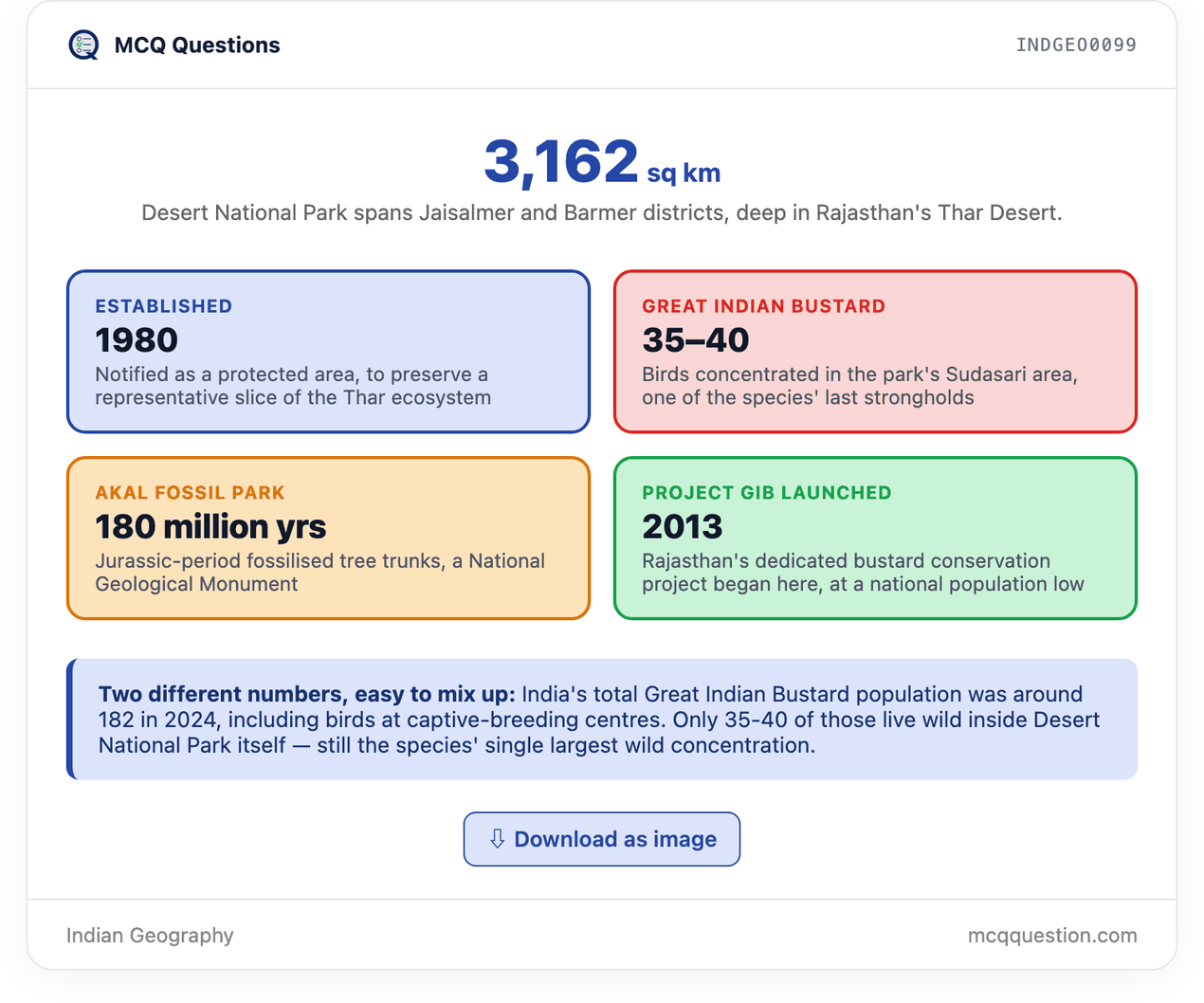
3,162 sq km
Desert National Park spans Jaisalmer and Barmer districts, deep in Rajasthan’s Thar Desert.
Established
1980
Notified as a protected area, to preserve a representative slice of the Thar ecosystem
Great Indian Bustard
35–40
Birds concentrated in the park’s Sudasari area, one of the species’ last strongholds
Akal Fossil Park
180 million yrs
Jurassic-period fossilised tree trunks, a National Geological Monument
Villages Inside
73+
Unlike many national parks, this one still has real human settlements within its bounds
Two different numbers, easy to mix up: India’s total Great Indian Bustard population was around 182 in 2024, including birds at captive-breeding centres. Only 35-40 of those live wild inside Desert National Park itself — still the species’ single largest wild concentration.
🏛️ Must Know
Location, Size, and Terrain
- Two Districts Desert National Park covers about 3,162 sq km, across Jaisalmer district (1,900 sq km) and Barmer district (1,262 sq km) in Rajasthan.
- Established in 1980 It was established in 1980, to protect a representative stretch of the Thar Desert ecosystem.
- Varied Terrain Sand dunes, rocky outcrops, and salt lake beds all appear within the park.
- Real Human Habitation Unlike many strictly protected parks, Desert National Park has real human habitation inside it. Over 73 villages and hamlets sit within its boundaries.
The Great Indian Bustard and the Fossil Park
- A Critical Stronghold The park is one of the last strongholds of the Great Indian Bustard. This critically endangered bird is found only in India and Pakistan.
- Sudasari’s Concentration Most of the park’s bustards, about 35 to 40 birds, live in its Sudasari area.
- Akal Wood Fossil Park The park also holds the Akal Wood Fossil Park. Its tree trunks fossilised around 180 million years ago, in the Jurassic period.
- A Recognized Monument Akal Wood Fossil Park is recognised as a National Geological Monument and a Biodiversity Heritage Site.
Good to Know
📘 Good to Know
The Great Indian Bustard’s Long Decline
- A Steep Fall India’s Great Indian Bustard population fell sharply over decades. It went from over 1,000 birds to 745 by 1978, then kept dropping to just 125 by 2013.
- Project Great Indian Bustard The Rajasthan government launched Project Great Indian Bustard on 5 June 2013, based at Desert National Park. This was a direct response to that decline.
- A Partial Recovery By 2024, the national population had recovered somewhat, to roughly 182 birds, including some raised at captive-breeding centres.
Geology and a Nearby River
- The Luni River The Luni River flows near the park’s wider desert region. It drains into the Rann of Kachchh’s salt marshes rather than the sea.
- Marine Fossils Too The park’s fossil beds also preserve marine fossils, evidence that a sea once covered this now bone-dry landscape.
📝 Previous Year Questions
UPSC CSP 2020 — What’s True About Desert National Park
- UPSC 2020 Desert National Park is genuinely spread over two districts, and is genuinely a Great Indian Bustard habitat. But it does have human habitation inside it, so that specific claim is false. See UPSC CSP 2020 GS Paper I, Q95. View this question.
Test Yourself

.jpg)

Great to Know
🌟 Great to Know
Two Numbers, and Two Kinds of “Old,” Easy to Mix Up
- National Count vs Park Count Don’t conflate India’s total Great Indian Bustard count with the park’s own resident population. The national figure, around 182 in 2024, includes captive-bred birds elsewhere.
- The Park’s Own Population Desert National Park’s own wild population is much smaller, at 35-40 birds, concentrated specifically in its Sudasari area.
- Ancient Fossils, Recent Settlement The park holds two very different kinds of “old” at once. Its fossils are around 180 million years old, from the Jurassic period. Its human settlement patterns, by contrast, are far more recent.
- Broader Desert Context This park sits within a much larger desert. See IndGeo0001 — The Thar Desert: Extent, Landforms and Human Adaptation.
Leave a Reply