Kerala’s average income is nowhere near the richest in India, yet it consistently tops the country’s human development rankings. That gap between income and development is the whole point of this chapter.
This article covers the four approaches to measuring development and why Indian states with similar incomes can have very different human development outcomes.
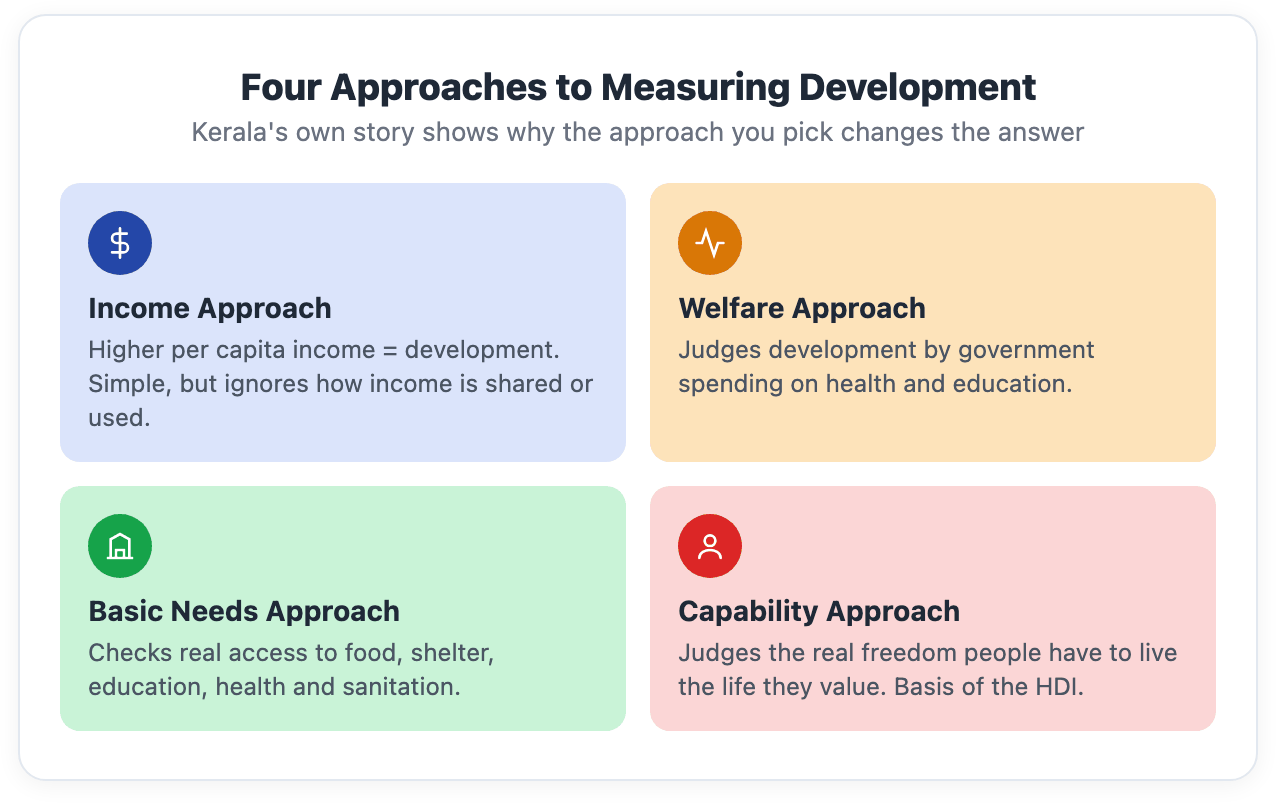
Four Approaches to Measuring Development
Kerala’s own story shows why the approach you pick changes the answer
Income Approach
Higher per capita income = development. Simple, but ignores how income is shared or used.
Welfare Approach
Judges development by government spending on health and education.
Basic Needs Approach
Checks real access to food, shelter, education, health and sanitation.
Capability Approach
Judges the real freedom people have to live the life they value. Basis of the HDI.
🏛️ Must Know
Four Approaches to Measuring Development
- Income ApproachThis treats a higher per capita income as the same thing as development. It is simple to measure, but it says nothing about how that income actually gets used or shared.
- Welfare ApproachThis judges development by how much a government spends on welfare, like health and education. It treats people as beneficiaries of state spending, rather than active participants.
- Basic Needs ApproachThis focuses on whether people actually have access to a fixed list of essentials. These are food, shelter, education, health, drinking water and sanitation, regardless of income level.
- Capability ApproachThis judges development by the real freedoms people have to live the life they value, not by income or state spending alone. It underlies the modern Human Development Index used worldwide.
Why States With Similar Incomes Differ So Much
- Income Doesn’t Guarantee DevelopmentTwo states can have similar per capita income, yet one invests that income heavily in public health and schooling while the other does not. The difference shows up directly in each state’s human development ranking.
- Historical Investment DifferencesStates that invested early and consistently in health and education infrastructure tend to keep that advantage for decades. Building schools, hospitals and trained staff simply takes far longer than raising income.
- Governance and Social PrioritiesHow a state government chooses to spend its budget matters. So does how effectively that spending actually reaches people, just as much as how much money is available in the first place.
📘 Good to Know
The Kerala Model
- High Human Development, Modest IncomeKerala has long topped India’s human development rankings, despite a per capita income that is not the country’s highest. This gap between income rank and development rank is exactly why development cannot be measured by income alone.
- What Kerala Did DifferentlyDecades of sustained public investment in health and education are the main reasons usually given for Kerala’s outcomes. High female literacy and land reforms also get credit.
- The Trade-OffKerala’s model has also faced criticism for slower industrial and economic growth compared to its social achievements. This shows that no single approach captures every side of development perfectly.
- A Real Example: Ernakulam, 1990On 4 February 1990, Ernakulam became India’s first fully literate district, under the “Lead Kindly Light” campaign run by the district administration and the Kerala Sastra Sahitya Parishad. Kerala itself was declared India’s first fully literate state just over a year later, on 18 April 1991. (Source: The South First)
Closing the Gap: The Aspirational Districts Programme
- The Problem It TargetsEven within a single state, some districts lag far behind others on health, education and basic infrastructure. This mirrors the same gap that shows up between different states.
- The ProgrammeLaunched in 2018, the Aspirational Districts Programme identifies India’s most underdeveloped districts and tracks their progress on health, education, agriculture and infrastructure indicators specifically.
- Why It Works DifferentlyRather than giving these districts more money alone, the programme focuses on improving how existing government schemes are actually implemented on the ground. This addresses the same governance gap that separates high- and low-development states.
- A Real Example: Chandauli’s Black RiceChandauli, an Aspirational District in Uttar Pradesh, encouraged farmers to grow fertiliser-free organic black rice as part of its development push. The experiment succeeded well enough that Chandauli now exports this rice to countries including Australia and New Zealand. (Source: IBEF)
Exam Point of View
Exam Wisdom: The Four-Approach Mix-Up
- Watch ForExams like to test which approach a described policy or measurement actually reflects. A scheme measuring only per capita income growth is the income approach; one guaranteeing minimum food and shelter access is the basic needs approach.
- Watch ForDon’t assume a state with a high GDP automatically has high human development. Kerala’s own history is the standard counter-example exams use to test this exact misconception.
- Watch ForThe capability approach and the basic needs approach can sound similar, since both go beyond income. Basic needs focuses on a fixed list of essentials. The capability approach instead focuses on a person’s actual freedom to choose the life they value.
✅ Test Yourself

Beyond the answer
Browse all indian-geography topics →
📚 Keep reading
Economy0001 — National and Per Capita IncomeIndEco0016 — Growth versus Development, and How We Measure ItIndSoc0090 — India's Higher Education Sector: A Decade of GrowthIndEco0003 — Poverty, Employment and Income DistributionGK0035 — Kerala: Literacy, Backwaters, and the 2026 UDF Return❓ Practice this topic
D4357 — Which conservation measure specifically involves ploughing along a slope's natural contour lines to slow rainwater runoff?D4356 — Which type of land degradation occurs when excessive or poorly-drained irrigation raises the water table too close to the surface, drowning plant roots?D4355 — Dividing gross cropped area by net sown area gives which measure?D4354 — What does 'net sown area' represent?🎲 Take a Indian Geography Quiz
Leave a Reply