A 1909 law expanded India’s legislative councils. It also planted a seed that would grow into Partition decades later. This article covers the Indian Councils Act of 1909, the Morley-Minto Reforms.


Timeline
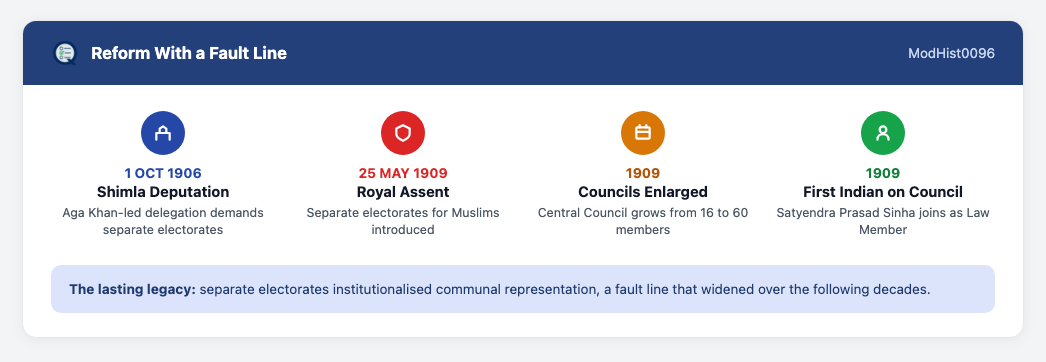
- 1 October 1906: A 35-member Muslim deputation, led by the Aga Khan, meets Viceroy Lord Minto at Shimla, demanding separate electorates.
- 25 May 1909: The Indian Councils Act receives royal assent, introducing separate electorates for Muslims.
- 1909: The Central Legislative Council is enlarged from 16 to 60 members; major provincial councils grow to around 50 members each.
- 1909: Satyendra Prasad Sinha becomes the first Indian appointed to the Viceroy’s Executive Council, as Law Member.
Must Know Need to Know
- The Indian Councils Act, 1909, known as the Morley-Minto Reforms, is named after Secretary of State John Morley and Viceroy Lord Minto.
- Its most consequential provision introduced separate electorates for Muslims — Muslim seats elected exclusively by Muslim voters.
- The Act enlarged the Central Legislative Council from 16 to 60 members. The Central Council itself kept an official majority, but major provincial councils gained a non-official majority.
- Satyendra Prasanna Sinha became the first Indian on the Viceroy’s Executive Council, appointed as Law Member.
Good to Know Good to Know
- The Shimla Deputation of 1 October 1906 argued Muslims deserved representation beyond their numerical strength, citing their contribution to imperial defence.
- Lord Minto is often called the “Father of the Communal Electorate,” for accepting the separate-electorate demand.
- The Act introduced indirect elections to fill the newly expanded council seats, rather than direct universal suffrage.
- Universities and certain other bodies were permitted to recommend and elect their own representatives to the councils under the Act.
Test Yourself

Great to Know Great to Know
- The 1909 Act is often read two ways at once. It was a genuine expansion of Indian participation in governance, but also a deliberate “divide and rule” move that formalised religion as a political category.
- Separate electorates set a precedent that shaped Indian constitutional debate for decades. The same basic demand resurfaced, in different forms, right up to Partition in 1947.
- Appointing Sinha to the Executive Council was largely symbolic at this stage. Genuine executive power remained firmly with British officials, but the appointment established that Indians could hold such posts at all.
- The Act shows how colonial “reform” could expand formal participation. At the same time, it deepened the very divisions that later made a unified independence movement harder to sustain.
- For a later, unrelated conference also held at Shimla, see ModHist0102 — The Wavell Plan and Shimla Conference, 1945.
Beyond the answer
Browse all modern-indian-history topics →
📚 Keep reading
ModHist0093 — Colonial Administrative Structure of British IndiaPolity0339 — Zonal Councils of IndiaGovernors-General and Viceroys of India (1773-1947)ModHist0006 — The Indian Councils Acts of 1861 and 1892IndGeo0077 — Hill Stations of India❓ Practice this topic
Between 1946 and 1948, the Nizam of Hyderabad's own irregular militia waged a separate campaign of terror against his opponents, including the peasant movement. Who led this militia, known as the Razakars?In Parliament in 1963, Ram Manohar Lohia sharpened his critique of Congress-era poverty with a famous claim. What did he say?In which year did Ram Manohar Lohia found the Socialist Party?Ram Manohar Lohia evaded arrest for nearly two years after going underground in 1942. In which year was he finally arrested?🎲 Take a Modern Indian History Quiz
Leave a Reply