Population education teaches people about population growth, family size and reproductive health.
It links demographic facts to everyday choices about family and well-being.


Must Know
What Population Education Is and Its Objectives
What population education means
- DefinitionPopulation education is a planned learning process about population matters.
- ScopeIt covers population growth, family size and reproductive health.
- OriginUNESCO shaped the term “population education” in the late 1960s.
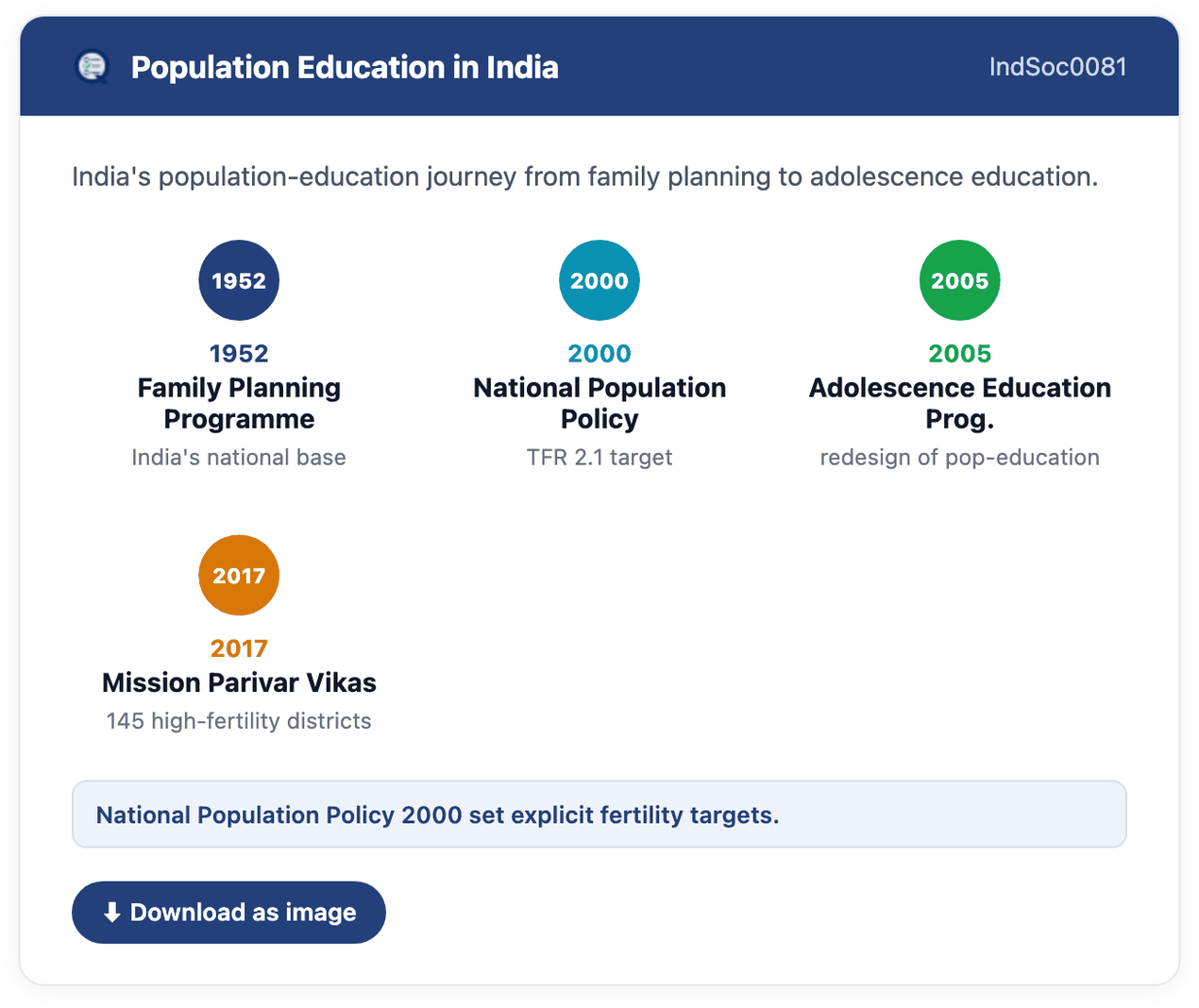
- RootsIndia’s 1952 family planning programme gave it a national base.
- EthosIt informs choices rather than imposing any single family size.
The core objectives
- AwarenessIt builds awareness of population problems and their causes.
- AttitudesIt develops rational attitudes towards family size and the small-family norm.
- DynamicsIt teaches births, deaths and migration as population dynamics.
- HealthIt spreads knowledge of reproductive health and family planning methods.
- TimingIt promotes delayed marriage and healthy spacing between children.
- EqualityIt encourages gender equality and women’s empowerment in family decisions.
- LinksIt connects population growth with development, resources and the environment.
Who the objectives serve
- StudentsSchool curricula carry the main burden of population education.
- YouthCo-curricular clubs reinforce the message among young people.
- AdultsCommunity programmes reach couples beyond the classroom.
- GoalThe ultimate aim is a better quality of life for all.
Good to Know
Measures to Achieve the Objectives in India
School curriculum and textbooks
- ProgrammeNCERT ran the Population Education Programme from 1980 with UNFPA support.
- RedesignIn 2005 it became the Adolescence Education Programme.
- IntegrationPopulation themes appear in social science, science and language textbooks.
- TeachersSCERTs and DIETs train teachers to handle sensitive topics.
- SkillsLessons cover puberty, relationships and responsible decision-making.
Youth and community channels
- NSSNSS, NCC and Scouts spread population awareness among students.
- ClubsSchool clubs organise rallies, quizzes and poster competitions.
- FolkStreet plays and folk songs carry messages into villages.
- CampsAwareness camps link young people with health services.
Family planning services as measures
- EvolutionThe 1952 programme grew into the National Family Welfare Programme.
- PolicyThe National Population Policy 2000 set clear national targets.
- TargetsIt aimed at a TFR of 2.1 and lower child and maternal deaths by 2010.
- FocusMission Parivar Vikas (2017) concentrates on 145 high-fertility districts.
- WorkersASHA workers counsel families at their doorsteps.
- MethodsThe basket includes condoms, pills, IUCDs and injectables.
Mass media and IEC campaigns
- MediaRadio, television and digital platforms spread family planning messages.
- IconsCampaigns like “Hum Do Hamare Do” popularised the small-family norm.
- Serial“Main Kuch Bhi Kar Sakti Hoon” promoted women’s health on national television.
- VernacularRegional and folk media reach non-literate audiences.
- PillarInformation, education and communication is a policy pillar.
Legal and social measures
- MarriageThe Prohibition of Child Marriage Act 2006 strengthens legal protection.
- SelectionThe PCPNDT Act 1994 bans sex-selective abortion.
- GirlsBeti Bachao Beti Padhao (2015) boosts girls’ education and survival.
- SchoolingGirls’ education is the strongest known driver of smaller families.
- RightsFamily planning is treated as a matter of informed choice.
Test Yourself


Great to Know
History, Data and the Road Ahead
The journey since 1952
- StartIndia launched the world’s first national family planning programme in 1952.
- BacklashCoercive excesses in the 1970s damaged public trust in the programme.
- RenameIn 1977 it was renamed the Family Welfare Programme.
- EducationThe 1980 Population Education Programme carried the message into schools.
- PolicyThe 2000 National Population Policy reshaped the national approach.
- TodayMission Parivar Vikas and FP2030 commitments guide current work.
Data that guides the effort
- SourcesCensus, SRS and NFHS supply the demographic evidence.
- NFHSNFHS-5 (2019-21) recorded India’s total fertility rate at 2.0.
- MeaningA TFR of 2.1 is the replacement level for a stable population.
- TargetingDistrict-level data sharpens messages for high-fertility regions.
- TestingRegular surveys test whether awareness turns into action.
Challenges that remain
- PreferenceSon preference still skews family decisions in some states.
- MarriageTeenage marriage and early pregnancy persist in parts of India.
- AccessUnmet need for contraception stays high among the poor.
- GapAwareness does not always convert into service use.
- TrustPast coercion still colours attitudes in some communities.
The way forward
- SkillsStrengthen life-skills and reproductive health education in schools.
- MediaUse digital and vernacular media for targeted messaging.
- ServicesPair education with accessible and quality health services.
- AgentsInvolve men and community leaders as agents of change.
- EthosKeep the focus on rights, dignity and informed choice.
PYQ
Previous Year Questions
2021 Mains — GS Paper I
- Mains 2021UPSC CSM 2021 GS Paper I, Q18 — View this question
- AskThe question demands objectives and measures in one answer.
- PlanDefine population education, list objectives, then measures.
- TipCite NPP 2000 targets and NCERT’s programme for marks.
📚 Related Articles
Beyond the answer
Browse all indian-society topics →
📚 Keep reading
IndEco0013 — Planning Commission and Five Year PlansIndSoc0090 — India's Higher Education Sector: A Decade of GrowthIndEco0015 — Planning Models and Resource MobilizationIndEco0014 — Objectives, Strategies and Outcomes of Indian PlanningLord William Bentinck: Sati, English Education and Reform❓ Practice this topic
D0401 — Arrange these agreements in chronological order: 1. Framework Agreement 2. Mizo Accord 3. Bodo Accord 2020 4. Karbi Anglong AgreementD0400 — The Bodo Accord of January 2020 was signed with the ABSU and NDFB factions. What did it establish?D0399 — The Framework Agreement of August 2015 between the Government of India and NSCN(IM) is significant because it:D0398 — Mizoram became a full state of India in 1987. Which accord had ended the Mizo insurgency just before that?🎲 Take a Indian Society Quiz
Leave a Reply