Regional disparity means unequal development across India’s regions. People often confuse it with diversity, but the two ideas are very different.

Must Know
Regional Disparity: Meaning, the Diversity Difference and the Scale of the Problem
What regional disparity means
- DefinitionRegional disparity means unequal development across regions.
- MeasureIncome, health, education and infrastructure differ sharply.
- ScopeSome states and districts stay far behind the national average.
- NatureIt is a measurable gap in living standards and opportunities.
- BasisComparisons use per-capita income, poverty and literacy rates.
How disparity differs from diversity
- MeaningDiversity is variety in languages, faiths, cuisines and climates.
- KindDiversity describes difference in kind, not difference in level.
- LevelDisparity describes difference in development and opportunity.
- ValueDiversity enriches society; disparity deprives people of options.
- ResponseDiversity needs celebration; disparity needs correction.
- TrapConfusing them hides real inequality behind natural variety.
Why the distinction matters
- IdentityIndia is a land of great cultural and linguistic diversity.
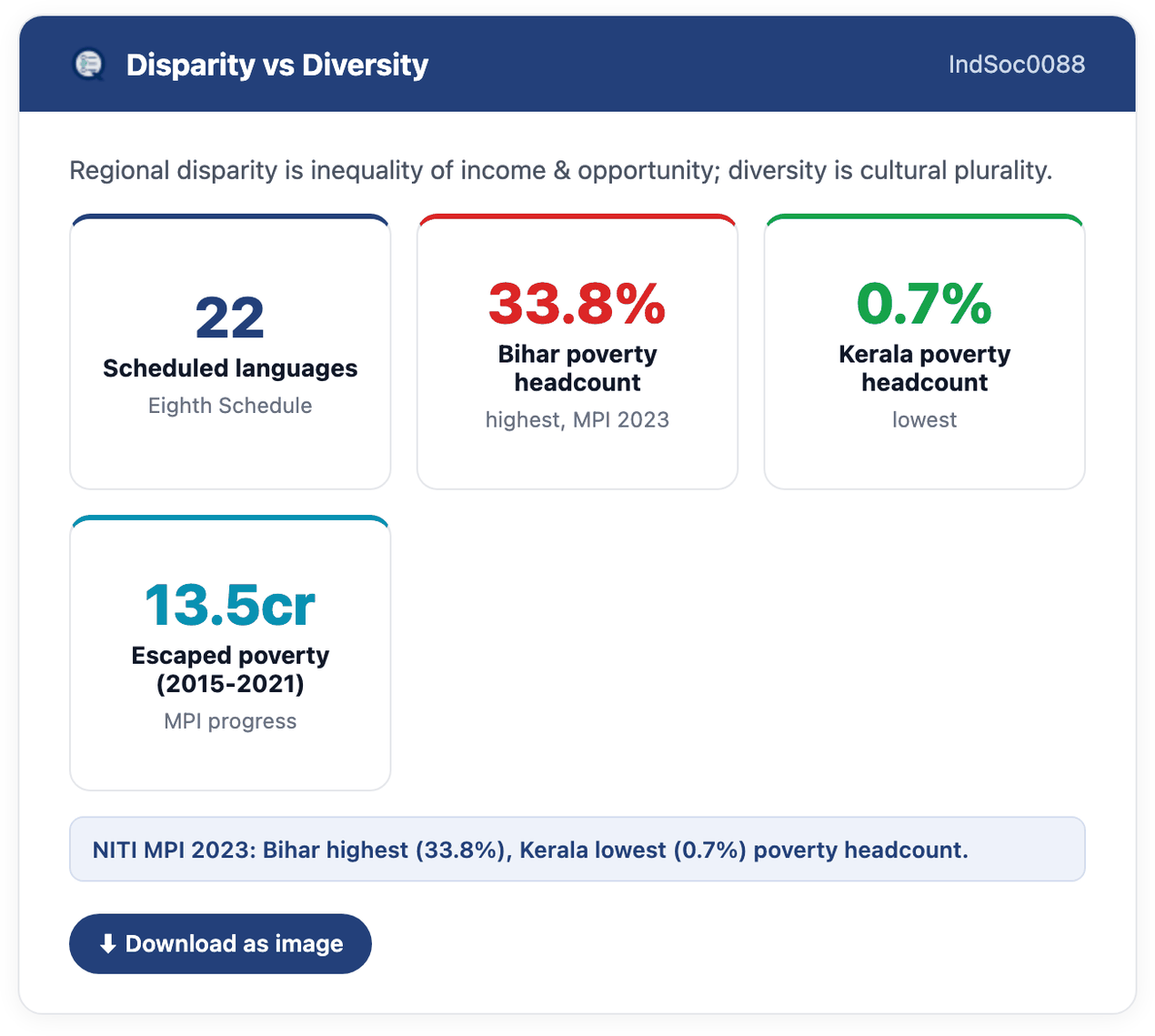
- ConstitutionThe Eighth Schedule recognises 22 scheduled languages.
- Unity“Unity in diversity” is a core national ideal.
- ProblemDisparity is uneven development, not a cultural trait.
- ExamUPSC asks candidates to separate the two clearly.
How serious the issue is
- ScaleThe gaps are large, old and still visible today.
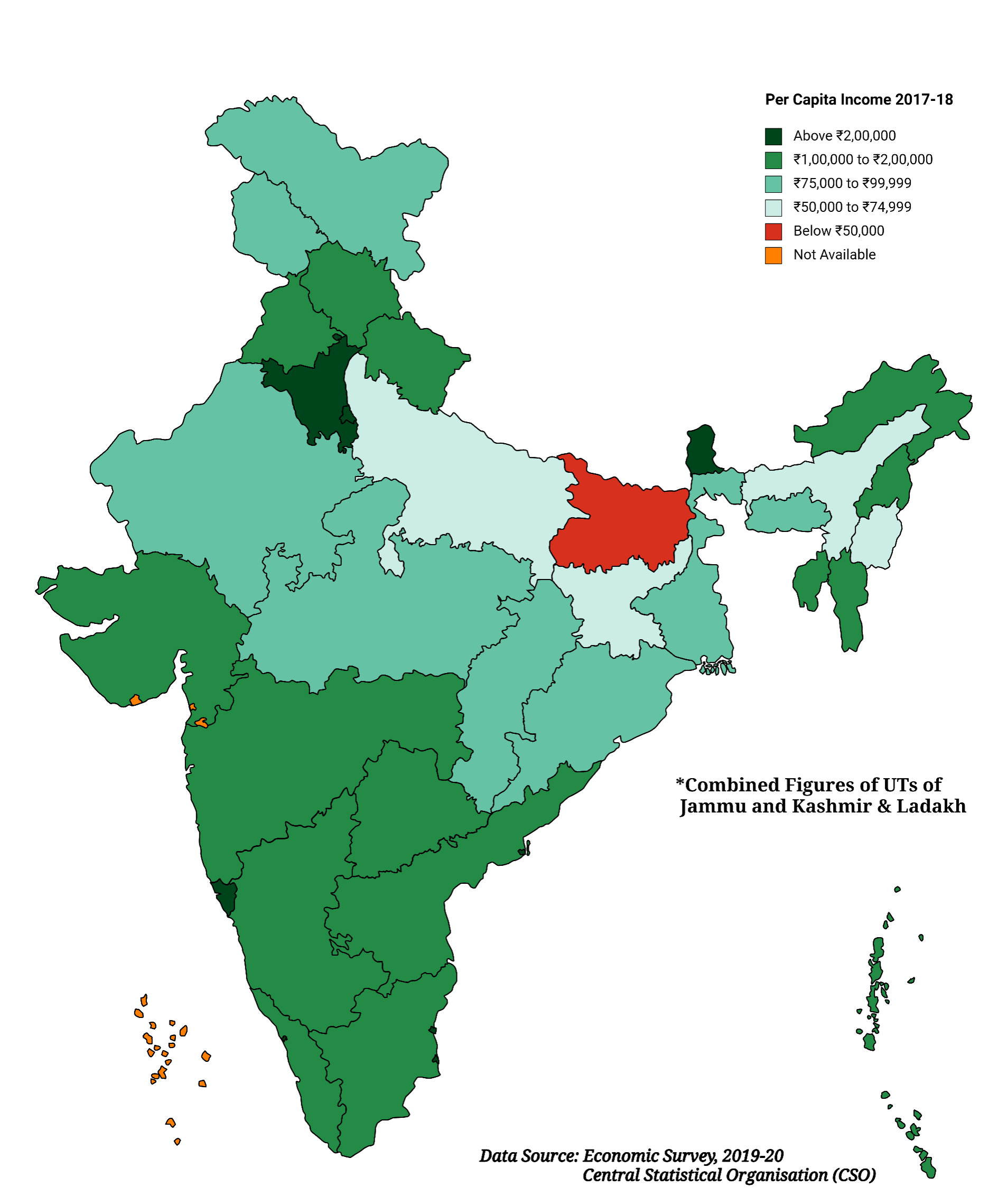
- IncomeThe richest state’s per-capita income is several times Bihar’s.
- PovertyMultidimensional poverty is concentrated in a few states.
- SpreadHealth and education gaps mirror the income divide.
- VerdictRegional disparity is among India’s biggest development failures.
Good to Know
The Evidence: Data, Causes and Persistent Divides
Income gaps across states
- RankingSikkim tops state per-capita income in recent years.
- BottomBihar and Uttar Pradesh sit at the bottom of the list.
- RatioThe gap between top and bottom runs into multiples.
- TrendRicher states often grew faster after the 1991 reforms.
- ResultIncome differences widened in the decades after liberalisation.
The poverty map
- SourceNITI Aayog’s Multidimensional Poverty Index 2023 used NFHS-5 data.
- HighestBihar recorded the highest headcount at 33.76 per cent.
- LowestKerala recorded the lowest at just 0.71 per cent.
- FollowersJharkhand, Meghalaya and Madhya Pradesh came next.
- ProgressAbout 13.5 crore people exited poverty between 2015-16 and 2019-21.
- RemainderThe poorest states still hold most of India’s poor.
Education and health divides
- LiteracyCensus 2011 put Kerala’s literacy at about 94 per cent.
- GapBihar’s literacy stood near 62 per cent.
- HealthInfant mortality varies widely between states.
- EAGEight Empowered Action Group states carry the heaviest burden.
- GeographyThe divide broadly runs between east and south.
Why the gap persists
- HistoryColonial rule built railways, ports and industry unevenly.
- GeographyHilly and landlocked states face higher costs.
- PolicyEarly planning placed heavy industry in a few states.
- FlowCapital and talent move toward already-prosperous regions.
- StructurePoor states lean heavily on low-productivity agriculture.
Test Yourself


Great to Know
Responses, the Convergence Debate and an Answer Skeleton
Fiscal tools for fairness
- DevolutionFinance Commissions share tax money with poorer states.
- ShareThe Fifteenth Finance Commission gave states 41 per cent.
- FormulaIts formula weights income distance most, at 45 per cent.
- GrantsArticle 275 allows grants to states in need of assistance.
- PastThe Backward Regions Grant Fund once aided lagging districts.
Programmes for lagging regions
- DistrictsThe Aspirational Districts Programme began in 2018.
- CoverIt covers 112 districts with the weakest indicators.
- BlocksThe Aspirational Blocks Programme added 500 blocks in 2023.
- ConnectivityPM Gati Shakti (2021) plans coordinated infrastructure.
- FocusSpecial schemes target the northeast and hill regions.
The convergence debate
- DivergencePost-1991 growth widened gaps between rich and poor states.
- Catch-upSome studies now report signs of catch-up growth.
- BasePoor states grow from a very low income base.
- LimitsWeak health and education slow their progress.
- MigrationWorker migration shifts people toward better regions.
- RemittancesMoney sent home lifts poor households’ incomes.
Why disparity is more than a statistic
- PoliticsPerceived neglect has fed regional movements and statehood demands.
- IntegrationDisparity strains the sense of national unity.
- TalentIt traps talent in low-opportunity regions.
- CitizenshipDevelopment levels decide what the state can deliver.
- QuoteIn 2008, Montek Singh Ahluwalia likened India’s states to “28 different countries.”
A skeleton for the Mains answer
- Step oneDefine disparity and contrast it with diversity.
- Step twoCite one income figure and one poverty figure.
- Step threeExplain causes in history, geography and policy.
- Step fourJudge severity with balance and evidence.
- Step fiveClose with fiscal and programmatic remedies.
PYQ
Previous Year Questions
UPSC CSM 2024 — GS Paper I, Q17
- PYQUPSC CSM 2024 GS Paper I, Q17 — View this question
- AskThe question demands a definition, a distinction and a judgement.
- PlanSeparate disparity from diversity first, then weigh the evidence.
- TipQuote MPI 2023 and per-capita income figures to ground the answer.
📚 Related Articles
Beyond the answer
Browse all indian-society topics →
📚 Keep reading
IndEco0017 — Development Issues and ConcernsIndEco0003 — Poverty, Employment and Income DistributionEconomy0001 — National and Per Capita IncomeIndGov0011 — Poverty in a Changing India: Urbanization, Globalization and the Sen-Bhagwati DebateIndEco0016 — Growth versus Development, and How We Measure It❓ Practice this topic
D0401 — Arrange these agreements in chronological order: 1. Framework Agreement 2. Mizo Accord 3. Bodo Accord 2020 4. Karbi Anglong AgreementD0400 — The Bodo Accord of January 2020 was signed with the ABSU and NDFB factions. What did it establish?D0399 — The Framework Agreement of August 2015 between the Government of India and NSCN(IM) is significant because it:D0398 — Mizoram became a full state of India in 1987. Which accord had ended the Mizo insurgency just before that?🎲 Take a Indian Society Quiz
Leave a Reply