India and Pakistan have fought four separate wars since gaining independence from the same empire, in the same year. This article covers India-Pakistan relations: their shared origin, their wars, and the agreements that followed.

Timeline
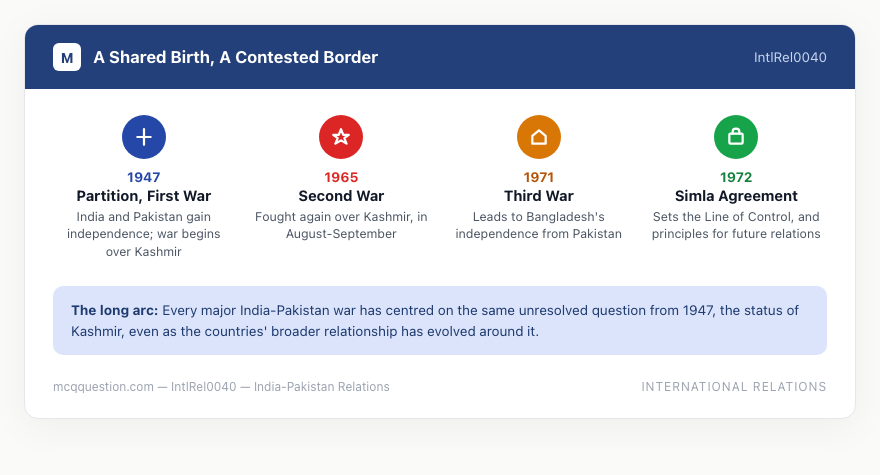
- 1947: British India is partitioned into India and Pakistan. War breaks out soon after, over Jammu and Kashmir.
- 1965: A second war is fought between August and September, again centred on Kashmir.
- 1971: A third war follows India’s support for Bangladeshi independence from Pakistan. It ends with Bangladesh becoming an independent nation.
- 1972: India and Pakistan sign the Simla Agreement. It establishes the Line of Control in Kashmir and sets principles for future relations.
- 2025: Terrorists kill 26 people at Pahalgam, Jammu and Kashmir, on 22 April. India responds with Operation Sindoor on 7 May, and a ceasefire follows on 10 May.
Must Know
- India and Pakistan gained independence together, through the 1947 Partition of British India.
- The two countries have fought four wars: in 1947-48, 1965, 1971, and 1999.
- The 1971 war led directly to the creation of Bangladesh, from what had been East Pakistan.
- The Simla Agreement, signed in 1972, established the Line of Control dividing Kashmir.
- The Line of Control is a ceasefire line, not a formally recognized international border.
- In May 2025, India launched Operation Sindoor, a calibrated military response, after the Pahalgam terror attack. Neither side formally declared war.
Good to Know
- The fourth conflict, the Kargil War, was fought in 1999. Pakistani troops had infiltrated Indian-administered areas of the Kargil district.
- Partition itself triggered mass migration and communal violence, with large-scale loss of life on both sides.
- The Simla Agreement was signed by Indira Gandhi and Zulfikar Ali Bhutto, the two countries’ leaders at the time.
- Unlike the earlier wars, the Kargil conflict stayed limited to a high-altitude area, rather than escalating into a full-scale war.
- On 22 April 2025, terrorists killed 26 people at Pahalgam, Jammu and Kashmir. The Resistance Front, linked to Lashkar-e-Taiba, claimed responsibility.
- India responded on 7 May 2025, with Operation Sindoor. Indian forces struck nine terror sites: four in Pakistan, and five in Pakistan-occupied Kashmir.
- The strikes hit Lashkar-e-Taiba and Jaish-e-Mohammed infrastructure, including their headquarters at Muridke and Bahawalpur. India called the strikes focused and non-escalatory, and did not target any Pakistani military facility.
- Pakistan responded with drone and missile strikes on Indian military installations, on 8 May. Hostilities ended with a ceasefire, reached on 10 May 2025.
- Kashmir has also been a long-running matter at the United Nations. India’s UN position on it has evolved over decades, reflecting shifting global alignments.
Test Yourself

Great to Know
- All four wars trace back to the same unresolved question from 1947: the final status of Kashmir. No single agreement has fully settled it.
- Choosing a ceasefire line, not a formal border, in the Simla Agreement kept the core dispute technically open. This shaped decades of relations that followed.
- The 1971 war shows how India-Pakistan relations aren’t purely bilateral. Regional politics, in that case East Pakistan’s own independence movement, can reshape the relationship entirely.
- Four wars in just over fifty years is an unusually high rate of conflict between two neighbours. Even other contested-border states rarely see this much repeated fighting.
- This dispute shares a structural pattern with India’s unresolved border dispute with China. Both are managed through ongoing diplomacy, rather than fully resolved.
Current Affairs
- On 18 July 2026, Defence Minister Rajnath Singh called Operation Sindoor proof of India’s defence readiness, at an event in New Delhi. He credited 12 years of defence-sector transformation. (Source: PIB)
- He said indigenous systems were used effectively during the operation. These included the Akash Teer and Akash missile systems, and BrahMos. (Source: PIB)
- Singh cited record indigenisation. Annual defence production reached about ₹1.78 lakh crore in FY 2025-26, up from ₹40,000 crore around 2014. (Source: PIB)
- Defence exports hit an all-time high of ₹38,000 crore, up from just ₹686 crore in FY 2013-14. (Source: PIB)
- He set new targets: ₹2 lakh crore in defence production this year, rising to ₹3 lakh crore by 2029. Defence exports are targeted to reach ₹50,000 crore by 2029. (Source: PIB)
- On 26 July 2026, at the 27th Kargil Vijay Diwas commemoration in New Delhi, Union Minister Dr. Jitendra Singh described the 1947 Partition as “the greatest blunder of history.”
- He said the retrieval of Pakistan-occupied Jammu and Kashmir (PoJK) remains the only pending issue between India and Pakistan. He cited Parliament’s unanimous 1994 Resolution, which declared PoJK an integral part of India.
- Singh linked Partition to the subsequent wars of 1947, 1965, 1971, and Kargil. He also cited the displacement of Kashmiri Pandits.
- He pointed to Jammu and Kashmir’s recent development as evidence that peace and development reinforce each other. This included rail connectivity to the Kashmir Valley, the world’s highest railway bridge, and new AIIMS institutions.
- On 9 August 2026, Rajnath Singh said Operation Sindoor sent a global message: India will go to any extent to protect its citizens. He credited the Defence Forces with eliminating Pakistan-based terrorists and their handlers. (Source: PIB)
Beyond the answer
Browse all international-relations topics →
📚 Keep reading
IndGeo0087 — Indian RailwaysIndEco0112 — Textile Industry in IndiaIndEco0126 — Blue Revolution: Fisheries and Aquaculture in IndiaGovernors-General and Viceroys of India (1773-1947)GenSci0027 — ICMR (Indian Council of Medical Research)❓ Practice this topic
On what date did India and Indonesia formally establish diplomatic relations?In what year did India recognise Israel, and in what year did the two countries establish full diplomatic relations?In what year did India and Japan establish diplomatic relations, through a Treaty of Peace?D0416 — Which event, eight years after Panchsheel, is often cited as the irony of the India-China framework of peaceful coexistence?🎲 Take a International Relations Quiz
Leave a Reply