A prescription that once cost a family a week’s wages can now cost a fifth of that. Over 20,000 stores across India make this happen daily.
 MCQ Questions
Jan Aushadhi Scheme
₹45,000 Cr
Saved by citizens over the scheme’s 12-year history
As informed to the Lok Sabha by the Union Minister for Chemicals and Fertilizers, 24 July 2026.
20,149 Kendras
As of 30 June 2026
Covering 776 of India’s 784 districts.
50-80% Cheaper
Than Branded Medicines
The scheme’s core affordability model.
2,110 Medicines
+315 Surgicals/Devices
The current Jan Aushadhi product basket.
80 → 20,149
Kendras Since 2014
Growth in outlet count over 12 years.
Must Know
- The Pradhan Mantri Bhartiya Janaushadhi Pariyojana (PMBJP) provides quality generic medicines at affordable prices. It sells them through dedicated retail outlets called Jan Aushadhi Kendras.
- The scheme was launched in November 2008, by the Department of Pharmaceuticals, Ministry of Chemicals and Fertilizers — the same ministry that also runs the Department of Chemicals and Petrochemicals, covered in IndEco0122. It was rebranded and expanded under its current name in 2016.
- The Bureau of Pharma PSUs of India (BPPI), later renamed the Pharmaceuticals and Medical Devices Bureau of India (PMBI), implements the scheme. It was set up in December 2008, and registered as an independent society in April 2010.
- Jan Aushadhi medicines are generally priced 50-80% lower than comparable branded medicines.
- The scheme has grown from just 80 stores in 2014, to over 20,000 Kendras today.
Good to Know
- The product basket spans major therapeutic categories: cardiovascular, anti-cancer, anti-diabetic, anti-infective, anti-allergic, and gastro-intestinal medicines, plus nutraceuticals, surgical items, and consumables.
- The government has set a target of 25,000 Jan Aushadhi Kendras by March 2027. Most of this growth is planned through a franchise-based expansion model.
- Nearly 60% of new Jan Aushadhi stores opened in the last three financial years are run by women entrepreneurs.
- The scheme now reaches nearly all of India’s districts. A small handful still have no Jan Aushadhi Kendra of their own.
Test Yourself

Great to Know
- Jan Aushadhi Diwas is observed every 7 March. It marks the day in 2019 when the observance was first launched, and a week-long “Janaushadhi Week” runs from 1-7 March each year.
- Kendra sales have grown roughly 270-fold: from ₹7.29 crore in 2014-15, to over ₹2,000 crore by February 2025.
- The scheme’s affordability model directly targets out-of-pocket health spending, a major driver of medical debt for low-income Indian households — a goal it shares with Polity0111 — Ayushman Bharat (PM-JAY), India’s flagship health-insurance scheme.
- Generic medicines contain the same active ingredients, in the same doses, as their branded equivalents. Indian drug regulators require them to meet the same quality and efficacy standards.
- Parliament’s own Standing Committee has examined healthcare affordability as a dedicated subject, well beyond just medicine prices. See GenSci0035 — Healthcare Affordability and Accessibility in India.
Current Affairs
- On 7 August 2026, in Lok Sabha replies, the government detailed the PLI Scheme for Pharmaceuticals. Of its ₹15,000 crore outlay, ₹6,659 crore had been disbursed by March 2026. (Source: PIB)
- Under the separate PLI Scheme for Bulk Drugs, 48 projects have been approved, against a ₹6,940 crore outlay. So far, 18 APIs have entered production, including Penicillin G and Atorvastatin, cutting import dependency. (Source: PIB)
- On drug pricing, the NPPA currently caps prices on 935 essential-medicine formulations. Their average price fell about 17%, after the 2022 National List of Essential Medicines revision. (Source: PIB)
- The NPPA has also fixed retail prices for 3,845 new drug variants. This stops manufacturers from selling them above the notified ceiling. (Source: PIB)
- On Jan Aushadhi sales specifically, the government reported ₹4,274.66 crore in total MRP sales, over the last two financial years. (Source: PIB)
- A day earlier, on 6 August 2026, the Health Ministry notified stricter Drugs Rules. Applicants who submit fake or fabricated data can now be debarred from filing fresh applications, for a set period. (Source: India Education Diary)
- On 4 August 2026, the government explained delays at the Bulk Drug Park in Haroli, Himachal Pradesh. Environmental clearance and tree-felling permissions, among other formalities, slowed the ₹1,000 crore project. (Source: The New Himachal)
- Separately, the Strengthening of Pharmaceuticals Industry scheme approved 16 pharma MSME units in Solan district in 2024-25, and 27 more in 2025-26. Support totalled ₹17.19 crore and ₹29.02 crore, respectively. (Source: IBG News)
- 31 July 2026: A Parliament reply detailed PACS involvement in the scheme.
- As on 30 June 2026, 846 Jan Aushadhi Kendras had opened under Primary Agricultural Credit Societies, with over 4,250 more PACS given initial approval.
- 31 July 2026: The reply also detailed NIPER, the scheme’s premier education and research arm.
- There are 7 National Institutes of Pharmaceutical Education and Research, all declared Institutions of National Importance.
- 31 July 2026: Separately, the Department amended the Drugs (Prices Control) Order, 2013, on 30 June 2026.
- The amendment eases compliance, letting other manufacturers adopt an already-approved price for 12 months without fresh approval.
- 31 July 2026: On the Haroli Bulk Drug Park, Parliament also got fuller project figures.
- Its total cost is Rs 1,923 crore, expected to create 15,000 to 20,000 direct jobs, and draw Rs 8,000 to 10,000 crore in investment.
- On 28 July 2026, the government detailed PMBJP’s own formal objectives. Beyond affordable medicines, these include popularising generics, menstrual-health access, and entrepreneurship-driven employment. (Source: PIB)
- On average, 15 lakh people visit Jan Aushadhi Kendras every day. (Source: PIB)
- PMBI monitors JAKs through a centralised IT system and field inspections. No separate district-level body oversees them. (Source: PIB)
- Other affordability schemes run alongside PMBJP. These include Ayushman Bharat’s ₹5 lakh health cover, and the Free Drugs Service Initiative at public hospitals. (Source: PIB)
- AMRIT Pharmacy stores add another layer, discounting medicines by up to 50%. (Source: PIB)
- On 24 July 2026, the government detailed JAKs’ quality-assurance system. Only WHO-GMP certified plants may supply medicines. (Source: PIB)
- Every batch gets 100% pre-testing, at NABL and GLP-compliant labs, before reaching any Kendra. (Source: PIB)
- Since September 2024, JAK owners earn a monthly incentive for stocking 200 commonly-used medicines — the scheme’s 100 top-sellers, plus 100 fast-selling market drugs. (Source: PIB)
- The supply chain itself runs on 5 warehouses, and a growing network of 42 distributors nationwide. (Source: PIB)
- A special one-time ₹2 lakh incentive applies to JAKs in North-Eastern states, Himalayan areas, and islands. (Source: PIB)
- It also covers Aspirational Districts, and JAKs run by ex-servicemen, women, divyangjan, or SC/ST applicants. (Source: PIB)
- Tamil Nadu alone has 1,631 JAKs. That includes 74 in the Kallakurichi Lok Sabha constituency. (Source: PIB)
- Of those 74, 62 sit in Salem district, and 12 in Kallakurichi district. (Source: PIB)
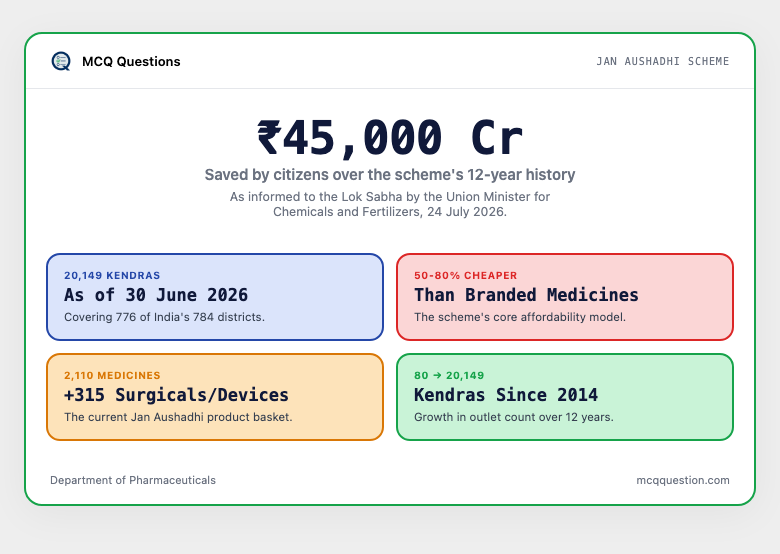
- On 24 July 2026, Union Minister for Chemicals and Fertilizers J.P. Nadda informed the Lok Sabha that Jan Aushadhi Kendras have saved citizens an estimated ₹45,000 crore, over the scheme’s 12-year history.
- As of 30 June 2026, 20,149 Jan Aushadhi Kendras were operational. They now cover 776 of India’s 784 districts.
- The scheme’s product basket stood at 2,110 medicines, plus 315 surgical items, medical consumables, and devices.
- These figures came from an official government factsheet on the scheme’s performance, presented in Parliament.
Leave a Reply