A king was once refused an invitation to a dance performance. So he created a new dance form of his own, one still performed 350 years later.
 MCQ Questions
Kathakali
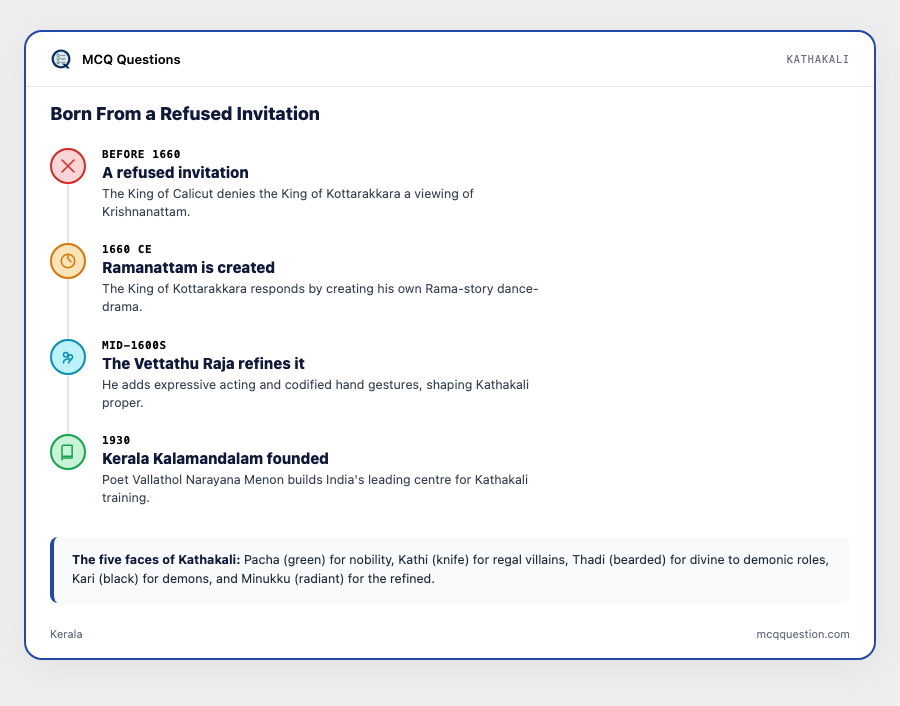
Born From a Refused Invitation
Before 1660
A refused invitation
The King of Calicut denies the King of Kottarakkara a viewing of Krishnanattam.
1660 CE
Ramanattam is created
The King of Kottarakkara responds by creating his own Rama-story dance-drama.
Mid-1600s
The Vettathu Raja refines it
He adds expressive acting and codified hand gestures, shaping Kathakali proper.
1930
Kerala Kalamandalam founded
Poet Vallathol Narayana Menon builds India’s leading centre for Kathakali training.
The five faces of Kathakali: Pacha (green) for nobility, Kathi (knife) for regal villains, Thadi (bearded) for divine to demonic roles, Kari (black) for demons, and Minukku (radiant) for the refined.
⬇ Download as image
Must Know
- Kathakali is a classical dance-drama from Kerala.
- It is known for elaborate, colourful makeup and costumes.
- Its stories are drawn mainly from the Ramayana and the Mahabharata.
- It is one of the eight classical dance forms recognised by the Sangeet Natak Akademi.
Good to Know
- Kathakali uses five main “vesham” styles, or coded makeup types, for its characters.
- “Pacha” (green) marks noble, heroic characters.
- “Kathi” (knife) marks villainous but still regal characters.
- “Thadi” (bearded) covers a range of characters, from divine to demonic, shown in different beard colours.
- “Kari” (black) marks demons and forest-dwelling characters.
- “Minukku” (radiant) is used for refined characters, including women, sages, and Brahmins.
- Performers train for years to master the form’s precise hand gestures, called mudras.
- Live percussion, led by the chenda drum, drives the performance’s rhythm.
Test Yourself

Great to Know
- In 1660 CE, the King of Kottarakkara created Ramanattam, a Rama-story dance-drama and Kathakali’s direct predecessor.
- He reportedly made it after the King of Calicut refused to let him view a Krishnanattam performance.
- Ramanattam itself drew on older traditions, including Kutiyattam, a Sanskrit theatre form.
- In the mid-17th century, the Raja of Vettathu reworked Ramanattam into what became Kathakali proper.
- He placed new emphasis on abhinaya (expressive acting) and on the form’s codified hand gestures.
- In 1930, the poet Vallathol Narayana Menon founded the Kerala Kalamandalam.
- It became India’s most important centre for training in Kathakali.
Beyond the answer
Browse all art-and-culture topics →
📚 Keep reading
GK0035 — Kerala: Literacy, Backwaters, and the 2026 UDF ReturnArtnCulture0142 — Vallathol Narayana MenonArtnCulture0098 — MohiniyattamArtnCulture0006 — Classical and Folk Dances of IndiaArtnCulture0094 — Kuchipudi❓ Practice this topic
D0421 — Which Director-General led the revival of the ASI under Lord Curzon in 1902?D0420 — Under which Ministry does the Archaeological Survey of India function?D0419 — Which Act governs the protection of monuments and archaeological sites of national importance in India?D0418 — Who is regarded as the founder and first Director-General of the Archaeological Survey of India?🎲 Take a Art And Culture Quiz
Leave a Reply