Hemu began his career selling vegetables. He rose to become the most powerful general of his age, won 22 battles in a row, and crowned himself Emperor of Delhi. He held that title for exactly one month.


Timeline
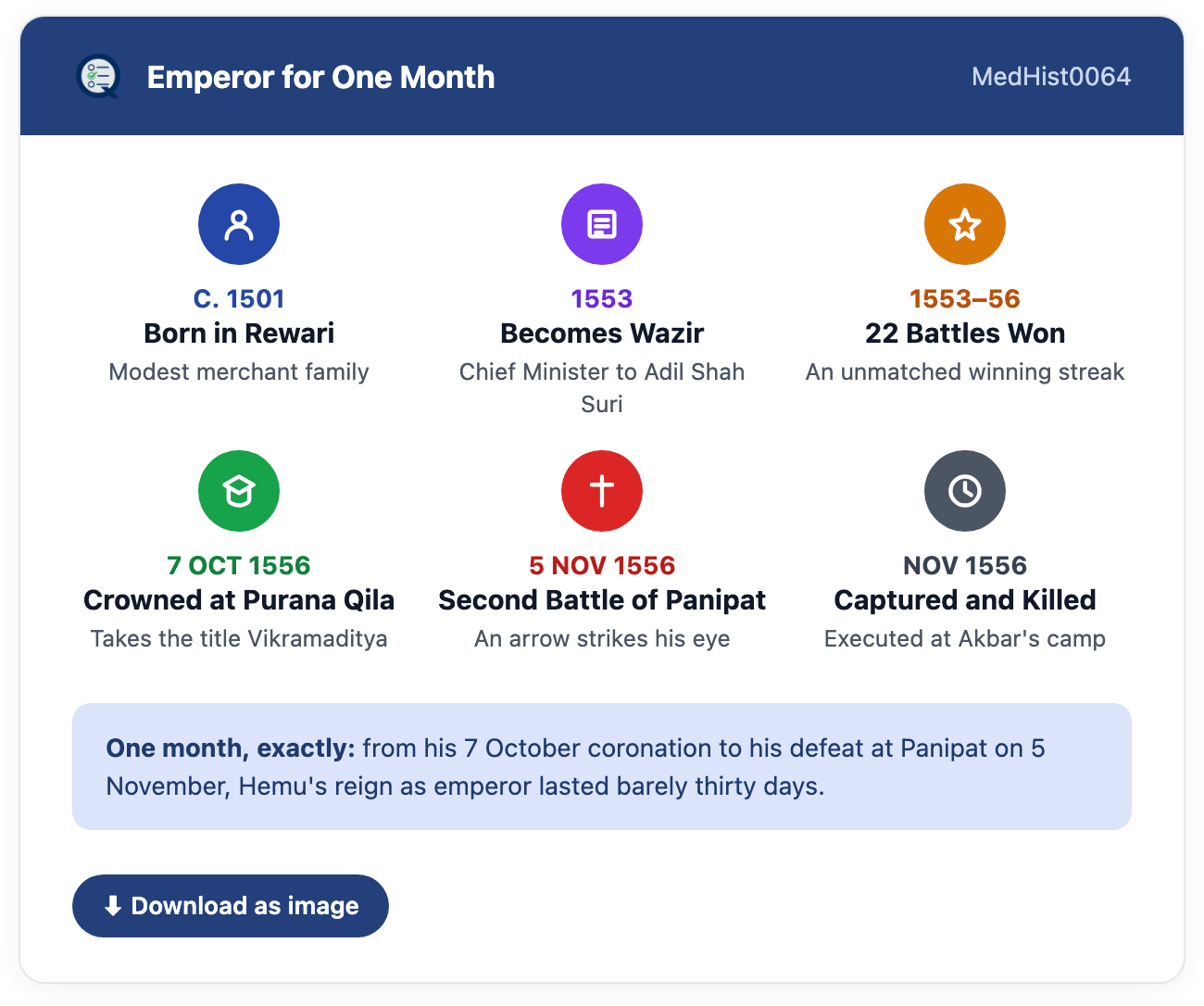
- c. 1501: Born in Rewari, in present-day Haryana, to a modest Hindu Vaishya family.
- Early career: Enters state service under the Suri dynasty. Rises through supply and market administration roles.
- 1553: Adil Shah Suri appoints him Wazir, or Chief Minister, of the Suri empire.
- 1553–1556: Wins 22 consecutive battles against Afghan rebels and Mughal forces.
- 7 October 1556: Wins his 22nd battle at Delhi against Humayun’s general Tardi Beg Khan. He is then crowned emperor at Purana Qila, taking the title Hem Chandra Vikramaditya.
- 5 November 1556: Fights the Second Battle of Panipat against Akbar’s forces. An arrow strikes his eye, and he loses consciousness.
- November 1556: Captured and executed. Historical accounts disagree on whether Akbar or his regent Bairam Khan struck the fatal blow.
From Grain Merchant to Chief Minister Need to Know
- Hemu (c. 1501–1556), born Hem Chandra, came from a modest Hindu Vaishya family in Rewari. His father was a petty grain merchant.
- Hemu began his own working life supplying provisions to the army, before rising steadily through administrative and market-control roles under the Suri dynasty.
- In 1553, Adil Shah Suri appointed him Wazir (Chief Minister) and effectively handed him control of both military command and civil administration.
- Between 1553 and 1556, Hemu won 22 consecutive battles, an unmatched record for the period. He fought Afghan rebels across North India, and Mughal forces at Agra and Delhi.
Emperor for One Month Need to Know
- Hemu’s 22nd victory, on 7 October 1556, defeated Humayun’s general Tardi Beg Khan at Delhi.
- He was crowned emperor that same day at Purana Qila, taking the title “Hem Chandra Vikramaditya.”
- His coronation is sometimes described as briefly restoring Hindu rule in Delhi, following roughly 350 years of Muslim rule in the city.
- His reign lasted barely a month: from his 7 October coronation to his defeat at the Second Battle of Panipat on 5 November.

Panipat and a Contested Death Good to Know
- At the Second Battle of Panipat on 5 November 1556, an arrow struck Hemu in the eye. He lost consciousness, and his army scattered once its leader fell.
- His regent Bairam Khan wanted the 13-year-old Akbar to personally kill the captured Hemu, so the young emperor could claim the title of Ghazi.
- What actually happened next is disputed among historical accounts. Some say Akbar refused to strike a helpless, dying man, so Bairam Khan beheaded Hemu himself. Others say Akbar did follow Bairam Khan’s urging and struck the blow.
- For Akbar’s own reign, see MedHist0057 — Akbar: Life and Reign. For the earlier Suri dynasty Hemu served, see MedHist0013 — Babur, Humayun and Sher Shah Suri.
Test Yourself



Legacy Great to Know
- After his death, Hemu’s body was gibbeted at Purana Qila, the very site of his coronation just weeks earlier.
- Hemu’s rise shows how far merit and administrative skill could carry someone in Suri-era North India, regardless of birth.
- His month-long reign is a rare, sharply-bounded case in Indian history. A dramatic rise and an equally sudden fall, both fully documented.
- The dispute over who killed him is a small but real reminder. Even a well-documented battle can leave its final, most dramatic moment unsettled.
Beyond the answer
Browse all medieval-indian-history topics →
📚 Keep reading
MedHist0057 — Akbar: Life and ReignMedHist0013 — Babur, Humayun and Sher Shah SuriMedHist0061 — Sher Shah SuriMedHist0014 — Akbar's EmpireModHist0004 — The Decline of the Mughal Empire: Causes Behind the Collapse❓ Practice this topic
During which two Mughal emperors' reigns did Tavernier make his six voyages to India, between 1630 and 1668?The 115-carat rough diamond Tavernier acquired in 1666 was later cut down and sold to Louis XIV as which famous diamond?In which year did Tavernier publish “Les Six Voyages,” recording diamond prices and mining techniques from his travels?Jean-Baptiste Tavernier's book gave the first detailed European technical description of which diamond mines?🎲 Take a Medieval Indian History Quiz
Leave a Reply