Most Mughal princes fought for the throne in their twenties or thirties. This one won it at 63 – and then spent his short reign trying to undo his father’s legacy.

Timeline
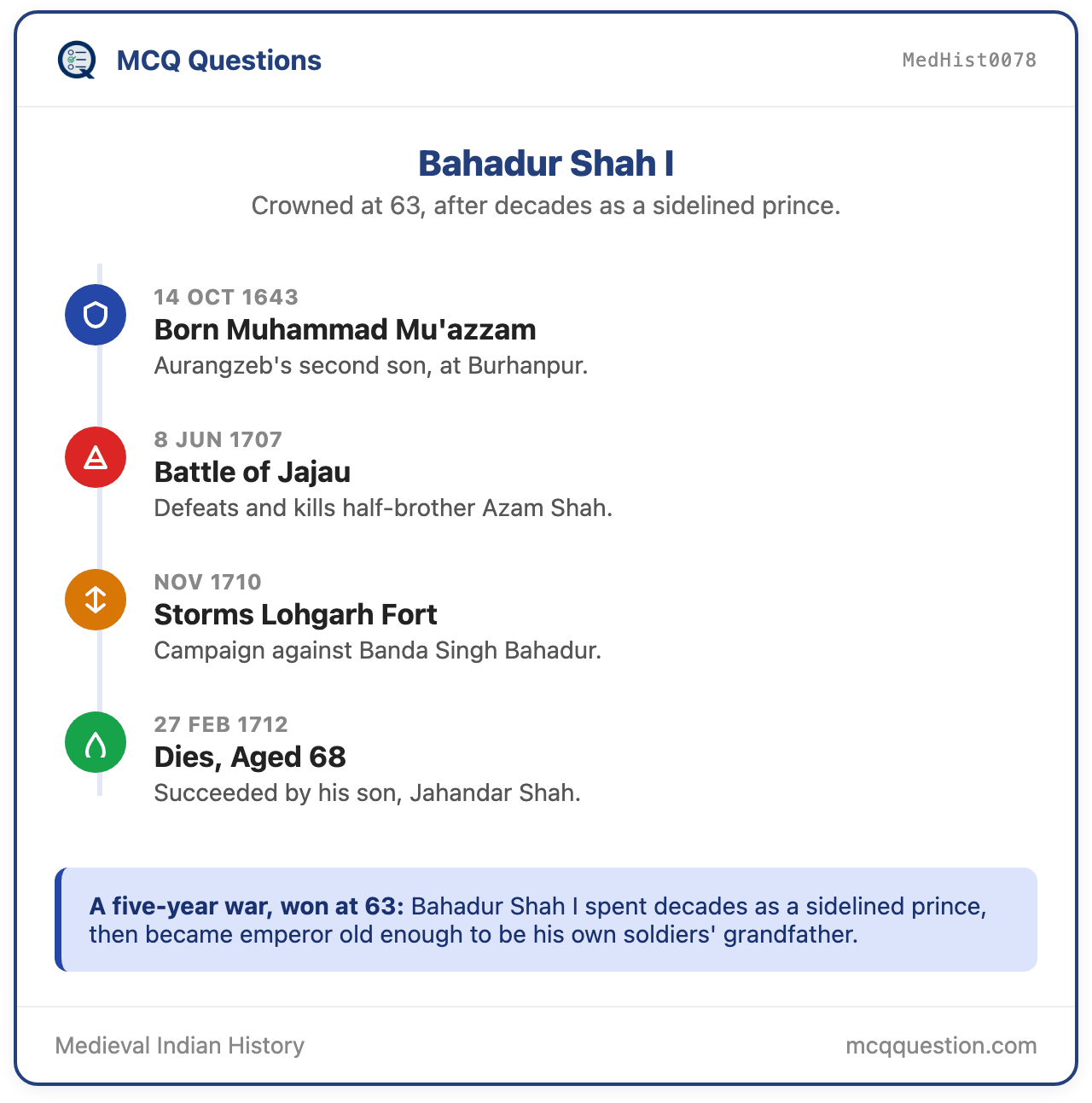
- 14 October 1643: Born Muhammad Mu’azzam, Aurangzeb’s second son, at Burhanpur.
- 8 June 1707: Wins the Battle of Jajau, defeating and killing his half-brother Azam Shah.
- 19 June 1707: Crowned emperor as Bahadur Shah I, also known as Shah Alam I, at age 63.
- November 1710: Personally leads an assault on Lohgarh fort, against Banda Singh Bahadur’s Sikh uprising.
- 27 February 1712: Dies of an enlarged spleen. His son Jahandar Shah succeeds him, after another war of succession.
From Prince Mu’azzam to Emperor Need to Know

- Muhammad Mu’azzam was born on 14 October 1643, Aurangzeb’s second son.
- His elder brother, Muhammad Sultan, died in captivity in 1676. This made Mu’azzam the eldest surviving son by the time Aurangzeb died.
- Aurangzeb died on 3 March 1707, triggering a war of succession among his surviving sons.
- Mu’azzam, then governor of Kabul, marched south and met his half-brother Azam Shah at Jajau, near Agra, on 8 June 1707.
- Bahadur Shah had more artillery, and part of Azam Shah’s army deserted in the summer heat. Azam Shah and his son Bidar Bakht were both killed in the battle.
- A contingent of Sikh soldiers, sent by Guru Gobind Singh, fought on Mu’azzam’s side at Jajau.
- He was crowned on 19 June 1707, taking the title Bahadur Shah I (also called Shah Alam I) – usually counted as the seventh Mughal emperor.
A Different Kind of Mughal Ruler Need to Know
- Aurangzeb’s nearly 49-year reign had been marked by rigid religious orthodoxy and constant warfare, especially in the Deccan.
- Bahadur Shah I took a visibly different approach, favouring reconciliation over confrontation with the empire’s rivals.
- He signed peace treaties with two major Rajput rulers: Jai Singh of Amber and Ajit Singh of Marwar (Jodhpur), restoring their titles and territories.
- He also made peace with Guru Gobind Singh, the tenth Sikh Guru, granting him a mansab (an official Mughal rank) after Jajau.
- Guru Gobind Singh accompanied Bahadur Shah on a campaign into the Deccan, in 1707-08.
- Historians generally see this conciliatory approach as a deliberate break from his father’s policies, not merely a lack of time to act otherwise.
The Sikh Question He Couldn’t Resolve Good to Know
- In October 1708, Guru Gobind Singh was stabbed by an assassin at Nanded, in the Deccan, reportedly sent on the orders of Wazir Khan, the Mughal governor of Sirhind.
- Bahadur Shah sent his own English surgeon to treat the Guru’s wounds, but they reopened, and the Guru died on 7 October 1708.
- Before his death, Guru Gobind Singh had commissioned Banda Singh Bahadur to lead an armed Sikh uprising in Punjab.
- From late 1709, Banda Singh Bahadur‘s forces captured Mughal territory, taking Sirhind itself in December 1710.
- Bahadur Shah personally marched north and led an assault on Banda Singh Bahadur’s stronghold at Lohgarh fort in November 1710.
- Banda Singh Bahadur escaped into the Himalayan foothills. Bahadur Shah’s forces pursued him as far as Kulu, but never captured him.
Test Yourself

Death and a Fading Empire Great to Know
- Bahadur Shah I died on 27 February 1712, of an enlarged spleen, aged 68.
- He was buried at the Moti Masjid in Mehrauli, Delhi, next to the dargah of the Sufi saint Qutb Sahib.
- His four sons immediately fought yet another war of succession. Jahandar Shah emerged as the winner.
- Historians often mark Bahadur Shah I’s reign as the start of the “Later Mughals” era, a period of rapid imperial decline that followed – covered in more detail in Mughal Decline After Aurangzeb.
- Some historians consider his short, conciliatory reign a genuine missed opportunity. A younger emperor pursuing the same policies might have slowed that decline.
- His own reconciliation policy could not survive him: succeeding emperors reverted to short, unstable, contested reigns, without his moderating approach.
Current Affairs
- Lohgarh fort, the site Bahadur Shah personally stormed in 1710, is now being developed as a major Sikh heritage site by the Haryana government. A foundation stone for a Baba Banda Singh Bahadur Memorial and museum at Lohgarh was laid in 2025, with the project’s foundation trust formally inaugurated that June. (Source: News on AIR)
Leave a Reply