India now runs the world’s third-largest metro network. It started with a single 3.4 km stretch in Kolkata, in 1984.
 MCQ Questions
IndEco0168
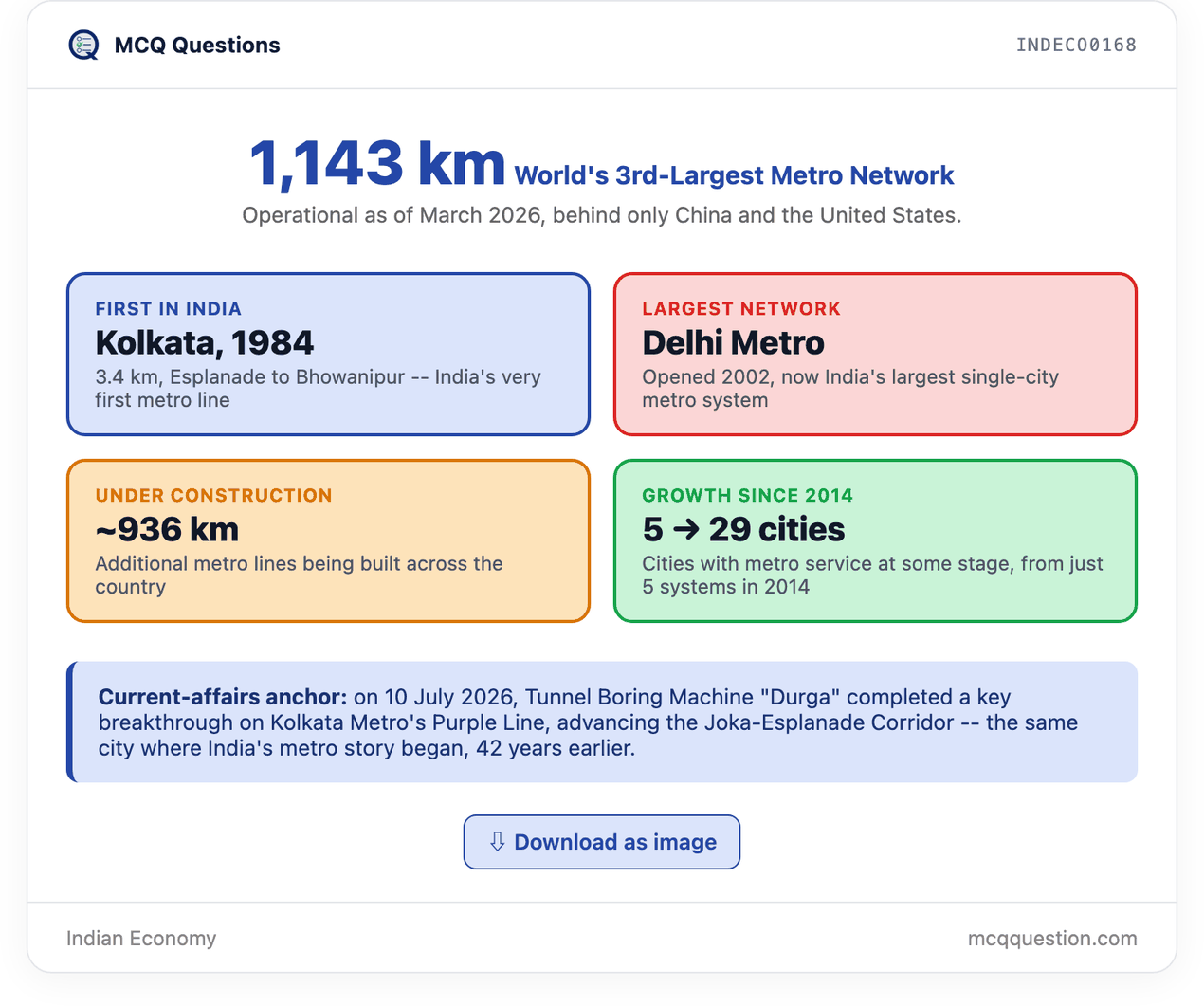
1,143 km World’s 3rd-Largest Metro Network
Operational as of March 2026, behind only China and the United States.
First in India
Kolkata, 1984
3.4 km, Esplanade to Bhowanipur — India’s very first metro line
Largest Network
Delhi Metro
Opened 2002, now India’s largest single-city metro system
Under Construction
~936 km
Additional metro lines being built across the country
Growth Since 2014
5 → 29 cities
Cities with metro service at some stage, from just 5 systems in 2014
Current-affairs anchor: on 10 July 2026, Tunnel Boring Machine “Durga” completed a key breakthrough on Kolkata Metro’s Purple Line, advancing the Joka-Esplanade Corridor — the same city where India’s metro story began, 42 years earlier.
Must Know
- Kolkata Metro opened India’s first metro line on 24 October 1984, a 3.4 km stretch between Esplanade and Bhowanipur.
- Kolkata Metro is the only Indian metro network run by Indian Railways. Every other Indian metro is run by its own autonomous state or city authority.
- Delhi Metro’s first line opened in December 2002, under E. Sreedharan, its Managing Director. It has since grown into India’s largest single-city metro network.
- By March 2026, India had over 1,143 km of operational metro lines. That makes India the world’s third-largest metro network, behind only China and the United States.
- On 10 July 2026, Tunnel Boring Machine “Durga” completed a key tunnel breakthrough on Kolkata Metro’s Purple Line. The breakthrough came between Khidderpore and Victoria, advancing the Joka-Esplanade Corridor.
Good to Know
- The Purple Line’s Joka-Esplanade Corridor spans 18.84 km. Its elevated Joka-Majerhat stretch is already operational, while the underground Majerhat-Esplanade section is still under construction.
- Once complete, Esplanade will become Kolkata’s first three-line interchange station, connecting the Purple, Blue, and Green lines.
- Other major systems include Mumbai Metro, Namma Metro in Bengaluru, Chennai Metro, and Hyderabad Metro.
- Hyderabad Metro is the world’s largest metro project built as a public-private partnership. It now runs 69.2 km, making it India’s second-largest operational metro network after Delhi.
- India’s metro systems have grown from just 5 cities in 2014 to 29 cities today, at some stage of metro development. About 936 km of additional lines are currently under construction.
Test Yourself

Great to Know
- The Metro Rail Policy, 2017, requires cities to prepare a Comprehensive Mobility Plan, and set up an Urban Metropolitan Transport Authority, before new metro projects get approved.
- The policy also pushes public-private partnerships in metro funding. Earlier systems, like Kolkata and Delhi, were built almost entirely with public money; newer expansions increasingly draw private capital too.
- India’s different city counts can be confusing. “29 cities” includes places at every stage, from fully operational lines to early planning — it doesn’t mean 29 cities already have running trains.
Leave a Reply