India tested a missile that can hit multiple targets at once, and started exporting another that travels at Mach 2.8. This article covers India’s missile technology programmes — Agni, BrahMos, and what their recent tests actually demonstrated.

Timeline
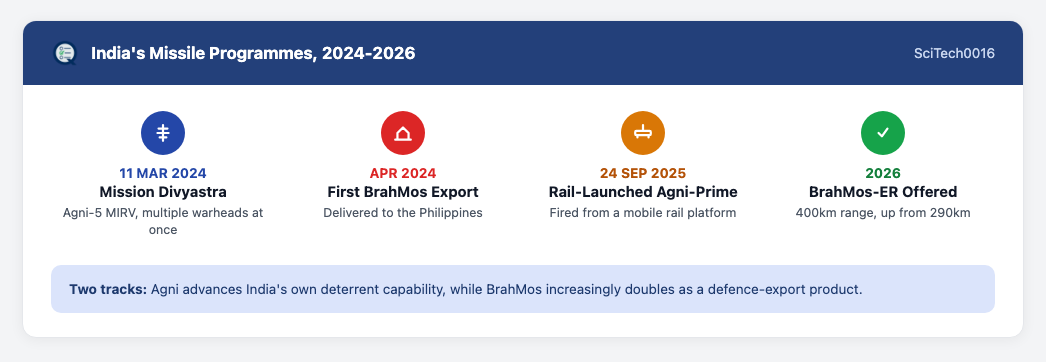
- 11 March 2024: Mission Divyastra — India’s first flight test of Agni-5 fitted with MIRV technology.
- April 2024: India delivers the first BrahMos battery to the Philippines, its first export customer.
- 24 September 2025: India test-fires Agni-Prime from a rail-based mobile launcher.
- 8 May 2026: A follow-up Agni MIRV flight test is conducted.
Must Know
- Agni-Prime is a two-stage, solid-fuel missile with a range of 1,000-2,000 km, launchable from road or rail platforms.
- On 24 September 2025, India test-fired Agni-Prime from a rail-based mobile launcher.
- Mission Divyastra (11 March 2024) was India’s first flight test of Agni-5 fitted with MIRV technology — letting one missile deliver multiple warheads to separate targets.
- Agni-5’s range exceeds 7,000 km, putting it in intercontinental ballistic missile (ICBM) class.
Good to Know
- BrahMos, a supersonic cruise missile jointly developed with Russia, travels at about Mach 2.8.
- The Philippines became BrahMos’s first export customer, in a $375 million deal signed January 2022, for three shore-based anti-ship batteries.
- India delivered the first BrahMos battery in April 2024, and the second in 2025.
- In 2026, India offered the Philippines BrahMos-ER, an extended-range variant reaching 400 km, up from the standard export range of 290 km.
Current Affairs
- 8 July 2026: DRDO successfully flight-tested the Pinaka Long Range Guided Rocket (LRGR). The test took place at the Integrated Test Range, Chandipur, covering a minimum range of 60 km. The rocket followed its predicted trajectory, hitting the target with precision. (Source: PIB)
- The rocket was fired from the in-service Pinaka launcher. This shows the same launcher can fire Pinaka variants of different ranges. DRDO’s Armament Research and Development Establishment designed the LRGR, with support from other DRDO labs. (Source: PIB)
Test Yourself

Great to Know
- MIRV technology isn’t really about hitting harder. It’s about defeating missile defence — multiple simultaneous warheads are far harder to intercept than one, even with the same total payload.
- Rail-mobile launch platforms, like Agni-Prime’s, matter strategically because they’re harder to track and target than fixed silos. That improves survivability, not just reach.
- BrahMos becoming an export product changes what these programmes mean. Some missile technology is now a foreign-policy and defence-export tool, not purely a domestic deterrent.
- For DRDO’s organisational history and how these programmes originated, see SciTech0011 — DRDO.
Leave a Reply