A club in her own city barred her people at the door. At 21, dressed as a man, she led the raid that answered it, then chose poison over capture.

Timeline
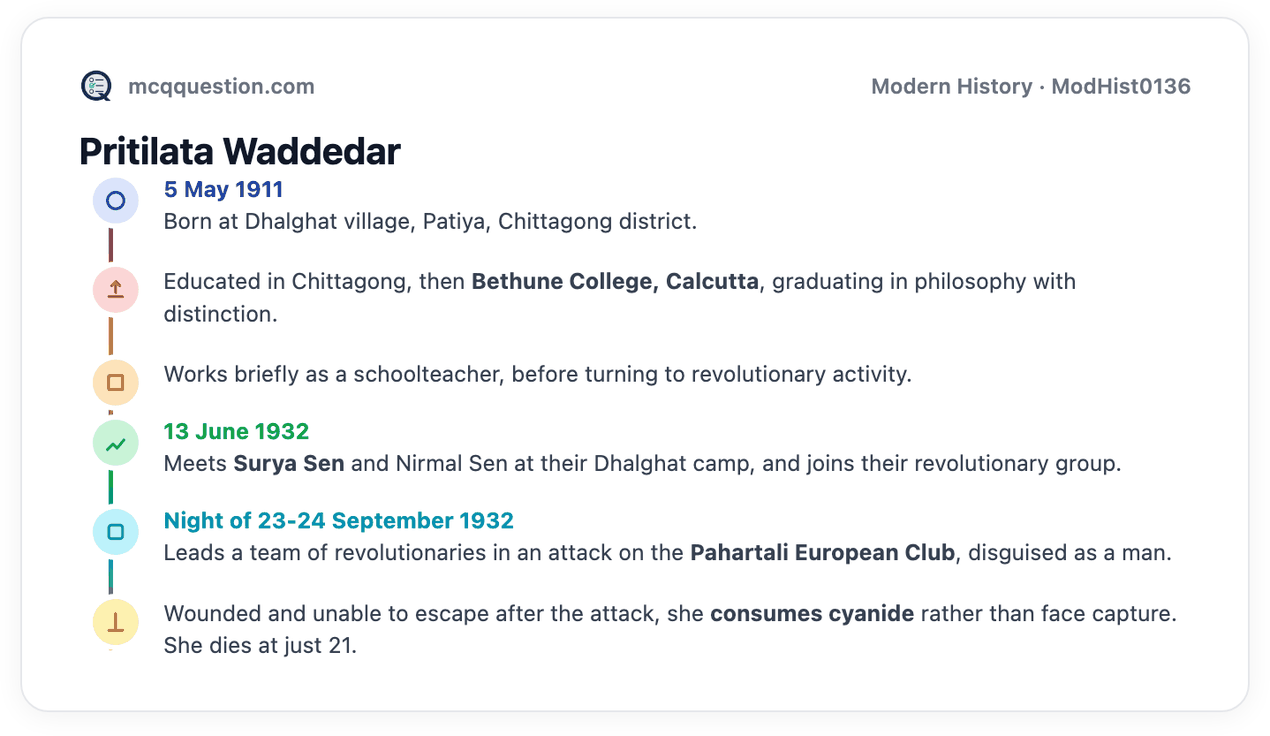
- 5 May 1911: Born at Dhalghat village, Patiya, Chittagong district.
- Educated in Chittagong, then Bethune College, Calcutta, graduating in philosophy with distinction.
- Works briefly as a schoolteacher, before turning to revolutionary activity.
- 13 June 1932: Meets Surya Sen and Nirmal Sen at their Dhalghat camp, and joins their revolutionary group.
- Night of 23-24 September 1932: Leads a team of revolutionaries in an attack on the Pahartali European Club, disguised as a man.
- Wounded and unable to escape after the attack, she consumes cyanide rather than face capture. She dies at just 21.
Must Know
- Pritilata Waddedar was born on 5 May 1911, at Dhalghat village in Chittagong district.
- She studied philosophy at Bethune College, Calcutta, graduating with distinction.
- She joined Surya Sen’s revolutionary group on 13 June 1932, after meeting him at his Dhalghat camp.
- On the night of 23-24 September 1932, she led a team of revolutionaries in an attack on the Pahartali European Club in Chittagong.
- The club barred Indians at its door; her raid directly targeted that racial exclusion.
- Wounded during the attack, she consumed cyanide to avoid capture, dying at the age of 21.
Good to Know
- Revolutionaries had initially objected to including women in the group. Sen’s circle reasoned that women carrying weapons would attract less police suspicion than men.
- On the night of the raid, she dressed as a man to move undetected toward the club.
- The Pahartali European Club barred Indians from entry, a standing symbol of racial exclusion under British rule.
- The attack killed one person and injured about a dozen others, before the revolutionaries retreated.
- Police later found a note on her body, declaring herself a revolutionary and rejecting surrender — now known as her “Do or Die” declaration.
Test Yourself

Great to Know
- She is widely regarded as the first woman martyr of India’s freedom struggle, honoured with the title “Bir Kannya,” or “Brave Daughter.”
- Her disguise as a man reflected a real tactical calculation, not just a personal choice. Women moving with arms drew far less suspicion from colonial police.
- She chose cyanide over capture, the same final choice Surya Sen’s other close associates made when cornered. This shows how deliberately the group had planned for this outcome, not left it to chance.
- Her raid came just months before Surya Sen’s own capture in 1933, marking one of the last major actions of the Chittagong uprising’s underground years.
- Bengal’s revolutionary underground had few women in armed roles. Her example directly inspired others, including Kalpana Dutta, who fought alongside her in the same network.
Beyond the answer
Browse all modern-indian-history topics →
📚 Keep reading
ModHist0129 — Surya SenModHist0068 — Bhagat Singh, Chandrashekhar Azad and Revolutionary NationalismModHist0185 — Ganesh GhoshLord Dufferin: The Founding of the Indian National CongressModHist0109 — Chandrashekhar Azad: The Vow of Azad❓ Practice this topic
The anti-Sikh violence that followed Indira Gandhi's assassination remained the subject of what, for decades afterward?Who became Prime Minister immediately after Indira Gandhi's assassination on 31 October 1984?Which Sikh religious structure inside the Golden Temple complex suffered major damage during Operation Blue Star?Who commanded the assault on the Golden Temple complex during Operation Blue Star in June 1984?🎲 Take a Modern Indian History Quiz
Leave a Reply