Bir Tikendrajit commanded the Manipuri army when it defied a British mission sent to arrest him. The resulting Anglo-Manipur War of 1891 ended in his public execution, on a date Manipur still observes as Patriots’ Day.
 mcqquestion.com
Modern History · ModHist0143
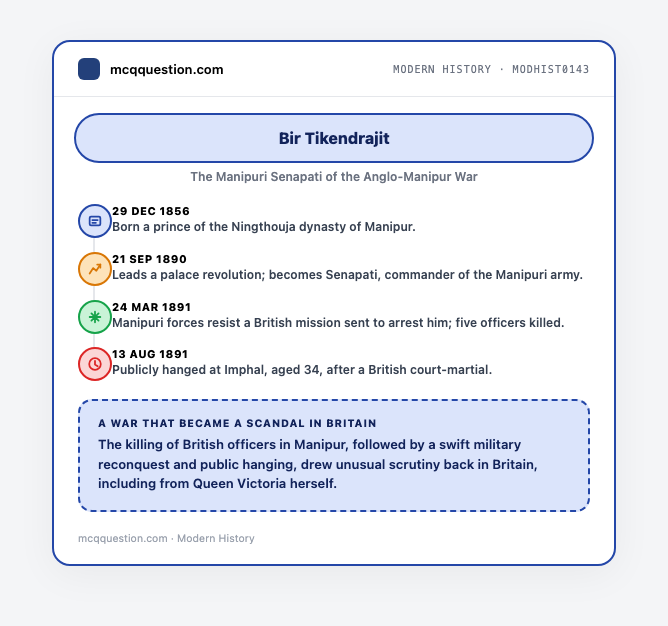
Bir Tikendrajit
The Manipuri Senapati of the Anglo-Manipur War
29 Dec 1856
Born a prince of the Ningthouja dynasty of Manipur.
21 Sep 1890
Leads a palace revolution; becomes Senapati, commander of the Manipuri army.
24 Mar 1891
Manipuri forces resist a British mission sent to arrest him; five officers killed.
13 Aug 1891
Publicly hanged at Imphal, aged 34, after a British court-martial.
A war that became a scandal in Britain
The killing of British officers in Manipur, followed by a swift military reconquest and public hanging, drew unusual scrutiny back in Britain, including from Queen Victoria herself.
Must Know
- Bir Tikendrajit Singh was born on 29 December 1856, a prince of Manipur’s Ningthouja dynasty.
- On 21 September 1890, he led a palace revolution. His brother, Maharaja Surachandra Singh, was pushed to abdicate and leave Manipur.
- Another brother, Kulachandra Singh, became the new Raja. Tikendrajit, as Senapati (commander), held real power as head of the Manipuri army.
- Surachandra appealed to the British for help. The British agreed to recognise Kulachandra as Raja, but ordered Tikendrajit’s arrest.
- On 24 March 1891, J.W. Quinton, Chief Commissioner of Assam, arrived in Manipur with troops to enforce this arrest.
- Manipuri soldiers resisted. Five British officers, including Quinton and Political Agent Frank Grimwood, were killed in the resulting violence.
- The British sent a larger military force in response. It took the Kangla Palace on 27 April 1891, ending organised resistance.
- Tikendrajit was arrested on 23 May 1891, tried, and sentenced to death. He was publicly hanged at Imphal on 13 August 1891, aged 34.
Good to Know
- Tikendrajit was hanged alongside Thangal General, another senior Manipuri leader convicted in the same trial.
- Raja Kulachandra Singh was also sentenced to death, but this was commuted to transportation for life.
- Ethel Grimwood, widow of the slain Political Agent, was consulted by Queen Victoria on the question of Tikendrajit’s execution. She said she did not hold him personally responsible for her husband’s death, though she believed he had committed other offences.
- After the war, Manipur became a British princely state. A minor, Churachand Singh, was placed on the throne.
- The execution site, Pheida-pung in Imphal, was later renamed Bir Tikendrajit Park.
- 13 August is observed in Manipur as Patriots’ Day, marking the executions of Tikendrajit and Thangal General.
Test Yourself

Great to Know
- The Anglo-Manipur War is unusual among 19th-century colonial conflicts. A local army briefly defeated and killed senior British officials, before the empire’s greater resources reasserted control.
- Queen Victoria’s own involvement in reviewing Tikendrajit’s case shows how closely the empire watched this conflict, compared to many smaller regional uprisings.
- Tikendrajit’s story is less widely known outside Northeast India than many other 19th-century resistance leaders, despite the scale of British loss of life involved.
- Patriots’ Day remains an active annual observance in Manipur today, keeping Tikendrajit’s memory alive well beyond the region’s own borders.
Beyond the answer
Browse all modern-indian-history topics →
📚 Keep reading
Lord Wellesley: The Subsidiary Alliance and the Conquest of IndiaGovernors-General and Viceroys of India (1773-1947)Lord Dalhousie: The Doctrine of Lapse, Railways and AnnexationGK0025 — ManipurLord Canning: The First Viceroy of India❓ Practice this topic
Junagadh, Hyderabad, and Kashmir were the three major contested princely-state accessions right after independence. Which method specifically resolved Junagadh's dispute?The anti-Sikh violence that followed Indira Gandhi's assassination remained the subject of what, for decades afterward?Who became Prime Minister immediately after Indira Gandhi's assassination on 31 October 1984?Which Sikh religious structure inside the Golden Temple complex suffered major damage during Operation Blue Star?🎲 Take a Modern Indian History Quiz
Leave a Reply