He was hanged from a tamarind tree after a summary trial. A later British inquiry found the collector who provoked him was the one actually at fault.
 MCQ Questions
MODHIST0175
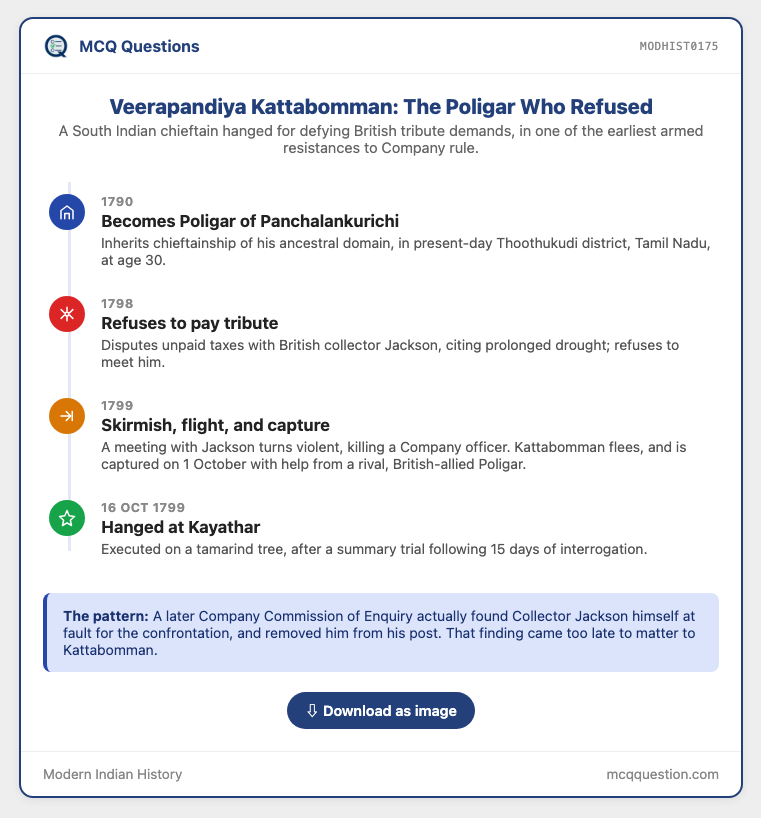
Veerapandiya Kattabomman: The Poligar Who Refused
A South Indian chieftain hanged for defying British tribute demands, in one of the earliest armed resistances to Company rule.
1790
Becomes Poligar of Panchalankurichi
Inherits chieftainship of his ancestral domain, in present-day Thoothukudi district, Tamil Nadu, at age 30.
1798
Refuses to pay tribute
Disputes unpaid taxes with British collector Jackson, citing prolonged drought; refuses to meet him.
1799
Skirmish, flight, and capture
A meeting with Jackson turns violent, killing a Company officer. Kattabomman flees, and is captured on 1 October with help from a rival, British-allied Poligar.
16 Oct 1799
Hanged at Kayathar
Executed on a tamarind tree, after a summary trial following 15 days of interrogation.
The pattern: A later Company Commission of Enquiry actually found Collector Jackson himself at fault for the confrontation, and removed him from his post. That finding came too late to matter to Kattabomman.
Modern Indian Historymcqquestion.com
Must Know
- Veerapandiya Kattabomman (3 January 1760 – 16 October 1799) was born in Panchalankurichi, in present-day Thoothukudi district, Tamil Nadu.
- He was a Palayakkarar (Poligar), a local chieftain, inheriting his domain from his father at around age 30.
- As Poligar, he held the right to collect taxes and raise soldiers within his own territory, under earlier arrangements.
- In 1798, he disputed unpaid taxes with British collector Jackson, citing a prolonged drought, and refused to meet him.
- A 1799 confrontation with Jackson turned violent, killing a British officer. Kattabomman fled, and was captured on 1 October 1799.
- He was hanged on a tamarind tree at Kayathar, on 16 October 1799, after a summary trial.
Good to Know
- His capture came with help from a rival Poligar allied to the British: the Raja of Pudukkottai, Vijaya Raghunatha Tondaiman.
- Facing British artillery at his fort in Panchalankurichi, he withdrew into the surrounding forests to fight a guerrilla campaign instead.
- A later Company Commission of Enquiry investigated the confrontation, and found Collector Jackson himself at fault. Jackson was relieved of his post as a result.
- The Indian Navy‘s communications centre at Vijayanarayanam is named INS Kattabomman, in his honour.
Test Yourself

Great to Know
- His resistance came nearly six decades before the 1857 Revolt, often taught as the starting point of organised opposition to Company rule. Regional resistance began much earlier than that framing suggests.
- The Commission of Enquiry’s finding against Jackson is a rare instance of the colonial administration formally acknowledging its own official’s fault, even though it changed nothing for Kattabomman himself.
- His capture through a rival Poligar’s help shows how British control often depended on local rivalries, not just direct military force.
Beyond the answer
Browse all modern-indian-history topics →
📚 Keep reading
Lord Wellesley: The Subsidiary Alliance and the Conquest of IndiaWarren Hastings: The First Governor-GeneralGovernors-General and Viceroys of India (1773-1947)ModHist0005 — The East India Company Becomes a Political PowerRobert Clive: The Foundation of British Rule in India❓ Practice this topic
On 28 April 1943, Bose was transferred from the German submarine U-180 to a Japanese submarine near Madagascar. What made this transfer historically unique?Which German submarine carried Bose on the first leg of his 1943 undersea journey from Europe toward Asia?When Bose finally met Adolf Hitler in Berlin in May 1942, what did Hitler actually offer him?For the journey from Kabul through Moscow and Rome to Berlin, Bose switched identities again. Which alias and passport did he now travel under?🎲 Take a Modern Indian History Quiz
Leave a Reply