She spent eight years in exile after the British killed her husband, training an army in secret. In 1780, she became the first Indian ruler to defeat the East India Company in battle, nearly seven decades before 1857.
 MCQ Questions
ModHist0184
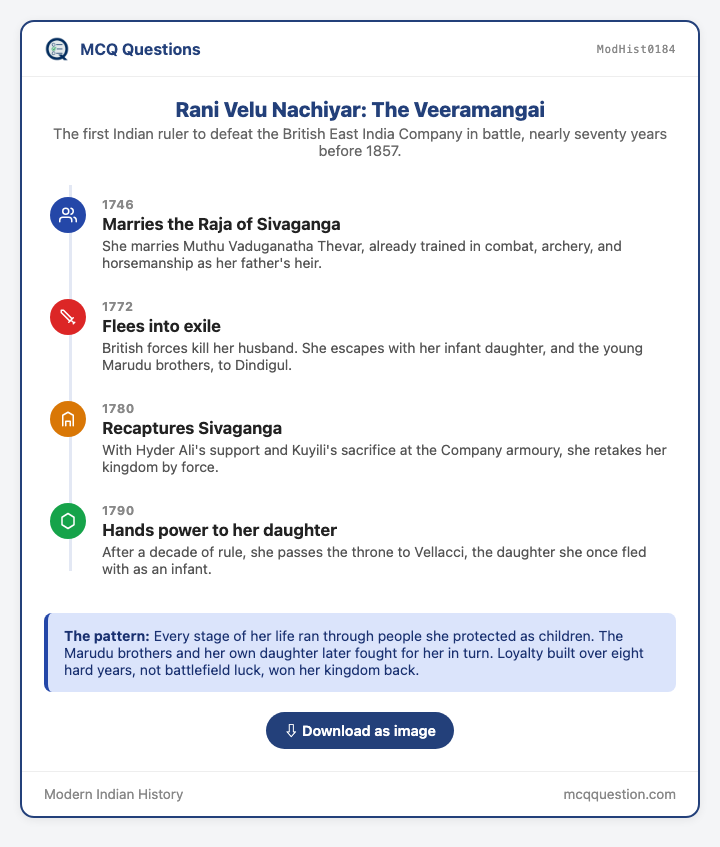
Rani Velu Nachiyar: The Veeramangai
The first Indian ruler to defeat the British East India Company in battle, nearly seventy years before 1857.
1746
Marries the Raja of Sivaganga
She marries Muthu Vaduganatha Thevar, already trained in combat, archery, and horsemanship as her father’s heir.
1772
Flees into exile
British forces kill her husband. She escapes with her infant daughter, and the young Marudu brothers, to Dindigul.
1780
Recaptures Sivaganga
With Hyder Ali’s support and Kuyili’s sacrifice at the Company armoury, she retakes her kingdom by force.
1790
Hands power to her daughter
After a decade of rule, she passes the throne to Vellacci, the daughter she once fled with as an infant.
The pattern: Every stage of her life ran through people she protected as children. The Marudu brothers and her own daughter later fought for her in turn. Loyalty built over eight hard years, not battlefield luck, won her kingdom back.
Modern Indian Historymcqquestion.com
Must Know
- Rani Velu Nachiyar (3 January 1730 – 25 December 1796) was the only child of the King of Ramanathapuram. With no son to succeed him, he raised and trained her as his heir.
- She was trained in combat, archery, horsemanship, and the martial arts Valari and Silambam, and was educated in French, English, and Urdu.
- In 1746, she married Muthu Vaduganatha Thevar, the Raja of Sivaganga.
- In 1772, East India Company forces killed her husband. She fled into exile with her infant daughter and the young Marudu brothers, seeking refuge in Dindigul under Hyder Ali’s protection.
- Over eight years in exile, she built an army and secured military support from Hyder Ali of Mysore.
- In 1780, she led a successful campaign to recapture Sivaganga, becoming the first Indian ruler known to defeat the East India Company in battle.
- She ruled Sivaganga for a decade, then handed the throne to her daughter, Vellacci, in 1790. She died on 25 December 1796.
Good to Know
- Her generals during the 1780 campaign were Periya Marudu and Chinna Marudu, the brothers she had protected in exile since 1772. See ModHist0181 — The Marudu Brothers: 1801’s Proclamation of Independence, which covers their own later rebellion.
- During the recapture of Sivaganga, her commander Kuyili is said to have covered herself in ghee and set herself on fire. She then ran into a British armoury, helping secure the victory. A dedicated article on Kuyili is in progress elsewhere on this site and will be linked here once published.
- She is remembered by the title “Veeramangai,” meaning “brave woman.”
- India issued a commemorative postage stamp honouring her on 31 December 2008.
Test Yourself

Great to Know
- Being raised as her father’s heir, despite having no brothers, gave her the military training a queen consort would rarely have received. That training directly shaped her ability to lead a real campaign years later.
- Eight years of exile spent building alliances and training an army, rather than simply waiting or negotiating, shows a deliberate long-term strategy. Her 1780 victory wasn’t a lucky uprising.
- Handing power to her daughter after a decade of rule, rather than a male relative, extended her unconventional succession one generation further. It kept Sivaganga’s throne in the hands of the family she had protected since their exile began.
Beyond the answer
Browse all modern-indian-history topics →
📚 Keep reading
Warren Hastings: The First Governor-GeneralModHist0005 — The East India Company Becomes a Political PowerLord Wellesley: The Subsidiary Alliance and the Conquest of IndiaModHist0181 — The Marudu Brothers: 1801's Proclamation of IndependenceRobert Clive: The Foundation of British Rule in India❓ Practice this topic
On 21 October 1965, Shastri coined the slogan 'Jai Jawan, Jai Kisan' at a public gathering near Allahabad. What was that village called?Lal Bahadur Shastri resigned as Railways Minister after a second train accident in November 1956. Where did that accident happen?Bengal National College and Bengal Technical Institute eventually merged to form which university, formally set up on 24 December 1955?At its December 1906 Calcutta session under Dadabhai Naoroji, the Indian National Congress passed four resolutions. Which one of these was NOT among them?🎲 Take a Modern Indian History Quiz
Leave a Reply