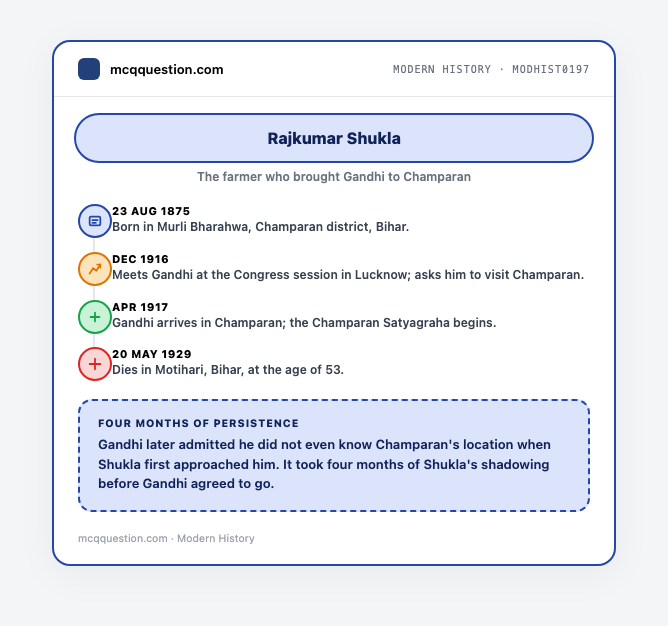
Rajkumar Shukla spent months following Gandhi from town to town, insisting he come see the plight of Champaran’s indigo farmers for himself. His persistence led directly to the Champaran Satyagraha of 1917, Gandhi’s first act of civil disobedience in India.

 mcqquestion.com
Modern History · ModHist0197
Rajkumar Shukla
The farmer who brought Gandhi to Champaran
23 Aug 1875
Born in West Champaran district, Bihar.
Dec 1916
Meets Gandhi at the Congress session in Lucknow; asks him to visit Champaran.
Apr 1917
Gandhi arrives in Champaran; the Champaran Satyagraha begins.
20 May 1929
Dies in Motihari, Bihar, at the age of 53.
Four months of persistence
Gandhi later admitted he did not even know Champaran’s location when Shukla first approached him. It took four months of Shukla’s shadowing before Gandhi agreed to go.
The Appeal to Gandhi Need to Know
- Rajkumar Shukla was born on 23 August 1875, in West Champaran district, Bihar.
- He was a farmer and moneylender from the area, and himself grew indigo under the exploitative system imposed on local cultivators.
- In December 1916, at the 31st Congress session in Lucknow, Shukla approached Mahatma Gandhi and asked him to see the condition of Champaran’s indigo farmers. He reportedly threw himself at Gandhi’s feet to press the request.
- Gandhi later wrote that he did not then know even the name, let alone the location, of Champaran.
- Shukla spent months following Gandhi from place to place, repeatedly asking him to visit Champaran.
- Gandhi finally travelled to Champaran, accompanied by Rajendra Prasad, Anugrah Narayan Sinha, and Brajkishore Prasad, in April 1917.
- This visit began the Champaran Satyagraha, Gandhi’s first major act of civil disobedience in India.
- Shukla died on 20 May 1929, in Motihari, Bihar, at the age of 53.
Legacy of Champaran Good to Know
- During the Satyagraha, Shukla ran one of the evidence-collection offices at Bettiah, helping document testimony from over 8,000 farmers for the official inquiry committee.
- Shukla worked alongside other local leaders in the same cause, including Sheikh Gulab and Harbans Sahay.
- By his own statement to the provincial government’s enquiry committee, he earned around two thousand rupees a month from interest. He also worked under Hafiz Din Mohammad.
- The Champaran Satyagraha that Shukla’s persistence triggered led directly to the Champaran Agrarian Act, passed on 4 March 1918, which abolished the exploitative “tinkathia” indigo-cultivation system.
- In 2000, the Department of Posts issued a commemorative stamp in his honour, on his 125th birth anniversary.
- To mark 100 years of the Champaran Satyagraha, the Bihar government installed a statue of Shukla at the Gandhi Sangrahalaya in Patna in 2017.
- Shukla kept a personal diary, now catalogued as a primary historical source, and is said to have continued visiting Gandhi at Sabarmati Ashram until his death.
Test Yourself

The Man Behind the Movement Great to Know
- Shukla’s four-month persistence is often cited as proof that Gandhi’s Satyagraha technique did not start from an abstract theory. It grew out of a farmer’s direct, personal appeal.
- His story is less well known than the Champaran movement he triggered, despite being its direct cause. This gap illustrates how history often remembers a movement’s leader far more than the person who set it in motion.
- The Champaran Agrarian Act’s abolition of tinkathia shows something important. A single localised grievance could produce a concrete legislative outcome, distinct from the broader national independence movement.
- Shukla was also a moneylender within the same exploitative economy. This complicates any simple reading of him as merely a victim of the system he fought.
Beyond the answer
Browse all modern-indian-history topics →
📚 Keep reading
ModHist0019 — Gandhi's Philosophy: From Hind Swaraj to ChamparanModHist0219 — Kheda Satyagraha (1918)ModHist0230 — Mahadev Desai: Gandhi's Secretary for 25 YearsModHist0206 — Mohanlal Pandya: The Onion Thief of the Kheda SatyagrahaModHist0153 — Ravishankar Maharaj: Gandhi's Constructive-Work Partner in Gujarat❓ Practice this topic
The famous Wood's Despatch (1854), which recommended a system of education in India, was issued during whose Governor-Generalship?Punjab was annexed to British India in 1849 after which conflict?The Doctrine of Lapse was famously applied to which of the following states (whose ruler was a woman)?Who introduced the Doctrine of Lapse, under which the Company annexed states whose rulers died without a natural heir?🎲 Take a Modern Indian History Quiz
Leave a Reply