Gandhi called him Bihar‘s first Satyagrahi. As Chief Minister, he became the first in the country to abolish the zamindari system outright.


Timeline
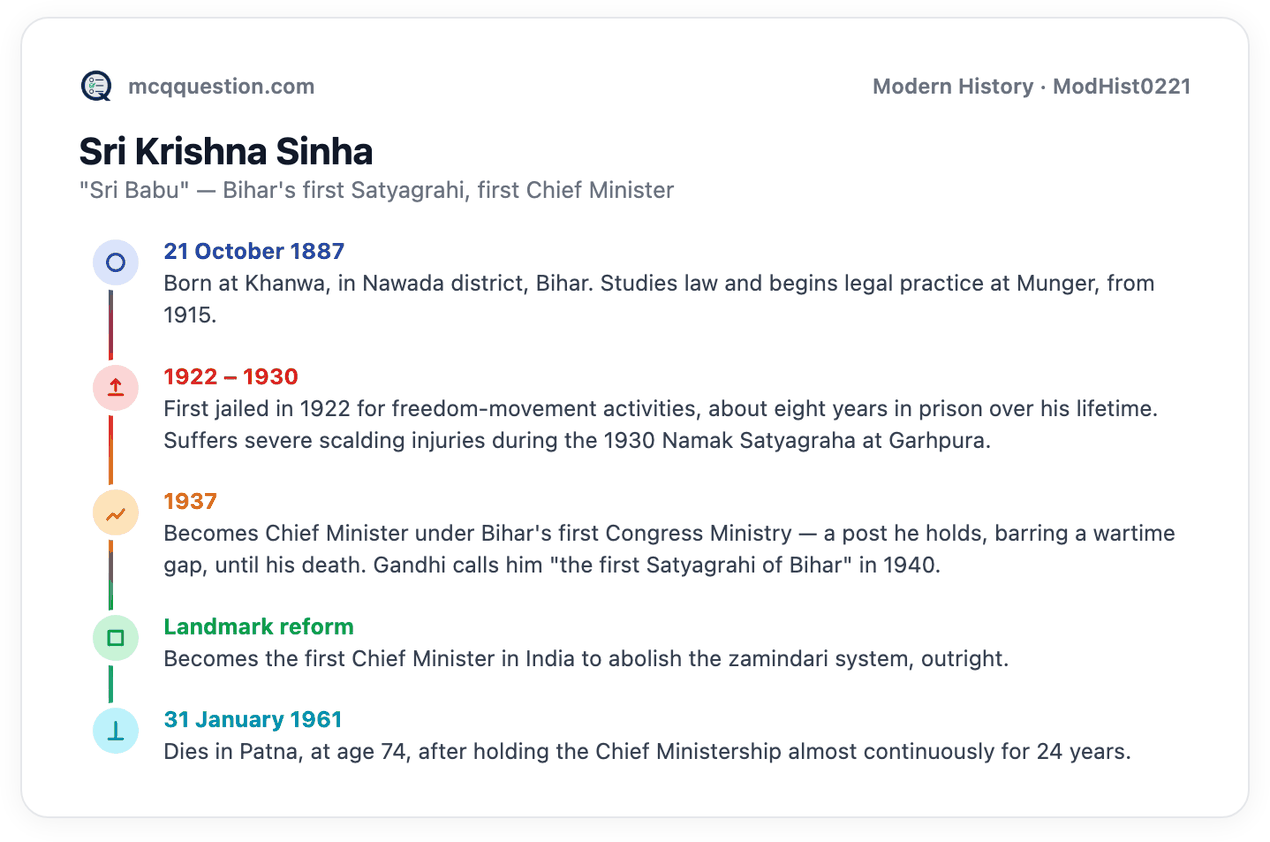
- 21 October 1887: Born at Khanwa, in Nawada district, Bihar.
- Studies law, and begins legal practice at Munger, from 1915.
- 1922: First jailed for his freedom-movement activities; spends about eight years in prison over his lifetime.
- 1930: Plays a key role in the Namak Satyagraha at Garhpura, suffering severe scalding injuries during his arrest.
- 1940: Mahatma Gandhi calls him “the first Satyagrahi of Bihar.”
- 1937: Becomes Chief Minister under Bihar’s first Congress Ministry, a post he holds, barring a wartime gap, until his death.
- Becomes the first Chief Minister in India to abolish the zamindari system.
- 31 January 1961: Dies in Patna, at age 73.
Must Know Need to Know
- Shri Krishna Sinha, known as Sri Babu, was born on 21 October 1887, at Khanwa, Bihar.
- Mahatma Gandhi called him “the first Satyagrahi of Bihar,” in 1940.
- He became Chief Minister under Bihar’s first Congress Ministry in 1937, a post he held until his death in 1961.
- He was the first Chief Minister in India to abolish the zamindari system.
- He led the movement for Dalit entry into the Baidyanath Dham temple at Deoghar.
- He is regarded, alongside Rajendra Prasad and Anugrah Narayan Sinha, as one of the Architects of Modern Bihar.
Good to Know Good to Know
- He was jailed multiple times from 1922, spending about eight years in prison across his freedom-struggle career.
- During his arrest at the 1930 Namak Satyagraha, at Garhpura, he suffered severe scalding injuries to his hands and chest.
- His government passed the Bodh Gaya Temple Act in 1949, creating a management committee with equal Hindu and Buddhist representation for the Mahabodhi Temple.
- As Chief Minister, he backed major river valley projects on the Koshi, Aghaur, and Sakri rivers.
- He introduced heavy industries into Bihar, including oil refining and fertiliser production.
- In 1959, he donated his personal collection of 17,000 books to Munger’s public library, later renamed Sri Krishna Seva Sadan in his honour.
Test Yourself

Great to Know Great to Know
- His zamindari abolition made Bihar a national first, not just a regional reform. Other states later followed a path he had already tested.
- Leading Dalit entry into a major temple went beyond land reform. It put him directly against entrenched social, not just economic, hierarchy.
- Nearly a quarter-century in office, spanning independence itself, gave him rare continuity. Few Indian leaders governed the same state across such a long, transformative stretch.
- Donating 17,000 personal books to a public library reflects a scholarly streak behind the politician. His legacy wasn’t only land reform and industry.
Leave a Reply