When Mahadev Desai died in Gandhi’s arms in 1942, someone still had to keep the diary, guard the papers, and one day write it all down. That task fell to Pyarelal Nayyar. He served as Gandhi’s last secretary, then spent decades writing his definitive biography.

 mcqquestion.com
Modern History · ModHist0231
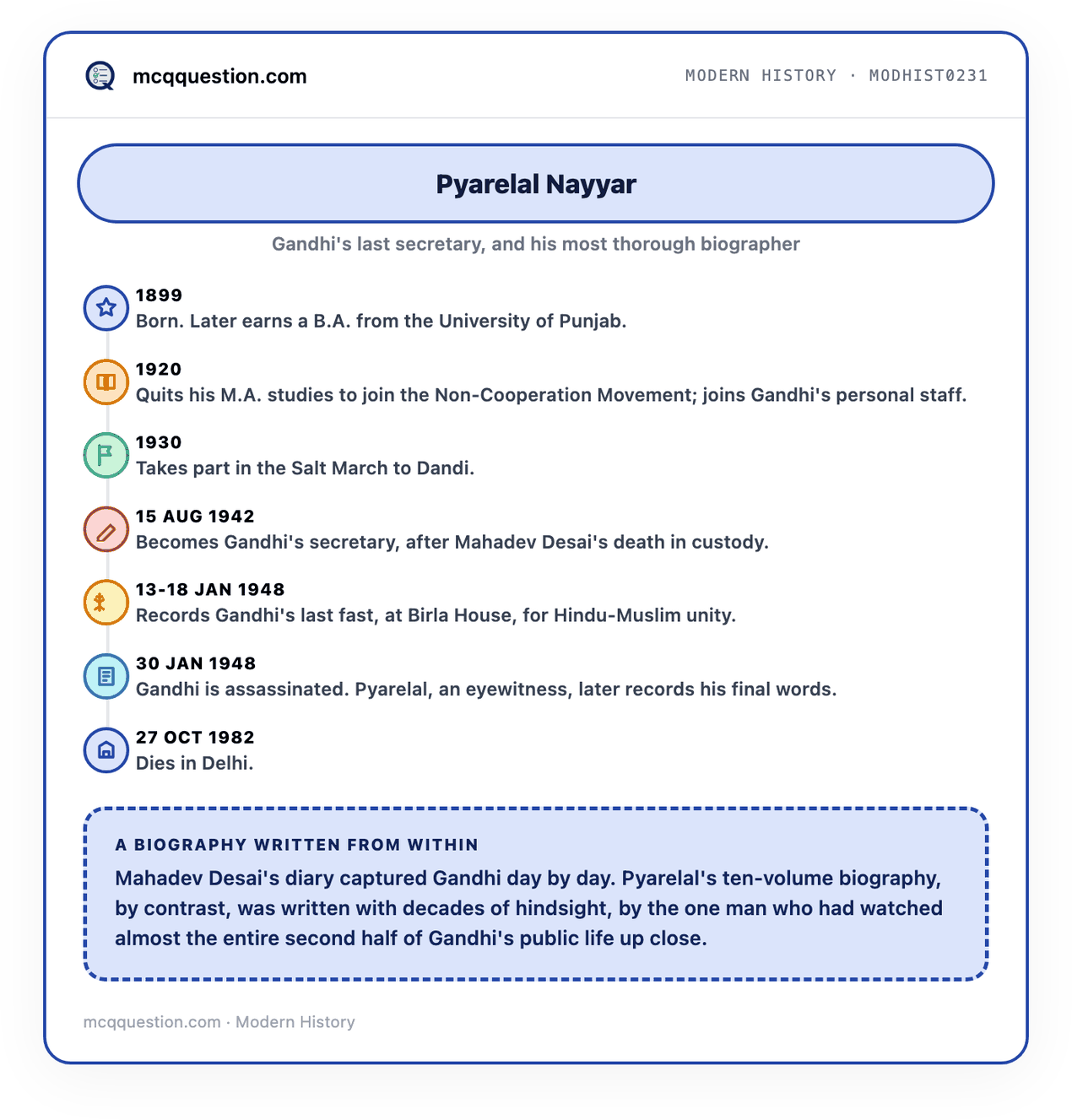
Pyarelal Nayyar
Gandhi’s last secretary, and his most thorough biographer
1899
Born. Later earns a B.A. from the University of Punjab.
1920
Quits his M.A. studies to join the Non-Cooperation Movement; joins Gandhi’s personal staff.
1930
Takes part in the Salt March to Dandi.
15 Aug 1942
Becomes Gandhi’s secretary, after Mahadev Desai’s death in custody.
13-18 Jan 1948
Records Gandhi’s last fast, at Birla House, for Hindu-Muslim unity.
30 Jan 1948
Gandhi is assassinated. Pyarelal, an eyewitness, later records his final words.
27 Oct 1982
Dies in Delhi.
A biography written from within
Mahadev Desai’s diary captured Gandhi day by day. Pyarelal’s ten-volume biography, by contrast, was written with decades of hindsight, by the one man who had watched almost the entire second half of Gandhi’s public life up close.
Timeline
- 1899: Pyarelal Nayyar is born. He later earns a B.A. from the University of Punjab.
- 1920: He quits his M.A. studies to join the Non-Cooperation Movement, and joins Gandhi’s personal staff.
- 1930: He takes part in the Salt March to Dandi.
- 15 August 1942: He becomes Gandhi’s secretary, after Mahadev Desai dies in British custody.
- 13-18 January 1948: Gandhi undertakes his last fast, at Birla House in Delhi, for Hindu-Muslim unity. Pyarelal later documents it in detail.
- 30 January 1948: Gandhi is assassinated in Delhi. Pyarelal, an eyewitness, later spends decades writing the definitive account of these final years.
- 27 October 1982: He dies in Delhi.
Gandhi’s Last Secretary Need to Know
- Pyarelal Nayyar (1899-1982) was Mahatma Gandhi’s secretary from 1942 until Gandhi’s death in 1948.
- He succeeded Mahadev Desai as secretary, after Desai died in British custody in August 1942.
- He had already been part of Gandhi’s personal staff for over two decades by then. He joined around 1920.
- He quit his M.A. studies at Punjab University in 1920, to join the Non-Cooperation Movement.
- He is best known as Gandhi’s biographer. He wrote a ten-volume life of Gandhi, including “Mahatma Gandhi: The Last Phase.”
- His sister, Dr. Sushila Nayyar, was Gandhi’s personal physician.
Biographer of The Last Phase Good to Know
- He took part in the 1930 Salt March to Dandi, one of the defining events of the independence movement.
- “The Last Phase” (Volumes IX and X of his biography) covers Gandhi’s final years, including Partition and the assassination. It remains a standard historical reference.
- He held a large collection of Gandhi’s personal papers. His family made them public in 2007.
- Actor Pankaj Kapur portrayed him in Richard Attenborough’s 1982 film, “Gandhi.”
- His longtime assistant, Dewan Vasdev Khanna, helped him with the biography until 1980. Khanna later helped complete the script for Attenborough’s film.
- His sister, Sushila Nayyar, went on to become India’s Union Health Minister (1962-67). She founded the Mahatma Gandhi Institute of Medical Sciences at Sevagram, in 1969.
- His biography project ran for decades. Its later volumes were completed after his own death, by his sister and other collaborators.
Test Yourself

An Eyewitness to the End Great to Know
- See ModHist0230 — Mahadev Desai, the secretary Pyarelal succeeded in 1942.
- Desai’s diary captured Gandhi in the moment. Pyarelal’s biography, by contrast, was written with decades of hindsight. He had watched almost the entire second half of Gandhi’s public life up close.
- Just before the assassination, Gandhi undertook his last fast, from 13 to 18 January 1948. It was for Hindu-Muslim unity, at Birla House in Delhi.
- Twelve days later, on 30 January 1948, Gandhi was shot dead at the same house. Pyarelal was present, and later recorded competing accounts of Gandhi’s last words.
- See Civil Disobedience and the Salt March, the 1930 campaign Pyarelal took part in.
- Two of Gandhi’s closest aides in his final years were siblings: Pyarelal as his secretary, and Sushila Nayyar as his physician.
Beyond the answer
Browse all modern-indian-history topics →
📚 Keep reading
ModHist0230 — Mahadev Desai: Gandhi's Secretary for 25 YearsModHist0019 — Gandhi's Philosophy: From Hind Swaraj to ChamparanModHist0266 — Sarvodaya: Gandhi's Word for Universal WelfareModHist0070 — The Freedom Struggle's Global Legacy and Gandhi's Relevance TodayModHist0014 — The Janata Party Interlude, 1977-1979❓ Practice this topic
Who among the following was/were associated with the introduction of the Ryotwari Settlement in India during the British rule? 1. Lord Cornwallis 2. Alexander Read 3. Thomas MunroStatement I: The Permanent Settlement was rarely extended to any region beyond Bengal. Statement II: After 1810, the agricultural prices declined, affecting adversely the income of the Bengal Zamindars.Consider the following statements about the Bengal countryside at the time of the Permanent Settlement: 1. The zamindars' troops were disbanded. 2. Within the villages, the power of jotedars was more effective than that of zamindars. 3. The East India Company made a rule that the property of women would not be taken over. 4. Adhiyars were sharecroppers on the land owned by bargadars.What was the consequence of the Permanent Settlement on rural society in Bengal?🎲 Take a Modern Indian History Quiz
Leave a Reply