Jayaprakash Narayan, widely known as “JP” or “Lok Nayak,” led the 1974-75 movement that called for “Total Revolution” against Indira Gandhi’s government. His movement is closely tied to the events leading up to the 1975 Emergency.

 mcqquestion.com
Modern History · ModHist0252
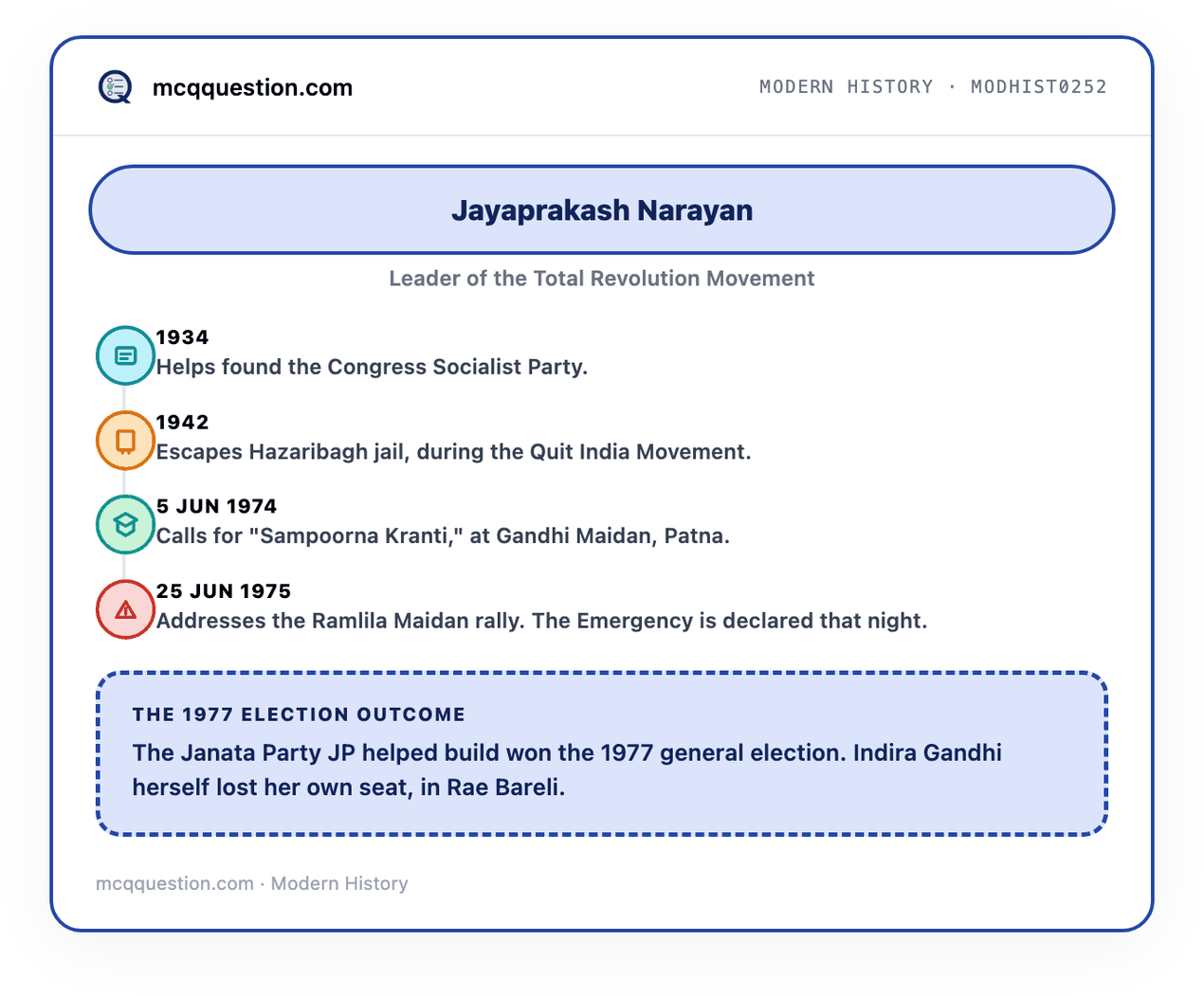
Jayaprakash Narayan
Leader of the Total Revolution Movement
1934
Helps found the Congress Socialist Party.
1942
Escapes Hazaribagh jail, during the Quit India Movement.
5 Jun 1974
Calls for “Sampoorna Kranti,” at Gandhi Maidan, Patna.
25 Jun 1975
Addresses the Ramlila Maidan rally. The Emergency is declared that night.
The 1977 Election Outcome
The Janata Party JP helped build won the 1977 general election. Indira Gandhi herself lost her own seat, in Rae Bareli.
From Socialist to Total RevolutionNeed to Know
- Jayaprakash Narayan was born on 11 October 1902, in Sitab Diara, then in the Bengal Presidency.
- He studied in the United States during the 1920s. He earned degrees in sociology and behavioural science, including at Ohio State University.
- He joined the Indian National Congress in 1929, at Jawaharlal Nehru‘s invitation.
- In 1934, he helped found the Congress Socialist Party, and served as its general secretary.
- During the Quit India Movement, in 1942, he escaped from Hazaribagh Central Jail. He then organised armed resistance against British rule, from hiding.
- After independence, he moved away from active politics. He later joined Vinoba Bhave’s Sarvodaya and Bhoodan movements, promoting voluntary land redistribution.
- On 5 June 1974, at Gandhi Maidan in Patna, he called for “Sampoorna Kranti,” or Total Revolution, against corruption and misgovernance.
- He led the student-driven Bihar Movement that followed, demanding sweeping political and social change. Its defining slogan was “Sampoorna Kranti ab nara hai, bhavi itihas hamara hai” — “Total Revolution is now the slogan, the future history is ours.”
- On 25 June 1975, he addressed a rally at Delhi’s Ramlila Maidan. He urged the police and armed forces not to obey orders he called illegal.
- He said the government would lose its moral and constitutional right to rule, if it ignored the people’s demands.
- The government declared a national Emergency later that night. JP was arrested and detained.
- After the Emergency ended in 1977, he guided the formation of the Janata Party. It defeated the Congress in that year’s general election.
Life After the EmergencyGood to Know
- He was released from detention in November 1975, after his health worsened. He needed regular kidney dialysis for the rest of his life.
- In 1977, the Janata Party offered to nominate him for President of India. He declined the nomination.
- He wrote “A Plea for the Reconstruction of Indian Polity,” proposing a political system without traditional parties.
- He served as President of the All India Railwaymen’s Federation, from 1947 to 1953.
Test Yourself

Honours and Final YearsGreat to Know
- He was awarded the Ramon Magsaysay Award, in 1965, for public service.
- He was awarded the Bharat Ratna, in 1999, posthumously.
- In March 1979, Prime Minister Morarji Desai mistakenly announced his death, causing widespread but premature mourning.
- He died on 8 October 1979, in Patna, three days before his 77th birthday.
Current Affairs
- On 11 July 2026, Union Home Minister Amit Shah inaugurated the Jayaprakash Narayan Library, in New Delhi. (Source: PIB, Ministry of Home Affairs, 11 Jul 2026)
- The library, developed by the New Delhi Municipal Council (NDMC), offers free access to over 1 crore e-books. (Source: PIB, Ministry of Home Affairs, 11 Jul 2026)
- Delhi Chief Minister Rekha Gupta and NDMC Chairman Keshav Chandra also attended the inauguration. (Source: PIB, Ministry of Home Affairs, 11 Jul 2026)
Leave a Reply