In June 1991, India’s foreign-exchange reserves had fallen to roughly $1 billion, barely enough to cover a few weeks of imports. P.V. Narasimha Rao became Prime Minister that same month, at age 70. He was a reluctant, semi-retired politician, chosen almost by accident. Within weeks, his government dismantled decades of economic controls, and changed India’s economic direction for good.


A Reluctant PM, and a Reform Package Need to Know
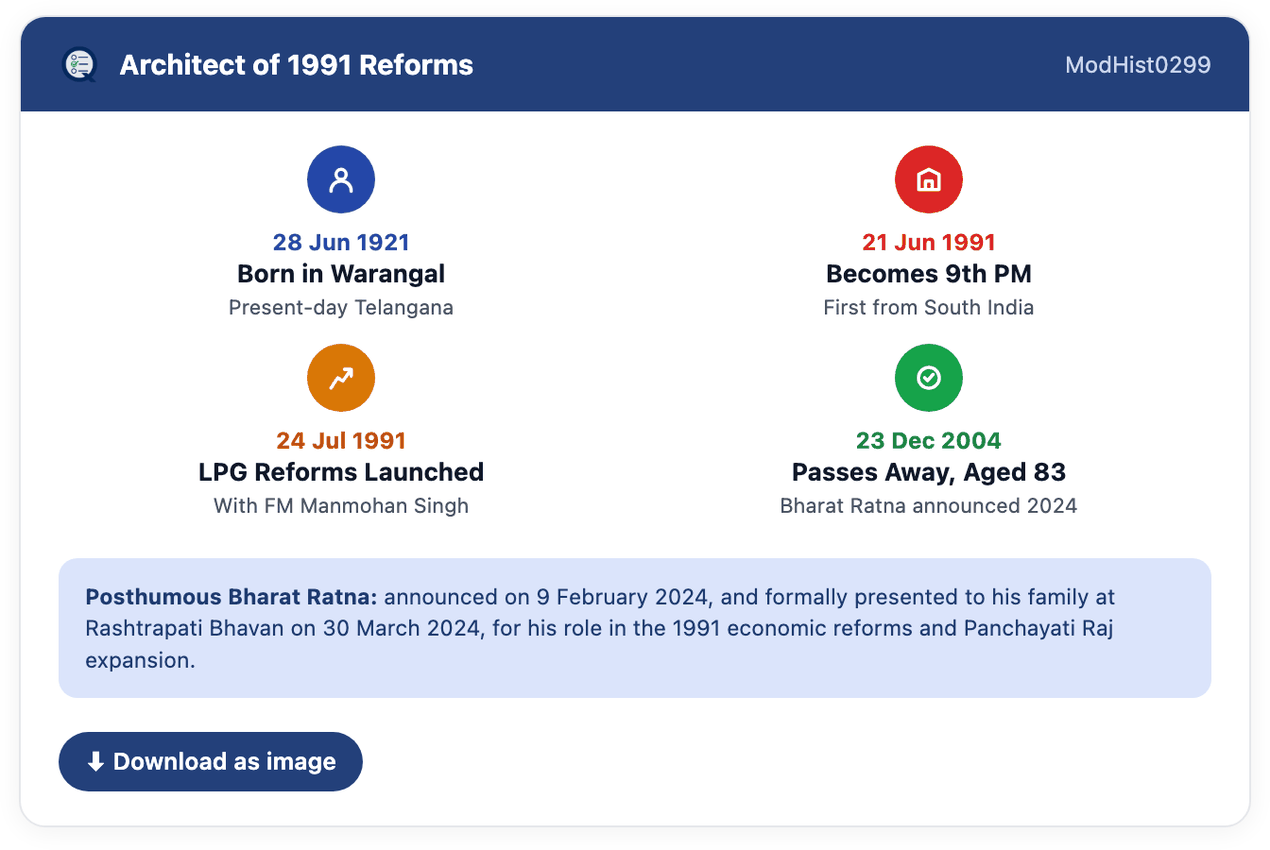
- Pamulaparthi Venkata Narasimha Rao was India’s 9th Prime Minister, serving from 1991 to 1996. He was born on 28 June 1921, in Warangal district, present-day Telangana.
- He became Prime Minister in 1991, as a consensus candidate after Rajiv Gandhi’s assassination. He was the first Prime Minister from South India, and the first Congress Prime Minister outside the Nehru-Gandhi family to complete a full five-year term.
- With Finance Minister Manmohan Singh, he launched India’s 1991 LPG reforms — Liberalisation, Privatisation, and Globalisation. These dismantled the industrial licensing system, and opened India’s economy to foreign investment.
- His government secured passage of the 73rd and 74th Constitutional Amendments through Parliament in December 1992. They took effect the following year, after state ratification, giving Panchayati Raj institutions and urban local bodies formal constitutional status.
- He died on 23 December 2004. The Government of India announced the Bharat Ratna for him posthumously on 9 February 2024, formally presenting it to his family the following month.
A Linguist, a Diplomat, a Difficult Legacy Good to Know
- Before entering electoral politics, he took part in the movement against restrictions imposed by the Nizam of Hyderabad’s government. He was suspended from Osmania University over the banned “Vande Mataram” song. He later served as Andhra Pradesh’s Chief Minister, from 1971 to 1973.
- He held several Union Cabinet portfolios under Indira Gandhi and Rajiv Gandhi through the 1980s. He led External Affairs from 1980, then briefly Home, then Defence into the mid-1980s.
- As Prime Minister, he is widely credited with initiating the Look East Policy in the early 1990s. It shifted India’s foreign policy toward stronger ties with Southeast Asia, and the wider Asia-Pacific region.
- He was a gifted linguist, fluent in several Indian languages, and reportedly conversant in a number of foreign ones too, including Spanish and French.
- In December 1995, he authorised secret preparations for nuclear tests at Pokhran. American satellites detected the activity, and forced a pause. He reportedly told incoming PM Atal Bihari Vajpayee, in 1996, “Saamagri tayyar hai” — the material is ready. This laid the groundwork for the 1998 Pokhran-II tests.
- The Babri Masjid was demolished on 6 December 1992, during his tenure. His government has faced lasting criticism, for failing to prevent the demolition, despite assurances given beforehand.
Test Yourself

A Reassessed Legacy Great to Know
- His reforms are widely credited with averting a deeper economic crisis. They also set up three decades of Indian growth, including the rise of its software and IT-services sector.
- Historians increasingly reassess his legacy as more complex than it once seemed. He was a cautious economic reformist, but his government also faced lasting communal-crisis criticism at home.
- His reform partnership with Manmohan Singh reshaped Indian economic policy for a generation. See IndEco0177 — Montek Singh Ahluwalia, another key official behind the same 1991 reforms.
Current Affairs Current Affairs
- 28 June 2026: On his birth anniversary, PM Modi paid tribute to Rao, calling him “an able administrator” and “a distinguished scholar.” (Source: PIB)
Leave a Reply