A flood at an ancient city on the Ganga once washed away part of a settlement. Some archaeologists think this event echoes a story in the Mahabharata itself.

Timeline
- c. 1200 BCE: Painted Grey Ware culture begins, spreading across the upper Ganga-Yamuna Doab and the Kurukshetra region.
- 1950s: Archaeologist B.B. Lal excavates Hastinapur, the Kuru capital named in the Mahabharata, uncovering a distinct PGW layer.
- c. 800 BCE: A flood strikes Hastinapur, washing away part of the PGW settlement there.
- c. 600 BCE: PGW gives way to Northern Black Polished Ware, marking India’s shift into the urban Mahajanapada era.
The Pottery and Its World Need to Know
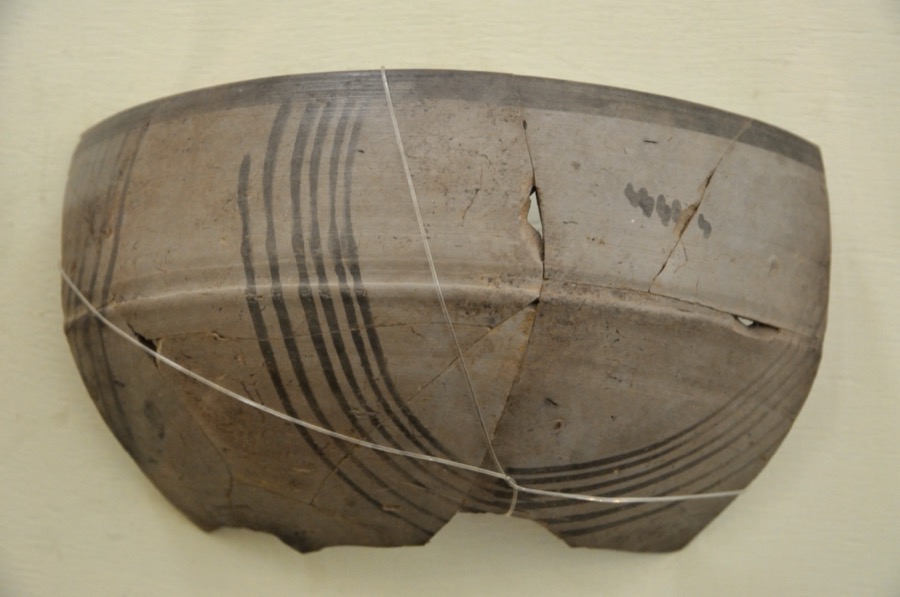
- The Painted Grey Ware (PGW) culture flourished across northern India from roughly 1200 to 600 BCE.
- It is identified by its signature pottery: fine grey clay, thrown on a fast wheel, then painted with black geometric patterns before firing.
- The grey colour comes from firing in a closed kiln with limited oxygen. This gave the clay a uniform, even tone.
- PGW sites cluster in the upper Ganga-Yamuna Doab and the Kurukshetra region — the Vedic-era Kuru-Panchala heartland. Sites are also documented further out, in Indian Punjab, northeastern Rajasthan, and parts of Haryana.
- PGW settlements were mostly rural and unfortified — pit dwellings and huts, not large fortified cities.
Sites and Significance Good to Know
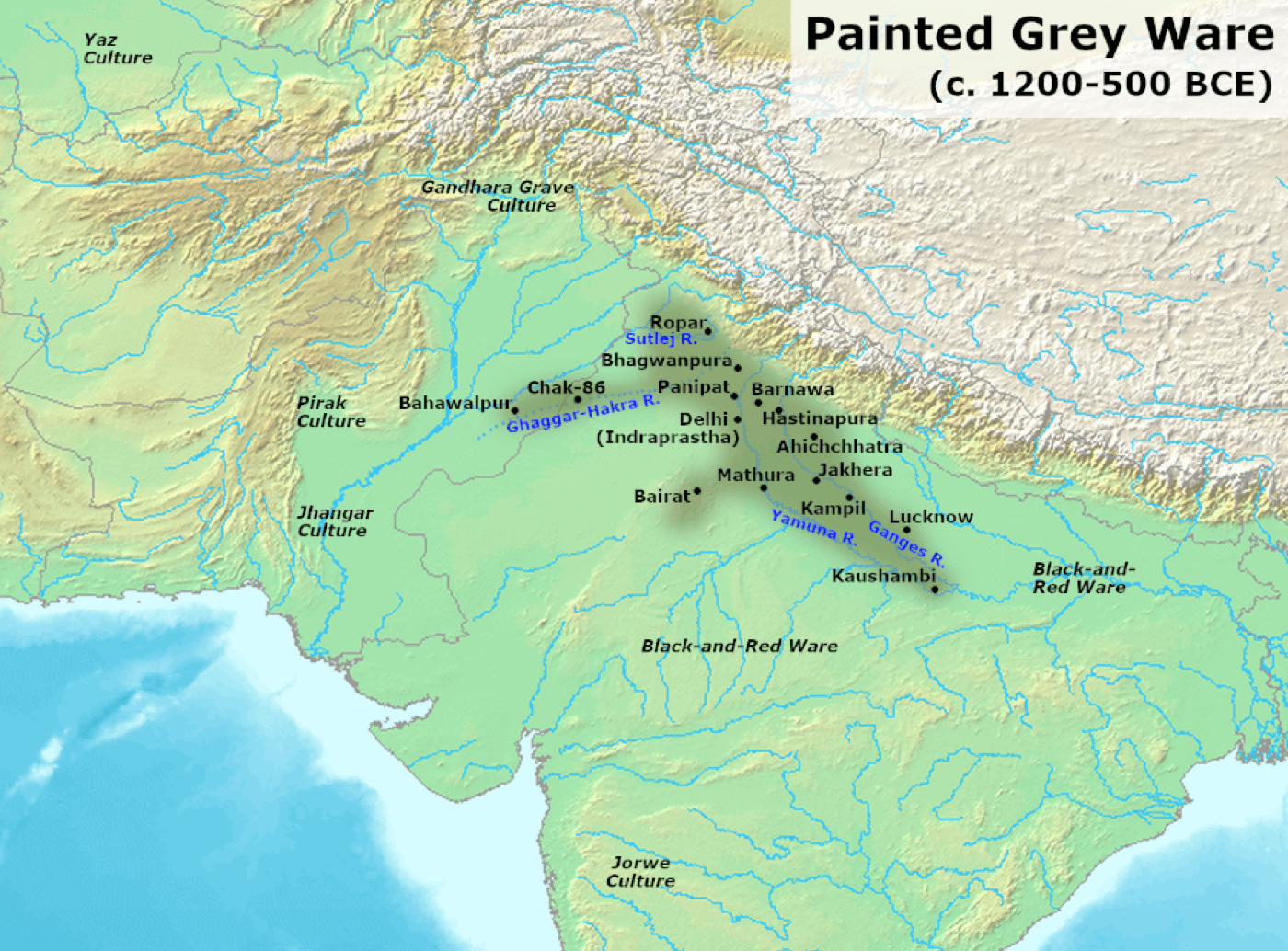
- PGW sites match the geography of two Mahabharata-linked capitals: Hastinapura, capital of the Kuru Mahajanapada, and Ahichchhatra, capital of the Panchala Mahajanapada.
- Ahichchhatra was the first site where PGW sherds were identified, back in 1944. Hastinapur, excavated a few years later, is where PGW was formally established as a distinct archaeological culture.
- No single site defines PGW on its own. It is identified collectively, across many excavated sites — including Atranjikhera, Bhagwanpura, Jakhera, Sonkh, Alamgirpur, and Noh, beyond the two capitals above.
- Iron tools and weapons — arrowheads, spearheads, and farming implements — appear at PGW sites, alongside copper objects and terracotta figurines. This is why PGW is treated as India’s Iron Age culture in this region, part of the broader Iron Age in India.
- PGW is chronologically earlier than the Northern Black Polished Ware (NBPW) culture, which followed it. NBPW, not PGW, marks India’s shift to walled cities and the historical Mahajanapada period described in the Mahajanapadas overview.
Test Yourself

The Hastinapur Flood Great to Know
- At Hastinapur, B.B. Lal found evidence of a major flood, around 800 BCE, that washed away part of the PGW settlement.
- Some scholars connect this to the Mahabharata’s own account of a flood forcing the Kuru capital to shift — from Hastinapura to Kaushambi.
- This connection is circumstantial, not proof. It doesn’t confirm the Mahabharata’s events happened as described, only that a real flood did occur at the site.
- Lal’s excavation uncovered five separate cultural layers at Hastinapur, from before 1200 BCE all the way to medieval times — with PGW forming just one middle layer, not the earliest or the last.
- A few more recent studies have suggested an even earlier start date for PGW at some sites. This hasn’t yet become the standard view among archaeologists, and the 1200-600 BCE range remains the widely accepted one.
Beyond the answer
Browse all ancient-indian-history topics →
📚 Keep reading
AncHist0060 — Northern Black Polished Ware (NBPW) CultureAncHist0039 — Kuru (Mahajanapada)GK0004 — Monuments of IndiaAncHist0032 — The Iron Age in IndiaAncHist0040 — Panchala (Mahajanapada)❓ Practice this topic
James Burgess founded a journal in 1872, and later served as Director General of the Archaeological Survey of India from 1886 to which year?Alexander Rea first excavated Amaravati in 1888–89. In which year did he go on to become the first Superintendent of the Archaeological Survey of Southern India?Robert Sewell's 1900 book “A Forgotten Empire” is a history of which South Indian empire, drawn from two Portuguese travellers' accounts?A.H. Longhurst's excavations from 1926 to 1931 uncovered a great stupa and several smaller structures at which site?🎲 Take a Ancient Indian History Quiz
Leave a Reply