On 23 January 2026, one government order rewrote how new IAS officers get assigned a state. It replaced a nine-year-old zone system with something entirely different. This article covers how cadre allocation actually works. It also covers why the rules keep changing.

🗓️ Timeline
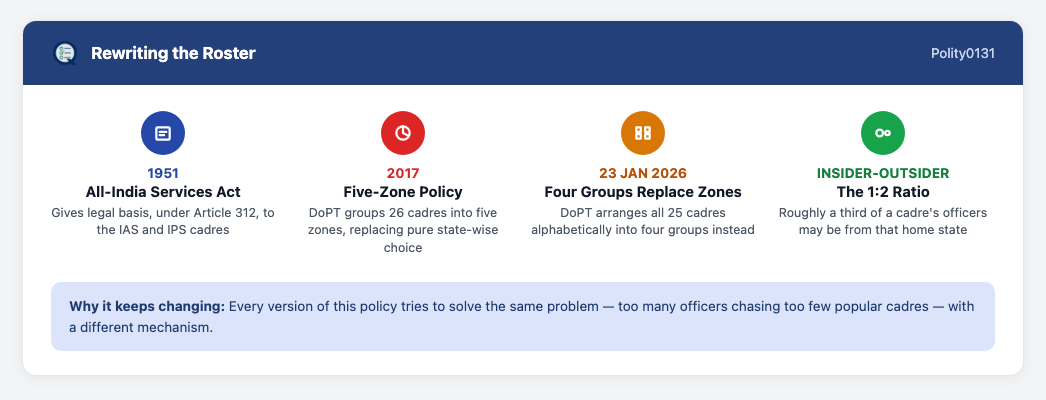
1951: All-India Services Act
- Legal Basis In 1951, the All-India Services Act gave legal basis, under Article 312 of the Constitution, to the IAS and IPS as all-India cadres.
2017: Five-Zone Policy
- DoPT In 2017, the Department of Personnel and Training (DoPT) notified a five-zone Cadre Allocation Policy, grouping the country’s 26 cadres into five zones.
2026: Four Groups Replace Zones
- 23 Jan 2026 On 23 January 2026, DoPT replaced the zone system with a four-group alphabetical framework, applicable from the CSE 2026 batch onward.
✅ Must Know
What a Cadre Is
- Definition A cadre is the state, or group of states, where an IAS officer is posted for most of their career. This is distinct from the broader All-India Services structure. That structure is covered in Polity0095.
The Old 2017 Policy
- Zone Ranking Under the old 2017 policy, candidates ranked five zones, then one cadre within each zone, in order of preference.
The New 2026 System
- Four Groups Since 23 January 2026, all 25 state and joint cadres are arranged alphabetically into four groups instead of five zones.
The Insider-Outsider Ratio
- Roughly 1:2 The insider-outsider ratio keeps roughly a third of a cadre’s officers as “insiders” from that home state, and two-thirds as “outsiders” from elsewhere.
The Central Deputation Reserve
- CDR The Central Deputation Reserve (CDR) sets aside a share of each cadre’s sanctioned strength for officers serving on deputation to the Union government.
The Chief Secretary’s Appointment
- UPSC 2016 A State’s Chief Secretary, its senior-most IAS officer, is substantively selected by the Chief Minister — only formally issued in the Governor’s name, as with all state executive action under Article 166. The post also has no fixed tenure; officers serve at the state government’s pleasure. Asked as: “Consider the following statements: the Chief Secretary in a State is appointed by the Governor of that State, and has a fixed tenure.” (UPSC CSP 2016, GS Paper I) — neither statement is correct.
📘 Good to Know
Why the 2026 Reform Happened
- Regional Imbalance The 2026 reform was driven by concerns over regional imbalance. Too many officers had been concentrating their choices on a small set of popular cadres.
Central Deputation
- Joint Secretary+ Central deputation lets IAS officers serve in Union ministries, regulatory bodies, and PSUs. These postings sit at Joint Secretary level and above. Officers remain formally attached to their home cadre throughout.
Why the Insider-Outsider Rule Exists
- Rationale The insider-outsider rule exists for a reason. It stops officers from spending an entire career only among people and networks from their own home state.
Test Yourself

🏆 Great to Know
Designing a “Fair” Rule Is Hard
- Lesson Moving from five zones to four alphabetical groups within a decade shows something important. Designing a “fair” allocation rule is hard, and officers keep finding ways to game whatever structure exists.
A Deliberate Trade-off
- Randomness Keeping cadre allocation partly random, rather than fully preference-based, is a deliberate trade-off. It sacrifices some officer convenience, in exchange for protecting the all-India character the Constitution’s framers intended.
Two Rules, One Idea
- Shared Logic The insider-outsider ratio and the central deputation reserve solve two different problems. Both rest on the same basic idea: spread officers across states and across governments, so no single power centre holds too much of their loyalty.
Dismissal Safeguards
- Article 311 IAS officers can’t be dismissed on a whim. See Polity0230 — Article 311: Dismissal Safeguards for Civil Servants for the constitutional protections behind that.
Leave a Reply