An armed insurgency simmered across parts of central and eastern India for nearly six decades. On 31 March 2026, the government declared it over. This article covers Left-Wing Extremism (Naxalism): its origins, the government’s response, and the 2026 declaration.
 mcqquestion.com
Indian Polity · Polity0147
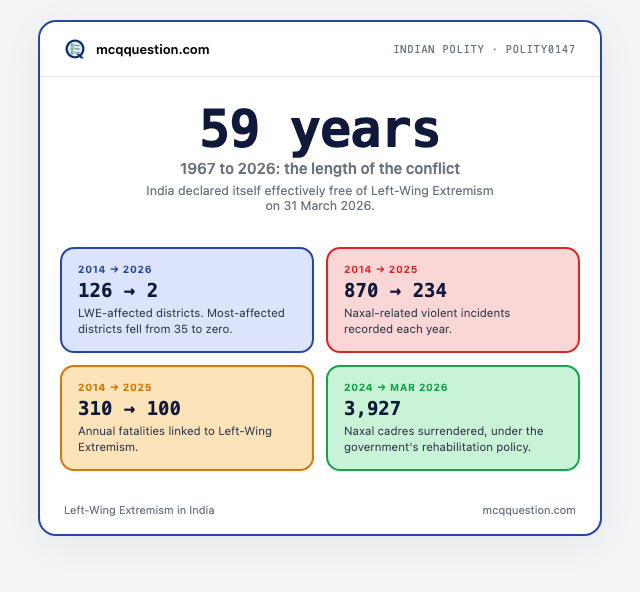
59 years
1967 to 2026: the length of the conflict
India declared itself effectively free of Left-Wing Extremism on 31 March 2026.
2014 → 2026
126 → 2
LWE-affected districts. Most-affected districts fell from 35 to zero.
2014 → 2025
870 → 234
Naxal-related violent incidents recorded each year.
2014 → 2025
310 → 100
Annual fatalities linked to Left-Wing Extremism.
2024 → Mar 2026
3,927
Naxal cadres surrendered, under the government’s rehabilitation policy.
Must Know
- Left-Wing Extremism (LWE), also called Naxalism, is a Maoist-inspired insurgency. It began in India in 1967.
- The movement takes its name from Naxalbari, a village in West Bengal. Police fired on protesting peasants there on 25 May 1967, sparking the uprising.
- The Communist Party of India (Maoist) became the movement's largest armed group. It formed in 2004, through a merger of the People's War Group and the Maoist Communist Centre.
- On 31 March 2026, the government declared India effectively free of Left-Wing Extremism. This ended nearly six decades of conflict.
- The government's response rested on three pillars: Vishwaas (security and trust-building), Nirman (infrastructure), and Jan Kalyan (welfare).
Good to Know
- LWE violence peaked in 2010. That year alone recorded 1,936 incidents and more than 720 civilian deaths.
- Across the 2004-2014 decade, LWE violence caused 17,542 incidents. Security forces lost 1,913 personnel, and 5,019 civilians died.
- The government set a formal target of 31 March 2026 on 24 August 2024. It met that target on schedule, after a sustained push under the government in office since May 2014.
- The National Policy and Action Plan, approved in 2015, structured the government's response. The Ministry of Home Affairs coordinated it centrally.
- The SAMADHAN doctrine, launched in 2017, set out the operational blueprint for security forces. Its elements included smart leadership, aggressive strategy, actionable intelligence, and harnessing technology.
- Fortified police stations in affected areas grew from 66 before 2014 to 597. Police stations reporting Naxal incidents fell from 333 to just 16 over the same period.
Test Yourself

Great to Know
- Security operations alone hadn't ended the conflict, across nearly five decades. The post-2014 approach paired security with infrastructure and welfare, addressing the conditions that let the movement persist.
- The Bastariya Battalion, a CRPF unit raised from Bastar's own tribal youth in 2017, illustrates this shift. Local recruitment gave security forces language skills, local knowledge, and community trust that outside forces couldn't easily build.
- Choking the movement's finances mattered as much as security operations. The NIA and Enforcement Directorate froze Naxal-linked assets, targeting the movement's funding, not just its fighters.
Current Affairs
- On 5 August 2026, in a written Rajya Sabha reply, MoS Home Affairs Nityanand Rai stated that no district in Chhattisgarh or any other state is currently classified as LWE-affected. The Government attributed this to the 2015 National Policy and Action Plan and coordinated Centre-State efforts. (Source: PIB)
- The same reply introduced a new classification: 38 districts nationally (13 in Chhattisgarh) are now categorised "Legacy & Thrust." These districts are no longer considered LWE-affected, but the Government said they continue receiving security and development support, to guard against relapse.
- In Chhattisgarh specifically, the Government cited a string of development figures. Road-building: 4,314 km under two LWE-specific schemes, plus 127.08 km and 6 bridges via the Border Roads Organisation. Connectivity and skilling: 1,511 telecom towers commissioned, alongside 9 ITIs, 14 Skill Development Centres, and 45 functional Eklavya Model Residential Schools. Financial inclusion: 1,508 post offices with banking services, 413 bank branches, and 269 ATMs. Health and land rights: a 240-bed PMSSY super-specialty hospital at Jagdalpur, and 5,34,068 land title deeds distributed (4,81,432 individual, 52,636 community).
- On security infrastructure nationally, the Government cited 663 fortified police stations built, 135 of them in Chhattisgarh. It also cited ₹3,805.04 crore released to LWE-affected states since 2014-15 under the Security Related Expenditure Scheme, of which ₹1,453.95 crore went to Chhattisgarh alone. A further ₹1,761 crore was sanctioned under the Special Infrastructure Scheme, and ₹1,303.68 crore provided to Central Agencies since 2014-15, for camps and helicopter support.
- Under the Tribal Youth Exchange Programme, 37,655 tribal youths from former LWE areas have taken exposure visits since 2014, per the same reply.
- The Government reiterated its surrender-cum-rehabilitation terms: an immediate grant of ₹5 lakh for higher-ranked cadre or ₹2.5 lakh for other cadre, plus vocational training with a ₹10,000 monthly stipend for three years.
- The Government also said one-third of security camps in now-LWE-free areas are being converted into "Jan Suvidha Kendras." The first opened at Netanar, Jagdalpur, Bastar, as the Shaheed Veer Gundadhur Seva Dera Kendra.
- On 31 March 2026, India became effectively free of Left-Wing Extremism. Union Home Minister Amit Shah announced it in the Lok Sabha the day before, on 30 March 2026. (Source: PIB)
- LWE-affected districts fell from 126 in 2014 to just 2 by 2026. The most-affected districts fell from 35 to zero over the same period.
- In Bastar, Chhattisgarh, the government launched the Shaheed Veer Gunda Dhur Seva Dera in May 2026. It converted around 70 CAPF camps into citizen-service centres, including a new Common Service Centre at Netanar, Gunda Dhur's birthplace.
- Between 2024 and March 2026, 3,927 Naxal cadres surrendered, including 2,337 in 2025 alone. Surrender grants range from ₹2.5 lakh to ₹5 lakh depending on rank, alongside a monthly stipend for three years.
- As of June 2026, the NIA had registered 112 cases against Naxal financing networks, and filed 100 charge sheets. The agency had also seized more than ₹40 crore in Naxal-linked assets, as of December 2025.
- Security forces ran a series of named operations, under a "Trace, Target, Neutralise" approach. These included Black Forest, Octopus, Double Bull, Thunderstorm, Bhimbarg, and Chakrabandha. Operation Black Forest alone accounted for more than 30 Maoists neutralised.
- Read the full story: PIB Backgrounder — Naxal-Free India: Integrated Strategies Defeated Left-Wing Extremism.
- MHA data, as of 21 July 2026, showed LWE-related incidents down to just 33 for the year, from 2,213 in 2010. Deaths fell to 11, from 1,005 over the same period. (Source: Security Risks)
Leave a Reply