India’s elections run without a single dedicated national police force of their own. One constitutional body makes that possible, and it has existed since 1950.
 MCQ Questions
Polity0203
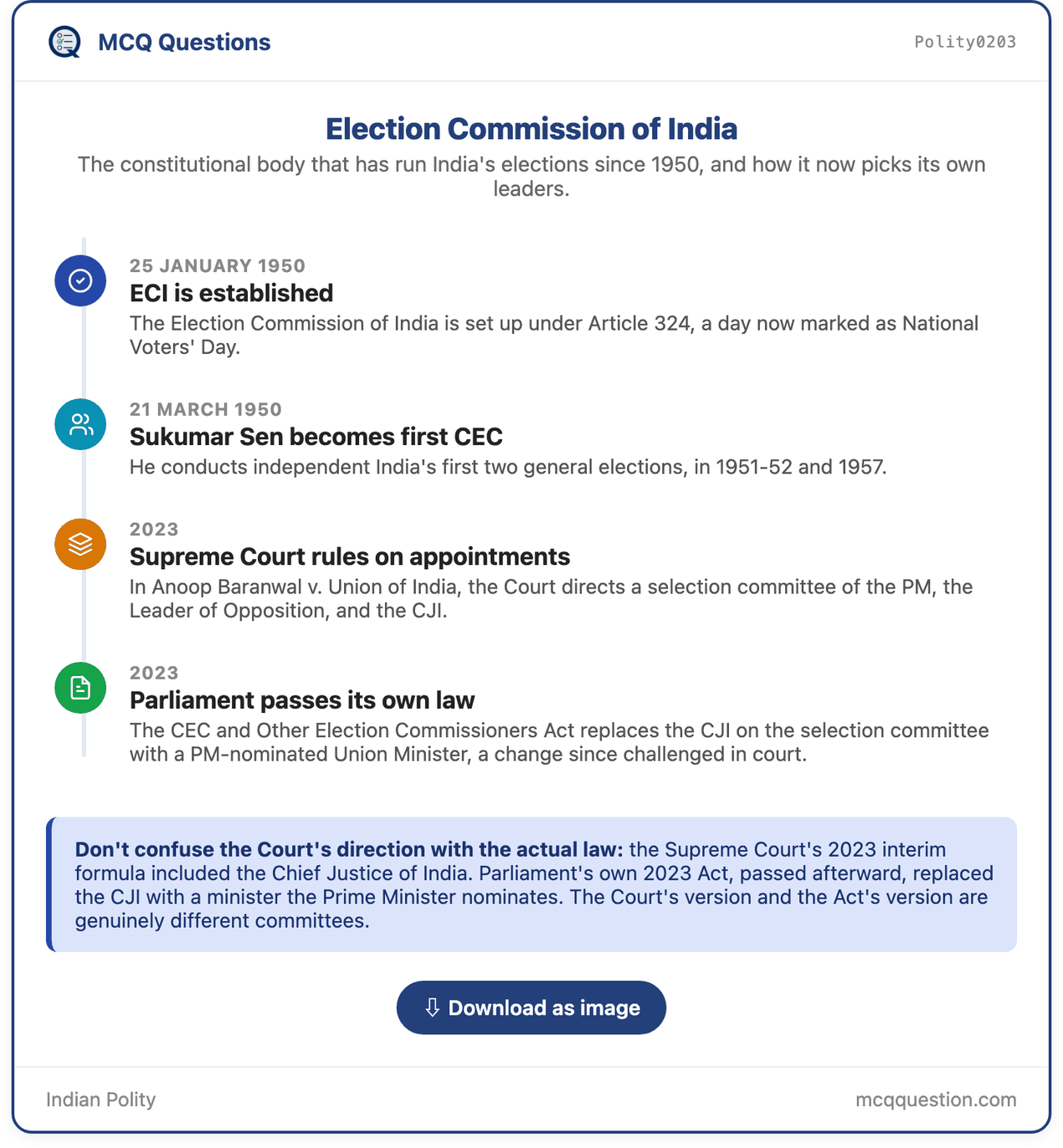
Election Commission of India
The constitutional body that has run India’s elections since 1950, and how it now picks its own leaders.
25 January 1950
ECI is established
The Election Commission of India is set up under Article 324, a day now marked as National Voters’ Day.
21 March 1950
Sukumar Sen becomes first CEC
He conducts independent India’s first two general elections, in 1951-52 and 1957.
2023
Supreme Court rules on appointments
In Anoop Baranwal v. Union of India, the Court directs a selection committee of the PM, the Leader of Opposition, and the CJI.
2023
Parliament passes its own law
The CEC and Other Election Commissioners Act replaces the CJI on the selection committee with a PM-nominated Union Minister, a change since challenged in court.
Don’t confuse the Court’s direction with the actual law: the Supreme Court’s 2023 interim formula included the Chief Justice of India. Parliament’s own 2023 Act, passed afterward, replaced the CJI with a minister the Prime Minister nominates. The Court’s version and the Act’s version are different committees.
Indian Politymcqquestion.com
Must Know
- The Election Commission of India (ECI) was established on 25 January 1950, under Article 324 of the Constitution.
- It conducts elections to the Lok Sabha and Rajya Sabha, state legislatures, and the offices of President and Vice-President.
- Sukumar Sen served as India’s first Chief Election Commissioner, from 21 March 1950 to 19 December 1958.
- Under him, the ECI conducted independent India’s first two general elections, in 1951-52 and 1957.
- The Commission’s decisions are taken by majority vote among its members. The Chief Election Commissioner has no overruling power over the other members.
- The CEC and Election Commissioners serve for a maximum of six years, or until age 65, whichever comes first.
- The CEC can only be removed through a process similar to impeaching a Supreme Court judge. Other Election Commissioners can be removed by the President, on the CEC’s recommendation.
Good to Know
- In 2023, in Anoop Baranwal v. Union of India, the Supreme Court directed that a selection committee of the Prime Minister, the Leader of Opposition, and the Chief Justice of India recommend CEC and EC appointments.
- Parliament then passed its own Chief Election Commissioner and Other Election Commissioners Act, 2023.
- That Act replaced the Chief Justice of India on the selection committee with a Union Cabinet Minister nominated by the Prime Minister.
- This change is currently being challenged in the Supreme Court, as a possible departure from the Court’s own 2023 direction.
- The Election Commission of India is a separate body from State Election Commissions, which independently conduct panchayat and municipal elections under Articles 243K and 243ZA.
- The Commission’s own powers, and the 2026 Bihar roll-revision ruling, come from one specific constitutional article. See Polity0245 — Article 324: Election Commission’s Powers of Superintendence.
Test Yourself

Great to Know
- Don’t confuse the Election Commission of India with State Election Commissions. Both exist under the Constitution, but they are separate bodies handling entirely different elections.
- The Chief Election Commissioner has no special veto. All three members vote as equals, and majority opinion decides every Commission ruling.
- See Polity0057 — The Election Commission and Electoral Reforms for the Commission’s own reform history, including its 1989 move to a three-member body and later electoral reforms.
Previous Year Questions
Asked as: “Consider the following statements on the Election Commission’s composition, who sets the election schedule, and its power over party splits/mergers.” (UPSC CSP 2017, GS Paper I). Only statement 3 is correct — the ECI is a three-member body, not five, it alone sets the election schedule (not the Ministry of Home Affairs), and it does resolve disputes over splits and mergers of recognised political parties. View this question.
Leave a Reply