The National Testing Agency runs some of India’s biggest exams, sitting more than two crore candidates every year. In 2026, one of those exams was cancelled mid-cycle, and a Union minister resigned over it.
 mcqquestion.com
Indian Polity · Polity0205
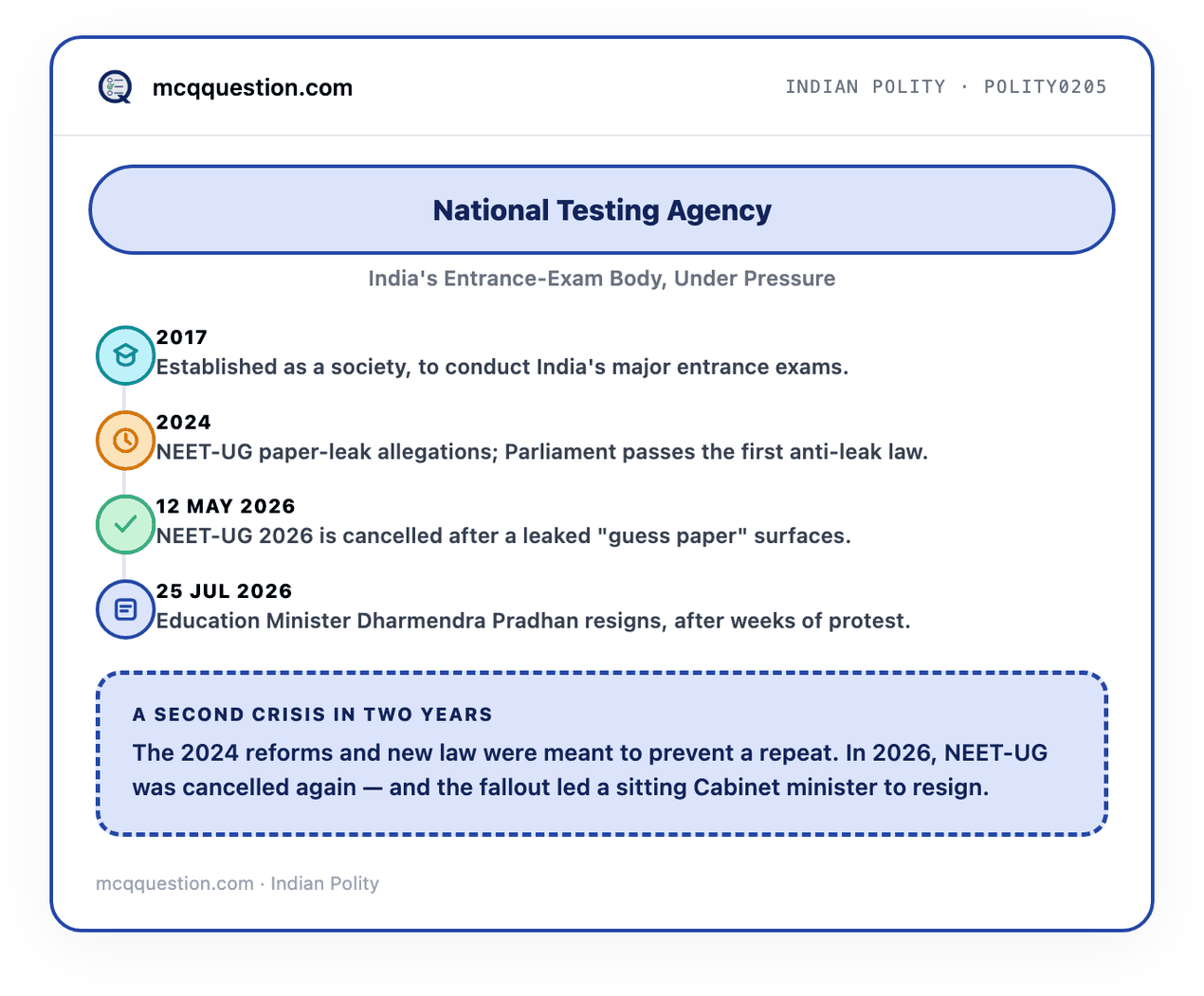
National Testing Agency
India’s Entrance-Exam Body, Under Pressure
2017
Established as a society, to conduct India’s major entrance exams.
2024
NEET-UG paper-leak allegations; Parliament passes the first anti-leak law.
12 May 2026
NEET-UG 2026 is cancelled after a leaked “guess paper” surfaces.
25 Jul 2026
Education Minister Dharmendra Pradhan resigns, after weeks of protest.
A Second Crisis in Two Years
The 2024 reforms and new law were meant to prevent a repeat. In 2026, NEET-UG was cancelled again — and the fallout led a sitting Cabinet minister to resign.
Must Know
- The National Testing Agency (NTA) was established in 2017, under the Ministry of Education.
- It is registered as a society, under the Societies Registration Act, 1860, not as a statutory body created by its own Act of Parliament.
- NTA’s core purpose is to conduct standardised entrance examinations for higher education. This relieves individual institutions of the task of running their own admission tests.
- It conducts several major exams. These include JEE Main, NEET-UG, CUET-UG, UGC-NET, CMAT, and GPAT.
- Since the National Medical Commission Act, 2019, NEET-UG has been the sole entrance exam for MBBS, BDS, and other undergraduate medical admissions across India, including at AIIMS and JIPMER.
Good to Know
- NTA-conducted exams collectively serve more than two crore candidates every year.
- NEET-UG, formerly called the All India Pre-Medical Test (AIPMT), is India’s largest single exam by number of applicants.
- NTA functions under the Department of Higher Education, within the Ministry of Education.
- Before NTA’s creation, bodies like the CBSE conducted several of these entrance exams directly.
Test Yourself

Great to Know
- NEET-UG 2024, held on 5 May 2024, was hit by allegations of a paper leak, centred on Hazaribagh and Patna in Bihar.
- The matter went to the Supreme Court, which found a leak had occurred but declined to cancel the entire exam. It found no evidence the leak was widespread enough to affect all candidates.
- The Central Bureau of Investigation (CBI) took up the case, leading to dozens of arrests across several states.
- In response, Parliament enacted the Public Examinations (Prevention of Unfair Means) Act, 2024, India’s first dedicated law against exam-paper leaks and impersonation.
- The government also set up the K. Radhakrishnan Committee, which proposed around 101 measures to make NTA’s exams more secure.
Current Affairs
- NEET-UG 2026 was held on 3 May 2026, for more than 2.27 million candidates. Investigators soon found a leaked “guess paper” that closely matched the actual exam questions.
- On 12 May 2026, NTA cancelled the 3 May exam and announced a re-examination, with fees to be refunded and no fresh registration required.
- The CBI took over the investigation the same day, and a re-examination was held on 21 June 2026.
- On 25 July 2026, Union Education Minister Dharmendra Pradhan resigned, after weeks of sustained student protests over the episode.
- Following the resignation, Prime Minister Narendra Modi constituted a high-powered task force, led by Nandan Nilekani, to recommend further reforms to India’s public examination system.
- Parliament also passed a tougher update to the 2024 law. See CA0071 — Public Examinations (Prevention of Unfair Means) Amendment Act, 2026 for that legislation, assented on 31 July 2026.
Leave a Reply