One Indian judge’s dissenting opinion made The New York Times promise him a monument. His own government instead denied him the top job.
 MCQ Questions
Polity0212
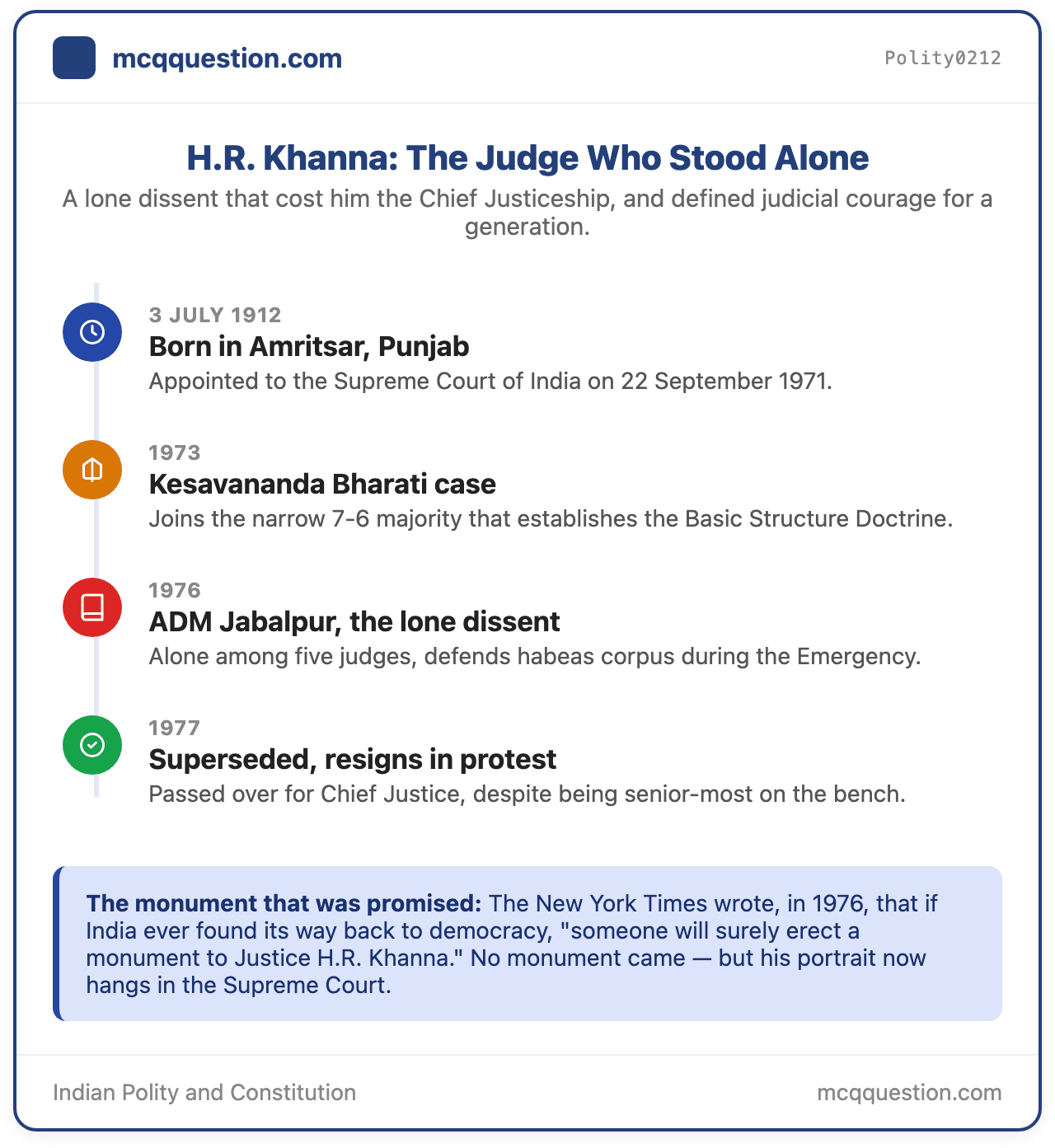
H.R. Khanna: The Judge Who Stood Alone
A lone dissent that cost him the Chief Justiceship, and defined judicial courage for a generation.
1973
Kesavananda Bharati case
Joins the narrow 7-6 majority that establishes the Basic Structure Doctrine.
1976
ADM Jabalpur, the lone dissent
Alone among five judges, defends habeas corpus during the Emergency.
1977
Superseded, resigns in protest
Passed over for Chief Justice, despite being senior-most on the bench.
The monument that was promised: The New York Times wrote, in 1976, that if India ever found its way back to democracy, “someone will surely erect a monument to Justice H.R. Khanna.” No monument came — but his portrait now hangs in the Supreme Court.
Indian Polity and Constitutionmcqquestion.com
Timeline
- 3 July 1912: Born in Amritsar, Punjab.
- 1969: Becomes Chief Justice of the Delhi High Court.
- 22 September 1971: Appointed a judge of the Supreme Court of India.
- 1973: Joins the majority in Kesavananda Bharati, establishing the Basic Structure Doctrine.
- 1976: Delivers his lone dissent in ADM Jabalpur v. Shivkant Shukla.
- 1977: Passed over for Chief Justice. Resigns from the Supreme Court in protest.
- 25 February 2008: Dies in New Delhi, aged 95.
Must Know
- Hans Raj Khanna was a Supreme Court judge, best known for a landmark constitutional dissent.
- In Kesavananda Bharati v. State of Kerala (1973), he was part of the narrow 7-6 majority. That ruling established the Basic Structure Doctrine.
- In ADM Jabalpur v. Shivkant Shukla (1976), the Habeas Corpus case, he was the lone dissenter among five judges.
- He held that the right to life and personal liberty exist independently of the Constitution. This held true even with Article 21 suspended, during the Emergency.
- His dissent cost him the Chief Justiceship. He was superseded in 1977, and resigned in protest.
Good to Know
- Before the Supreme Court, he served as Chief Justice of the Delhi High Court, starting in 1969.
- The New York Times, in a 1976 editorial, wrote that India would one day “erect a monument” to Justice Khanna.
- The government instead appointed Justice M.H. Beg as Chief Justice, superseding Khanna despite his seniority.
- He briefly served as India’s Law Minister, for three days, in 1979. He also chaired the Eighth Law Commission of India, from 1977 to 1979.
- He received the Padma Vibhushan in 1999, India’s second-highest civilian honour.
- See Polity0083 — Judicial Activism in India, for how his dissent fits into India’s broader judicial history.
Test Yourself

Great to Know
- His dissent was vindicated four decades later. The Supreme Court‘s 2017 ruling in K.S. Puttaswamy v. Union of India effectively overruled ADM Jabalpur.
- He reportedly told his family that his ADM Jabalpur judgment would cost him the Chief Justiceship, before it was even delivered.
- His memoir, Neither Roses Nor Thorns, was published in 2003.
- His portrait now hangs in the Supreme Court. The monument The New York Times imagined was never built.
- ADM Jabalpur turned on Article 22’s own weaker safeguards for preventive detainees. See Polity0223 — Article 22: Preventive Detention for that underlying constitutional provision.
Leave a Reply