Law firms have operated in India for decades, with no formal legal recognition of their own. A new draft bill would finally give them one.
 mcqquestion.com
Polity0218
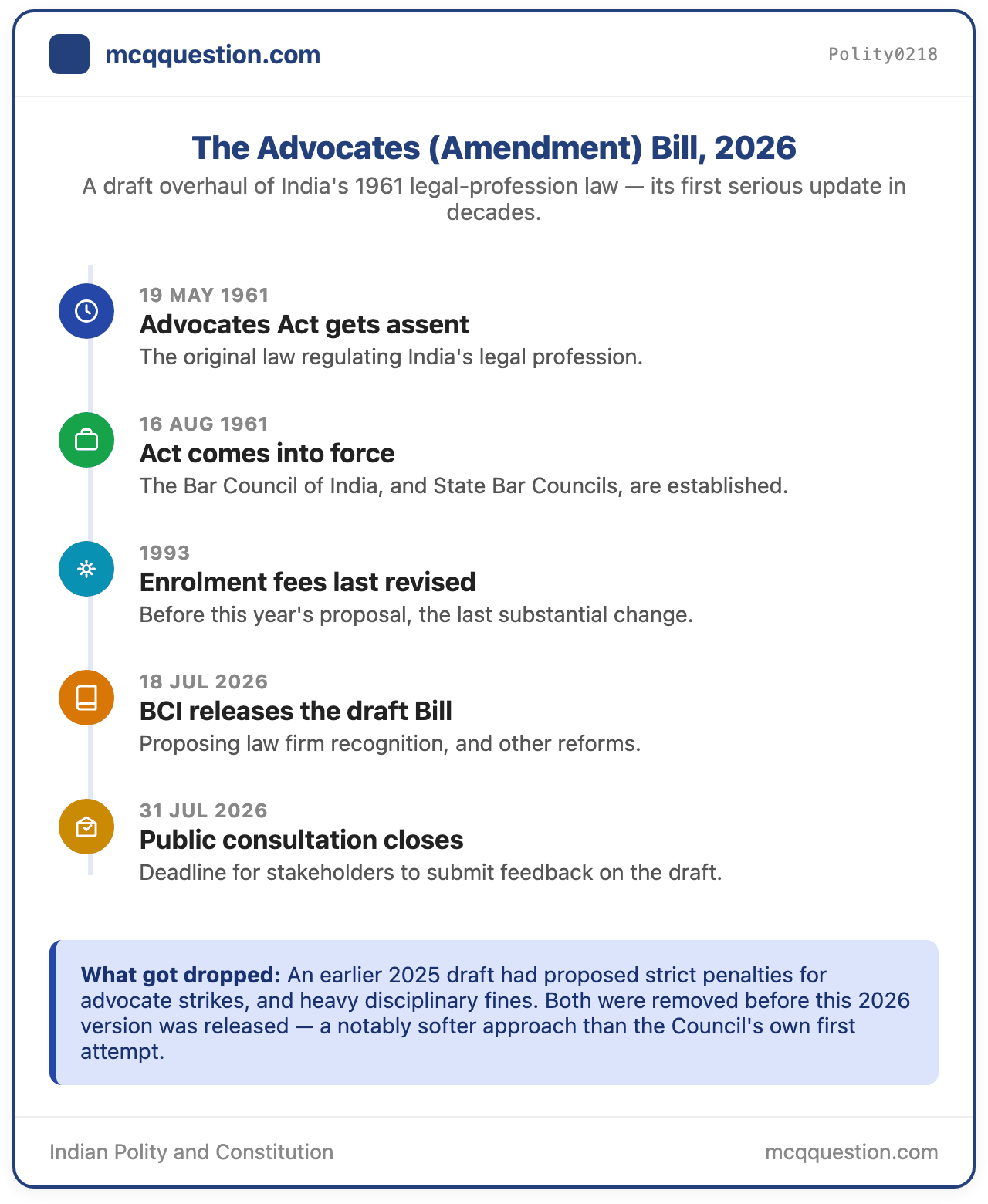
The Advocates (Amendment) Bill, 2026
A draft overhaul of India’s 1961 legal-profession law — its first serious update in decades.
19 May 1961
Advocates Act gets assent
The original law regulating India’s legal profession.
16 Aug 1961
Act comes into force
The Bar Council of India, and State Bar Councils, are established.
1993
Enrolment fees last revised
Before this year’s proposal, the last substantial change.
18 Jul 2026
BCI releases the draft Bill
Proposing law firm recognition, and other reforms.
31 Jul 2026
Public consultation closes
Deadline for stakeholders to submit feedback on the draft.
What got dropped: An earlier 2025 draft had proposed strict penalties for advocate strikes, and heavy disciplinary fines. Both were removed before this 2026 version was released — a notably softer approach than the Council’s own first attempt.
Indian Polity and Constitution⬇ Download as image
Timeline
- 19 May 1961: The Advocates Act receives presidential assent.
- 16 August 1961: The Act comes into force. The Bar Council of India and State Bar Councils are established.
- 1993: Advocate enrolment fees are last substantially revised, before the 2026 proposal.
- 18 July 2026: The Bar Council of India releases the Draft Advocates (Amendment) Bill, 2026, for public consultation.
- 31 July 2026: The consultation window for stakeholder feedback closes.
Must Know
- The Bar Council of India (BCI) released the Draft Advocates (Amendment) Bill, 2026, on 18 July 2026. This opened it for public consultation, before any formal introduction in Parliament.
- It proposes amendments to the Advocates Act, 1961, which currently regulates India’s legal profession.
- For the first time, the Bill proposes statutory recognition for Indian law firms, under a new Chapter IIIA. Advocates would keep their exclusive right to courtroom practice.
- It also revises advocate enrolment fees, to Rs 18,000 (State Bar Council) and Rs 4,500 (BCI). This is the first substantial revision since 1993.
- The Bill restricts foreign lawyers to international commercial arbitration involving foreign law. It also removes their reciprocal enrolment rights in India.
- Stakeholders could submit feedback on the draft until 31 July 2026.
Good to Know
- The original Advocates Act, 1961, received presidential assent on 19 May 1961, and came into force on 16 August 1961.
- It created a single, unified class of legal practitioners, called “Advocate,” with uniform qualifications for Bar admission.
- The 2026 Bill also proposes amendments to Sections 6 and 7. These would set up welfare funds and trusts for advocates, covering insurance, pensions, medical relief, and support for advocates with disabilities.
- Under Section 3 amendments, the Bill also seeks to increase women’s representation on State Bar Councils, through elected and co-opted seats.
- The BCI would also gain authority to conduct training, in arbitration, mediation, artificial intelligence, cyber law, and international legal practice.
Test Yourself

Great to Know
- An earlier, 2025 draft of the Bill had proposed strict penalties for advocate strikes, and heavy fines for disciplinary infractions. Both were dropped from the 2026 version.
- The revised Bill also drops an earlier proposal, that would have allowed government nominees on Bar Councils.
- The Bill’s push into AI and cyber-law training reflects a wider shift already underway in India’s courts. See Polity0164 — Artificial Intelligence and the Indian Judiciary.
- M.C. Setalvad, India’s first Attorney General, helped shape the country’s early legal profession, decades before this latest reform push. See ModHist0258 — M.C. Setalvad: India’s First Attorney General.
- As a draft still under public consultation, its final form — and whether Parliament ultimately passes it — remained undecided as of publication.
Leave a Reply