Women across India face violence and discrimination, often silently. The National Commission for Women exists to hear their complaints and press for their rights.


Must Know
The National Commission for Women
What the NCW Is
- Full formNCW is the National Commission for Women.
- PlainIt is India’s statutory watchdog for women’s rights.
- LawIt was created under the National Commission for Women Act, 1990.
- StartedThe Act passed in 1990, but the Commission was constituted on 31 January 1992.
- Why it existsWomen often have little access to power or the courts, so a dedicated body takes up their cause.
Composition
- SizeIt has a Chairperson, five Members, and a Member-Secretary.
- AppointmentAll are nominated by the Central Government.
- ExpertiseMembers bring skills in law, trade unionism, administration, health and education.
- RepresentationAt least one Member must be from Scheduled Castes and another from Scheduled Tribes.
- TermChairperson and Members serve three years.
- Why the mixDiverse expertise lets the Commission understand many kinds of harm to women.
- SoIts members can judge legal, social and health issues together.
Its Powers
- Civil-court powersUnder Section 10, the NCW has the powers of a civil court while investigating a complaint.
- HowIt can summon witnesses and call for records.
- CellIts Complaints and Investigation Cell processes written complaints and cases taken up on its own initiative.
- SoThe Commission can begin a case even if no victim files a complaint.
- Full formNHRC is the National Human Rights Commission, a related statutory rights body.
Good to Know
How the NCW Helps
The Women Helpline
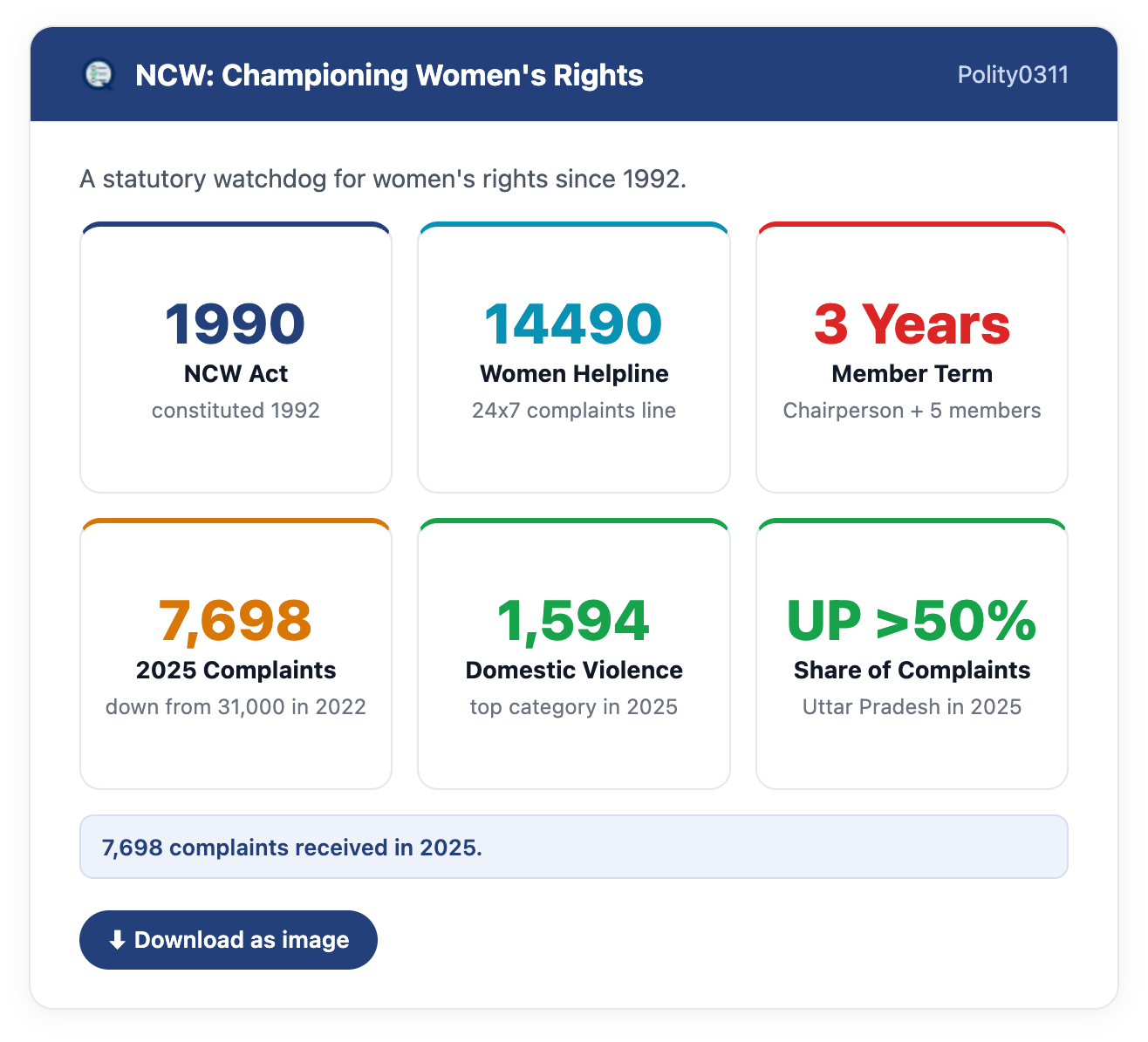
- NumberThe NCW runs a 24×7 Women Helpline on short code 14490.
- UseIt takes complaints of violence against women.
- DistinctionThe general national helpline 181 is a separate, broader emergency number.
- Why a lineA phone line makes it easy for a woman in distress to reach help.
Inquiry Committees
- UseFor serious cases, the NCW forms an Inquiry Committee.
- WorkIt makes spot enquiries, examines witnesses and collects evidence.
- OutputIt then submits a report with recommendations.
- SoSerious cases get a deeper investigation than a simple complaint.
- WhySome cases are too grave or complex to settle from an office alone.
Advisory Only Limits
- RealityEven though the NCW can compel evidence, its recommendations are advisory.
- LimitThey are not legally binding on the government.
- SoThe NCW can expose a wrong, but fixing it depends on the government acting.
- EffectIts findings matter through public pressure, not legal command.
✅ Test Yourself
Work through a 5-question chain on the National Commission for Women, then keep practising with a random Indian Polity question.
Great to Know
What the Numbers Show
Complaint Trends
- 2022The NCW received nearly 31,000 complaints.
- 2023It received 28,811.
- 2025Its complaints fell to just 7,698.
- Top categoryDomestic violence led in 2025, at 1,594 cases.
- GeographyUttar Pradesh alone accounted for over half of nationwide complaints in 2025.
- InterpretationThe fall could mean real improvement, or lower awareness and trust.
- Why unclearPeople may complain less if they think the process will not help.
- SoReading the numbers needs care, not a simple success story.
Tere Mere Sapne
- WhatLaunched on 8 March 2025, it is a network of pre-marital communication centres.
- GrowthIt grew from 23 centres in 9 states to 58 centres in 11 states.
- WhyEarly communication between couples may help prevent later domestic conflict.
- SoIt works on the causes of conflict before it turns into complaints.
- ApproachCounselling and communication help couples set expectations openly.
Current Affairs
📰 Current Affairs
Tere Mere Sapne Expansion
- EventSince its launch, Tere Mere Sapne has expanded to 58 pre-marital communication centres across 11 states.
- KarnatakaKarnataka is expanding it to 175 centres under its Santhwana Kendras network.
- SourceNCW, Deccan Chronicle.
🎯 Exam Angle (PYQ & MCQ Traps)
The ‘Constitutional Body’ Trap
- Trap option‘The NCW is a constitutional body.’
- DistractorIts national watchdog role feels constitutional.
- Fact testedThe NCW is STATUTORY, created under the National Commission for Women Act, 1990.
- Eliminate fastIf an option assigns constitutional status, it is wrong.
- Try this ruleNCW = statutory (1990 Act), not constitutional.
The ‘Act = Started’ Trap
- Trap option‘The NCW began operating in 1990.’
- DistractorThe Act passed in 1990, so it feels like the start.
- Fact testedThe Act passed in 1990, but the Commission was constituted on 31 January 1992.
- Eliminate fastIf an option pins operations to 1990, it confuses the Act with the constitution date.
- Try this ruleAct 1990, constituted 31 Jan 1992.
The ‘Victim Must Complain’ Trap
- Trap option‘The NCW can only act on a victim’s complaint.’
- DistractorCommissions respond to complaints.
- Fact testedUnder Section 10, the NCW has civil-court powers and can begin a case even if no victim files a complaint.
- Eliminate fastIf an option requires a victim complaint, it is wrong.
- Try this ruleNCW can act suo motu.
Beyond the answer
Browse all indian-polity-and-constitution topics →
📚 Keep reading
GK0038 — Women's Sports in IndiaPolity0034 — Statutory Bodies for Rights and WelfarePolity0351 — The Nature of Rights: Claims, Privileges and the Citizen-State RelationshipPolity0307 — NHRC: India's Human Rights WatchdogPolity0033 — Constitutional Bodies: UPSC, State PSCs and the SC/ST Commissions❓ Practice this topic
Which of the following Acts, receiving presidential assent on 24 December 2023, replaced the Indian Telegraph Act 1885, the Wireless Telegraphy Act 1933 and the Telegraph Wires (Unlawful Possession) Act 1950?Under Article 61 of the Constitution, by what majority must the resolution preferring the charge of impeachment against the President be passed in each House of Parliament?Which Article of the Constitution provides that it shall be the endeavour of every State to provide adequate facilities for instruction in the mother tongue at the primary stage to children belonging to linguistic minority groups?In which situation can a State Governor issue an ordinance under Article 213 of the Constitution?🎲 Take a Indian Polity And Constitution Quiz
Leave a Reply