India does not reform its laws by accident. A body that is neither constitutional nor statutory reviews them every few years, and hands the government its recommendations.


Must Know
The Law Commission of India
What the Law Commission Does
- PlainThink of the Law Commission as a team of legal experts who study India’s laws and suggest how to improve them.
- JobIt reviews existing laws and recommends reforms to the government.
- Why it mattersLaws written decades ago can become outdated, contradictory or unfair; the Commission spots those problems.
- OutputIt submits detailed, numbered Reports.
- HowIt studies a legal question in depth, sometimes for years, before publishing a reasoned recommendation.
- NatureIts Reports are advisory and never legally binding.
- SoThe government can accept, amend or ignore a Report; the Commission persuades rather than orders.
Its Legal Status
- StatusIt is neither a constitutional nor a statutory body.
- PlainThere is no Article of the Constitution and no Act of Parliament that creates it.
- HowThe government simply issues an executive order to set up a fresh Commission.
- WhyThis gives the executive flexibility, because it can reshape the Commission as needs change.
- RenewalThe government reconstitutes it every few years.
- ContrastBecause it is not statutory, it could also be ended by a simple executive decision.
Composition
- HeadIt is led by a full-time Chairperson, usually a retired Supreme Court judge or HC Chief Justice.
- Why that profileLaw reform needs deep judicial experience, so a senior judge is chosen to lead it.
- TeamIt includes four full-time Members, up to five part-time Members and two ex-officio Members.
- MixThe blend of full-time and part-time members brings both dedicated effort and outside expertise.
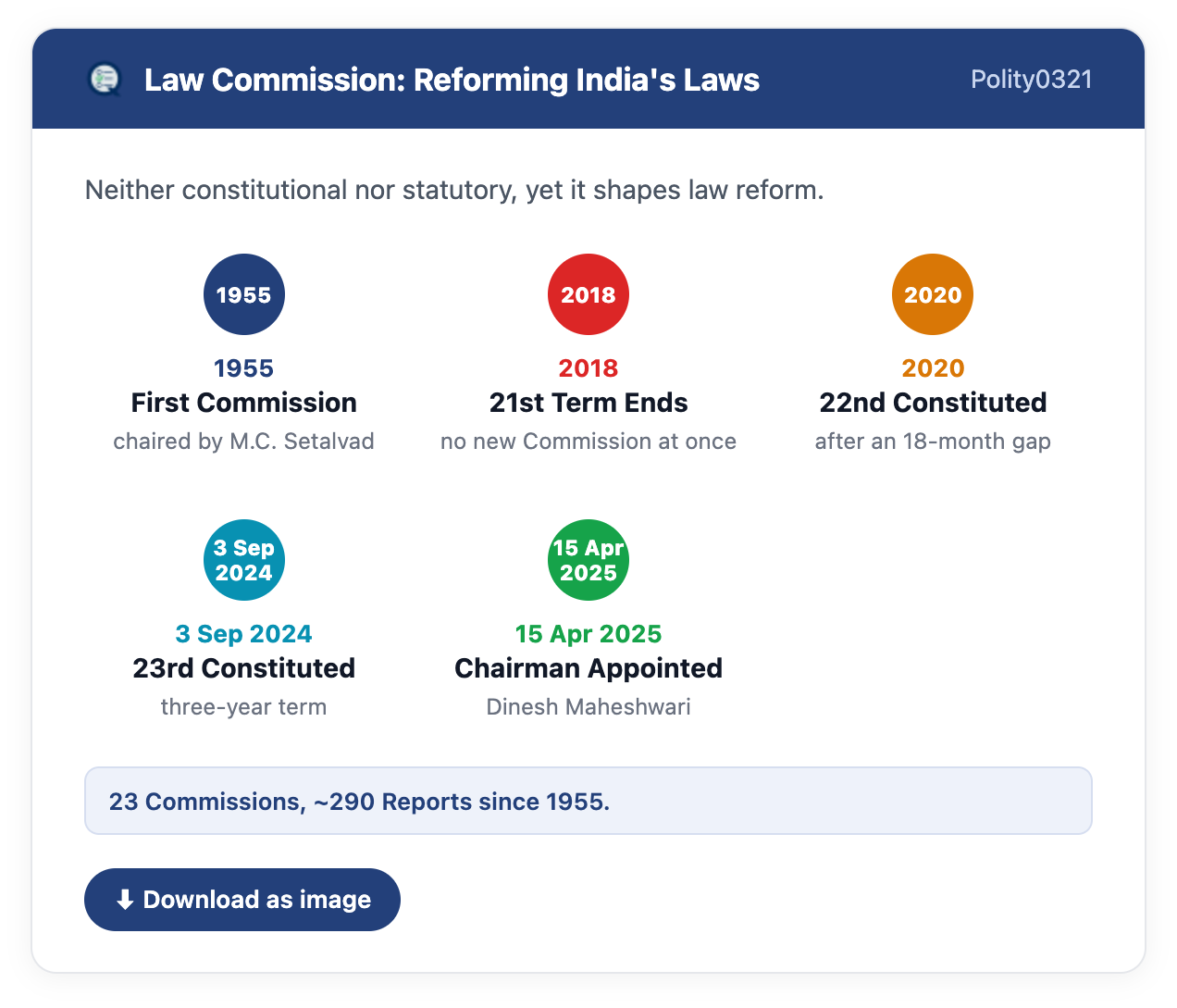
- TermEach Commission serves a fixed three-year term, then gets reconstituted.
Its Reports
- CountSince 1955, the Commissions have produced close to 290 numbered Reports.
- MeaningEach numbered Report is one finished piece of research on a legal question.
- 262ndThe 262nd Report (2015) recommended phasing out the death penalty, except for terrorism and war-related offences.
- Why notableThat Report reshaped a major public debate about capital punishment in India.
- SoEven without legal force, a well-argued Report can shift government and public opinion.
Good to Know
Mandates and History
The Uniform Civil Code
- Full formUCC is the Uniform Civil Code.
- PlainIt means one common set of personal laws for all citizens, instead of separate laws by religion.
- MandateThe 23rd Commission’s mandate explicitly includes reviewing the UCC.
- Why contestedPersonal laws touch marriage, divorce and inheritance, which different communities follow differently.
- 2018 viewIn 2018, the 21st Commission concluded a UCC was “neither necessary nor desirable at this stage.”
- SoThe question keeps returning, because it sits at the heart of religious identity and equality debates.
One Nation One Election
- OriginThe idea of simultaneous elections traces back to the Law Commission’s 170th Report (1999).
- Why it recursStaggered elections cost money and keep politicians campaigning almost continuously.
- RecentThe 2024 push came from a separate High-Level Committee chaired by Ram Nath Kovind, not the Law Commission.
- DistinctionIt is a common exam trap to credit the Law Commission; the recent proposal came from the Kovind Committee.
- ResultSo while the Law Commission floated the idea in 1999, the current push is a separate political exercise.
✅ Test Yourself
Work through a 5-question chain on the Law Commission of India, then keep practising with a random Indian Polity question.
Great to Know
Continuity and Impact
A Seven-Month Gap
- EventThe 23rd Commission, constituted in September 2024, had no Chairman until April 2025.
- Why it mattersWithout a leader, the Commission cannot begin its work or direct its research agenda.
- MechanismBecause the Commission is set up by executive order, its leadership depends on the government making an appointment.
- ChairmanJustice Dinesh Maheshwari took charge on 15 April 2025.
- PatternContinuity gaps are real; even the 22nd to 23rd handover needed a term extension.
- SoA body meant to keep law current can itself fall idle while waiting for its members.
Criminal Defamation
- ReportThe 22nd Commission’s 285th Report recommended retaining criminal defamation.
- WhyIt judged that the offence protects reputation and deters defamatory speech.
- ImpactThis fed directly into drafting the Bharatiya Nyaya Sanhita, which replaced the IPC.
- SoA Law Commission recommendation became part of a new criminal code, showing its real influence.
- BalanceCritics argue criminal defamation can chill free speech; defenders say it protects reputations.
Current Affairs
📰 Current Affairs
The 23rd Commission’s Chairman
- EventOn 15 April 2025, Justice Dinesh Maheshwari was appointed Chairperson of the 23rd Commission.
- ContextThe post had been vacant for seven months since the Commission’s constitution.
- SourceIndia TV News.
The 23rd Commission Constituted
- EventOn 3 September 2024, the 23rd Law Commission was set up for a three-year term.
- MandateIts terms explicitly include reviewing the Uniform Civil Code.
- SourceOnmanorama.
🎯 Exam Angle (PYQ & MCQ Traps)
The Legal-Status Trap
- Trap option‘The Law Commission is a constitutional body.’
- DistractorIts authority feels constitutional.
- Fact testedIt is a non-statutory, executive-appointed body — set up by government resolution, not the Constitution.
- Eliminate fastConstitutional = in the Constitution; the Law Commission is not.
- Try this ruleLaw Commission = executive/advisory, not constitutional.
The First-Chairman Trap
- Trap option‘The first Law Commission was chaired by a sitting Chief Justice only.’
- DistractorChairmanship details are easy to conflate.
- Fact testedThe first Law Commission of independent India (1955) was chaired by M.C. Setalvad, the first Attorney-General.
- Eliminate fastIf the name is wrong, the option is wrong.
- Try this rule1955 + M.C. Setalvad = the first Commission.
The Reports-Are-Binding Trap
- Trap option‘The Law Commission’s reports are binding on the government.’
- DistractorIt makes sweeping recommendations, so binding feels right.
- Fact testedIts reports are advisory recommendations; the government may accept or ignore them.
- Eliminate fastAdvisory ≠ binding — any ‘must implement’ phrasing is the trap.
- Try this ruleIt recommends; Parliament/executive decides.
Leave a Reply